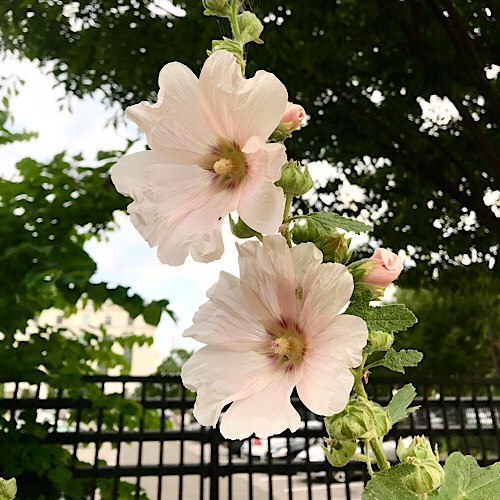
State of the Garden (Fleeting)

It’s hard to believe that I’ve only been home from India for a little over two weeks given how busy I’ve been at work. I found some time this afternoon to pick out some photos to share.
On this second trip to South India, I was even more conscious of the protective bubble in which we traveled. I am not afraid or ashamed to admit that some of the places through which the bus drove would have been a big travel challenge for me without the bus and knowledgeable, competent, supportive guides.
These photos were mostly taken on a long day’s ride that became that much longer to encompass a detour to incorporate a last minute addition to the itinerary of an older and beautiful Shiva temple (I took the photo of the jackfruit vendor I posted last week after this temple visit). The detour was one of those only 20 kilometers extra detours that turn out to add three hours to the trip because it shifted from the main road to tertiary roads–I’m sure you, like I, have done that in the mountains somewhere), and it was truly someplace else from where I am used to being.
It was hard to be on the bus for those extra hours, but it was powerfully interesting to observe. Do click on individual pictures to see detail and facial expressions and in some, of course, the signs.
The space between the spheres thins and the wind creates passageways.
The spirits are outraged; how could they be otherwise? Their dance tramples
And blows things down, but still cannot help but create beauty.
The leaves–green, red, gold, brown from the drought, that distant memory–
Hang listlessly with the weight of rain and a bit of slush
Hardly even dancing in the wind, but still becoming perhaps
More extravagantly lovely by the storm’s grey light.
When my students arrived at William Penn House last night for class, I said, “yes, I knew him; they are both my co-workers.” I didn’t need to say anything else. All of them read the Washington Post and know that I work for the Department of Labor in the area of pension benefits. I said that I was shaken by the news, and I would offer the best practice I could. At my invitation, we worked on grounding, being heavy in the best meaning of heavy so that we would feel the stability to rise and to stay graceful and open as we practiced some challenging standing poses and backbends, leading to a modified version of natarajasana (dancing in the cosmic fire).
One co-worker is dead (either suicide or murder in his jail cell) after having severely injured another. Yes, we all worked in the same office for three years when I first started at the Department in 1991 and episodically have worked on common projects for almost 22 years, most recently just three weeks ago. Had it been a fatal accident or a heart attack, a few dozen of us would have been at the funeral and spoken of what we liked about him. It wouldn’t have been the horrified questioning ourselves and each other of what possibly could have gone so terribly, shockingly wrong. The grieving and sense of loss are no less present and real, though, for the recoiling from his last acts and the salacious and rapacious local media coverage.
Quaker practice has me holding those affected in the light–he and his family and she and hers, and our co-workers. On hearing yesterday that he had died in jail, I was moved to chant the maha mrityunjaya mantra. I was taught that chanting this mantra every day for 30 days can help a spirit cross-over. What is spirit and to where it might be crossing was not really explained because how could it be? But I do think chanting with such an intention can be a useful tool to help focus one’s own emotional process and healing in connection with a death.
For some background on the mantra, you might want to start with this overview with useful links published by the Himalayan Institute (be advised that though citing to the YI because of the breadth of coverage, to get to the basic details, I needed to ignore the cheesy graphics and the use of the term “Lord” before Shiva in the linked article on what the author says are appropriate uses of the mantra).
My co-worker gave me this oakleaf hydrangea about 10-12 years ago; his brother had pulled an extra seedling that was an offshoot from a larger plant in his yard. It did not start thriving until two seasons ago when I moved it to a different corner of my front garden.