State of the Garden

I spent a few hours this weekend reading Joseph Campbell’s Baksheesh and Brahman, which is Campbell’s journals from a year in India from 1954-55 (I’m now about a third of the way through). Campbell writes that he went to India to find Brahman and instead found politics. He approached his visit from the perspective of a mythologist. In contrast to Allen Ginsberg and the Beats, who went to India to find God, Joseph Campbell went to observe religious practices. Although the journals evidence his own perspective and prejudices, he makes cogent observations on the difference between religiosity and spirituality (not all that dissimilar to the distinctions made in the Bhagavad Gita about the difference between rigidly practicing ritual and truly believing). He also makes very interesting and still timely and cogent comparisons between the relationship of Hinduism and to the then rather new Indian nationalism and American Protestantism to democracy.
Ultimately, though, it is evident that this year was important for Campbell’s life path and work, as it was for the Beats, and has been for many of my friends who have gone, though not for all. I think about going to India. It will be when I have several weeks and don’t have a venerable and ancient cat who cannot be left behind for a long stretch of time. In the meantime, reading of such journeys can stimulate thought and can be applied to other aspects of my life, though reading and studying (especially in the yoga tradition), is never a substitute for experience. Just reading of spiritual experiences, but not doing the practices to open the door to one’s own experience is like reading cooking or gardening books, but never going into the kitchen or the garden.
Last night in class, I asked why people continued to come to class. “To see how I can expand,” “for the community,” “for the delight,” “for relaxation,” were some of the answers. Orie asked me what led me to teach. The first reason I gave (and the one that was the primary reason for entering teacher training) was that I had been so inspired by what yoga had offered me that I wanted to share it.
The second reason I gave was that teaching helps keep me disciplined about my practice. I cannot abide hypocrisy, and so, I feel compelled to try my best to practice what I teach. I do not always embody fully the teachings in my own life and practice, but I am always trying. Knowing how the teachings and practices have shifted me and witnessing how the teachings inspire my students, leads me to continue to study, to practice, to try and align better on and off the mat.
Today, with a day of stressful meetings and phone calls ahead, it will be a good day to try to live the practice.
I have had a more stressful than usual couple of weeks at the office. While I was walking into the office, I was thinking about how the more deadlines I needed to meet and the more difficult interchanges I had to bring to the most optimal resolution, the harder it was also to have energy to give to those who are in far greater need, though I seek ways to be of service.
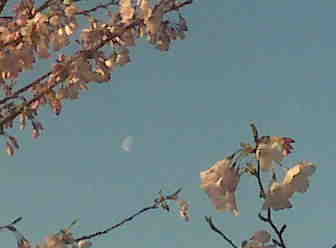
When I saw the oversized half moon dwarfed by the cherry blossoms, it helped put things in perspective. Nothing I do immediately impacts life or death. A hard week does not mean much in my life as a whole, my tribulations are only so much play in the midst of the outrageous ground of all human being, human being is only one small part of life on this planet in this galaxy in this universe, and who knows how vast is the realm of consciousness. I smiled at the moon and the blossoms and thought of their beauty throughout the day.
Peace and light, E — Posted with WordPress for BlackBerry.
This site uses Akismet to reduce spam. Learn how your comment data is processed.

Hilarious!