Asana, Pranayama, and Yoga Practice | Community and Family | Food for the Mind (Yoga Philosophy, etc) | Meditation | Quaker
Found Exhortation
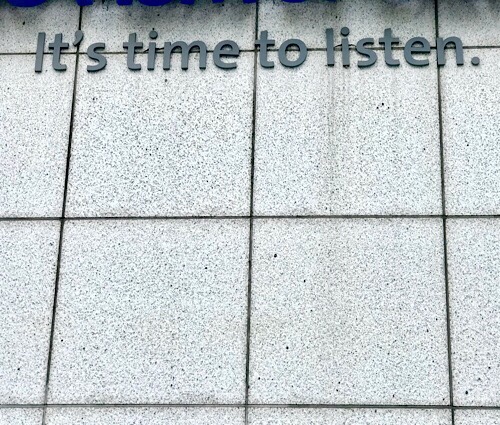
I cannot tell from looking at the image on my Blackberry whether the words “faith” and “hope” that appear on this statue can be discerned in the photo, but they are there when standing and seeing the statue in person.
This morning, when I was reading through the news, I came across a curious headline that averred that the killing of Osama Bin Laden had brought us a “rare moment of unity.” This saddened me, as did the reportage of spontaneous celebrations.
I am calling on my reserves of practice so that my sense of faith and hope for humanity, for peace, and for social priorities is not as faint as the way the words appear in the photograph.

Peace and light, E — Posted with WordPress for BlackBerry.
says the man next to me with a slightly interrogative inflection, while we are both looking at a photo of Dylan taken by Alan Ginsberg at the show of Ginsberg’s photos at the Nat’l Gallery. He is a beefy guy with a crew cut, wearing chinos and a polo shirt. He looks like he’s maybe one of the thousands of police officers from around the country who are here for “Police Week.” Lots of police wives are taking a break from the demos and competitions to look at the impressionist and modern paintings from the Chester Dale Collection. Maybe he just got a little farther west than he had intended.
I smile at him in a way that I hope seems welcoming and open, yet does not actually convey agreement with his statement. I wonder how he felt about the photos ofd the Orlovsky brothers. I am at the exhibit on my lunch hour for the first of what will likely be a number of visits.
The Beats are an important part of my identity. My parents met in Greenwich Village in the late fifties — my mother dabbling as an artist, my father involved in peace activism, the places they frequented also frequented by the beats. My great Aunt H’s favorit book in those days allegedly was “On the Road.”
As a teenager, I relished and romanticized this part of my history. In so doing I read widely not only the writings of the Beats, but also what they were reading, which included the great Hindu and Buddhist texts. To want to discover the illumination of the Beats was to explore Eastern philosophy and mysticism and to meditate and practice yoga.
“No,” I thought to myself, “I’ve never connected the word ‘strange’ to Bob Dylan. Maybe when I get home I”ll play me some before I sit to meditate.”
The New York Times just published a blog entry on the perils of faking happiness. The first problem with the article was that I could not get to the study to see if I agreed that the actual premise was that “faking a smile” was what led to a deterioration in mood or feeling unduly pressured by a need to do so regardless of what was going on inside was the problem. The second is the definitional problem of what it means to “fake” a smile. I think it not unlikely that contorting the face into a fake smile (i.e., grimacing) because one feels one has to do so does not improve mood when one is in physical or emotional pain. According to the little cover blog, though, those that made an attempt to smile from the inside by thinking a positive though–even though it was a conscious effort– did experience an improvement in their mood.
Any good method actor will tell you that to make an outer expression believable, one has to cultivate inner thoughts to go with it (though that is still “acting”). Having been taught by my mother by age six in preparation for my first school play performance, that to act I should try to “be an apple” a la Stanislovski, I disagree that intentionally putting a smile on your face cannot help improve your mood. It’s all in how you fake it ’til you make it. I have long advocated to my yoga students, based on my personal experience with the practice of smiling whether I think I mean it or not, to try smiling on the outside improve mood. Even leaving aside the inner experience, just walk down the street with an open posture and a smile on your face and see how people respond, though I caution to do this at your peril in New York. When you smile at people and be polite, they generally respond in kind. You are then much more likely to feel good than if you are scowling and rude and people respond back in kind.
What on earth (or in heaven’s name) does faking a smile until you feel one have to do with satcitananda, you may find yourself asking yourself at this point. The second line of the Anusara invocation is “satcitananda murtaye.” Murtaye, from the same verbal root as murti or statue, here is usually translated as saying that Siva (from the first line) embodies the characteristics of satcitananda, being (what I like to call is-ness), absolute consciousness, and bliss.
Another way of looking at this phrase, though, is that when we open to the possibility of discovering our siva nature, which is the reason we practice yoga, and when we use the principles of alignment to help do so, then we discover how to be, if even for a moment, simply present, fully conscious, and blissful with the consciousness of the ultimacy of being. In a word, when we soften and look within, using the knowledge and experience of our teachers and our practices, a smile of recognition lights us up. If we start out having a bad day, feeling stressed or anxious or in pain, or just plain grumpy from reading the news, we just have to practice with more depth and sincerity to find the smile and not beat ourselves up if we are struggling to find the smile despite our desire and the intensity of our practice.
Is that faking a smile or being the smile? Does trying to smile when we are feeling blue really make us more unhappy? I think it is all in how we do it.