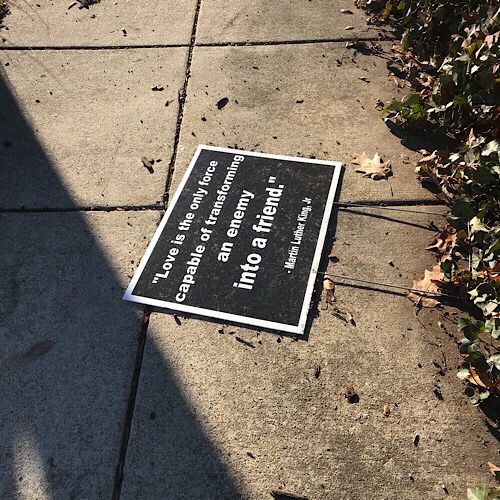
Signs Around Town


Last night another storm front passed us by with only a trace of rain, leaving us deeper in drought. The wind picked up, the temperature dropped, and the clouds scattered, leaving the sky scrubbed bright blue and the air fresh. Though this morning on my walk to work there was hardly a cloud in the sky, a rather menacing gray cloud hovered directly over the building where I work. Observing this odd cloud led me to ponder about how I often feel that I have my own personal cloud–everyone else has purpose in their lives and is worthy of love, but not me (this is a bit of an exaggeration, but you get the idea).
The reality is that all of us get such feelings to a greater or lesser degree some of the time. It can be a helpful step in clearing away feelings of unworthiness to remember that it is part of the human condition. The tantric yogis say that there are three cloaks or malas (anava mala, mayiya mala, and karma mala) that result from the manifestation of diversity from the pure universal out of its own play. The sense of unworthiness we sometimes feel (anava mala) comes from forgetting that we are spirit, and anava mala– in whatever form it appears to manifest–is just because of the loneliness of not remembering our true self. When we experience or create conflict or unhappiness out of the illusion (maya) that separateness and distinction are the only state of all that is real then we are in thrall to mayiya mala. When we think we are completely in charge and responsible for everything we do and how it impacts the world, that is karma mala at work.
We practice to pierce through the clouding of our individual consciousness by the malas. By inviting ourselves to open to the luminous space of consciousness and to surrender to the very fullness of our being, we reduce the impact of the malas on how we conduct our lives. Our practice helps us to remember our worthiness so that we can be happier and freer and do our work and engage in our relationships with more love and light. It helps us remember the light in each being so we are naturally drawn to respond with more compassion and friendliness to everything on the planet. The grace of dissolving kriya mala is that when it is not obscuring our vision, we can engage fully on our path, but still accept that we are ultimately not in charge and do not know what the universe truly has in store.

The doves perched in that spot for at least an hour and a half–right above the murti of Ganesha.
“Write more, that’s all I have to say.” There were several more lines of text, but none so coherent or compelling as this.
Yes, spammer, I would like to be writing more imaginatively and more about the yoga here and elsewhere. I am fully occupied, though, with a technical writing of quite some magnitude if magnitude were to be measured only by the number of words and ideas included. With the social and substantive complexity relating to the project and how it fits within the fabric of creating the rules that govern our society, it is a creative in its own way, but it is more draining than inspiring.
The exercise involves many drafters who come from a wide range of perspectives, training and background, and who have different responsibilities and senses of responsibility. Most everyone is feeling stressed and under-supported in their own way and acting in the multifarious ways people act when that’s how they are experiencing things. I am struggling to stay compassionately present for myself and all who are engaged in the endeavor.
Reminding myself of reasons to be grateful always helps. The yoga and meditation practices, in addition to my creative pursuits, are at the top of the list. The practices are the only truly steady back up that I have. Perhaps that is true for everyone to a greater or lesser degree. The philosophies that inform the practices–whether renunciate or tantra–ultimately would not, I think, disagree.
Anusara yogini and teacher extraordinaire, Amy Ippoliti, started a “30-Day Yoga Challenge,” which she updates monthly, for students and friends who are her Facebook friends. For the past several months, the challenge has been to work towards some very challenging poses (how appropriate for a challenge). This month Amy invited students to practice without air conditioning, or for hot yoga practitioners, without extra heat. Granted, she is based in Boulder, Colorado, where it is not 101F today, but she speaks my mind. Whenever people have asked me what I think about hot yoga, I have answered that it serves some people very well, but I always find myself asking the question, whence is the heat coming and will it enhance my yoga to change the room temperature if I need to burn fossil fuels to practice?
Why is practicing without a technologically altered environment a yoga challenge? Have you ever found that if conditions aren’t right, you think you cannot do your practice? If we are truly practicing with commitment, then what we want to do is to find the practice that will fit the environment (including not just the outer environment, but the state of our mind and physical well-being) on any given day, even if it means that the practice will not meet our expectation of what our practice should be.
When we practice steadily and listen to the teachings, one of the things yoga teaches us is how to be more sensitive to our environment and to what we put into our minds and bodies. A friend complained of being terribly sleepy the other day. I said it was the heat; look at your pets; don’t you notice that they are sleeping more in the heat? What practicing in accordance with the ambient temperature means (or eating or sleeping or dressing or engaging in leisure activity) learning better how to align with the energies around us, including being sensitive to how we would optimally practice in the heat. As yogis, I believe that what we want, ever more deeply and more profoundly, is to live aligned with nature and our own being in it so that we can find better recognize the fullness and the light of being whatever challenges arise.
I’m doing a modified version of Amy’s challenge here in DC this week: at the William Penn House, I’ll take whatever air conditioning is on (which, for those of you who are wondering, can be pretty nice and cool since it is the ground floor). At the house practice, I’ll keep the house at the same 80-82F I typically keep the house when it is over 90F outside; I won’t lower it because I am practicing, but we won’t be having it over 90F. At Willow Street, I’ll go with the flow.
I went today with my younger sister and brother-in-law to see the Terracotta Warriors exhibit at the National Geographic Museum. Even with only a few of the warriors and photographs of the site, it is possible to imagine the sheer magnitude of the vision of thousands of these life-sized images living underground at the tomb of the Emperor. I then thought of how vast must have been the Emperor’s yearning for power and the wildness of his vision of this extraordinary tomb for it to have become manifest. Trying to expand my imagination to understand the reality of such ambition and creativity I thought of the principle of iccha shakti. Iccha shakti is the very will of consciousness to be, to creatively manifest, to become diversified embodiment out the universal. Ego and will are not themselves bad, but our very freedom allows us to choose a path that is out of alignment with the principles of joy and unity.
The Terracotta Warriors show the immense possibilities of exercising will. In their very existence and the manner of their coming into being, they evidence both enormous cruelty and disdain for life and a wondrous manifestation of human creativity, collaboration, and effort. One of the goals of yoga, in teaching us the possibilities of our own freedom and creativity, is to lead us to choose a life that is progressively better aligned with nature and with all of beings. This is the path of one who practices, and I find it ever a challenge.