Statues Around Town
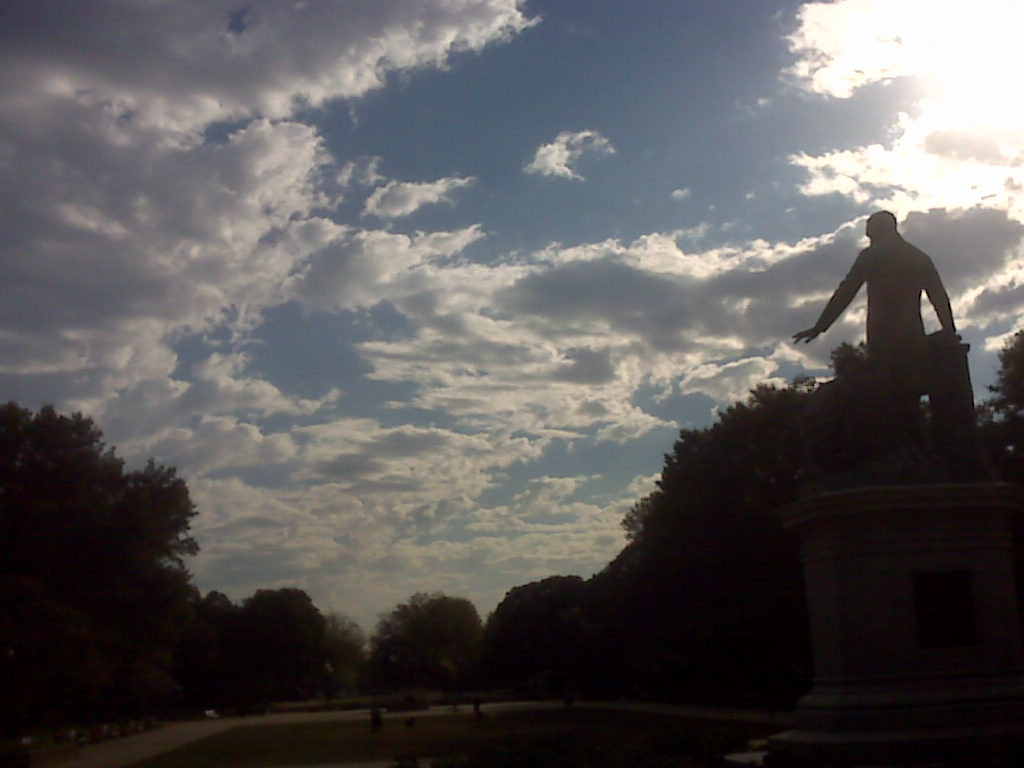
I would not be walking through Lincoln Park past a sculpture of Lincoln emancipating the slaves. There might not have been any slaves to emancipate. My great grand parents might not have made the trip from Eastern Europe to Ellis Island, which might never had been a portal for millions of human beings to arrive by ship from Europe. What an extraordinary web of existence. What do I think is my purpose and what is my part/purpose in the great web–the part I can never have the vision to know because I am inevitably bound by the perspective of my embodiment?
This pilgrimage is shortly coming to a close. I do not know what it will bring nor what I will bring home (I actually wrote this entry on December 16th). What I do know is that I will be eager to share all the learning and visions and use them to seek more peace and joy, fairness and health, love and compassion. May your most heartfelt, true wishes be realized in the new year.
The guy in the Apple store in Georgetown who showed me why I really wanted to walk out of the store with the IPad 2 had never heard the song “New Toy.” The year it came out, I was in London studying and being tragically hip; he was a year old give or take a few months. I suggested he find it on ITunes.
Three days of Ipad 2 ownership later, “New Toy” kept running through my head. Oh my god, and then I started hearing Nina Hagen infiltrating from the past. Was I really in New York when this song came out and kind of out of my mind? Yes I was. Does anything we experience ever completely fade away? Probably not, which is why the great yoga masters advise us to be careful what we bring into our consciousness, lest we establish new samskaras that draw us away from the light.
 I took this picture the other day when I was walking to work. I have seen TV cameras set up at this spot dozens of times to film news interviews. I have seen tourists galore photographing each other. I’ve seen a couple of photo shoots of brides and grooms dressed in their wedding clothes. I’ve seen the fountain full of ducks or gulls. I’ve seen it empty of water, with rain pelting on it to eliminate any reflection, in a blizzard, iced over, full of algae, as a play spot for dogs who like to swim, in fog, in beating down sun, with cherry blossoms floating on the water, and with waves from a strong wind. Although (or more likely because) I’ve walked past this view hundreds of times in the 25 years I have lived on Capitol Hill and the 18 I have worked for the Department of Labor, I have never taken out my camera and photographed this incredibly photogenic spot.
When I took the photograph on this day when the reflection just happened to be perfect, it led me to see the spot the way tourists see it: full of freshness and wonder, beauty, and excitement to be in this place that represents a certain mind-blowing type of power. Reflecting on the act of taking the photo from my perspective as a resident, led me to think about the Anusara alignment principle of “opening to grace.”
One of the many aspects of “opening to grace” is having a “beginner’s mind.” What does it mean to have a beginner’s mind on or off the mat? I think it means being open to new insight, to a sense of joyous discovery, to a feeling of fresh intoxication and wonder, no matter how many times we have done or seen something before. How many times have you done lunge or downward facing dog? Eaten a green bean or a potato chip? Petted a dog? Turned on a light switch? Filled a glass with potable water out of the tap? If it is the “same old, same old,” then you will lose the desire to practice and the possibility of growing. But most of what we do, especially as we get older, is a repeat of something we have done before. Grasping at new experience as a cure for boredom or jadedness will only make us unhappy. If we can see each day with newly opened eyes, then we can find fulfillment in each moment and be better able to grow. We will be open to ever deepening refinement and exploration within the space of our existence.
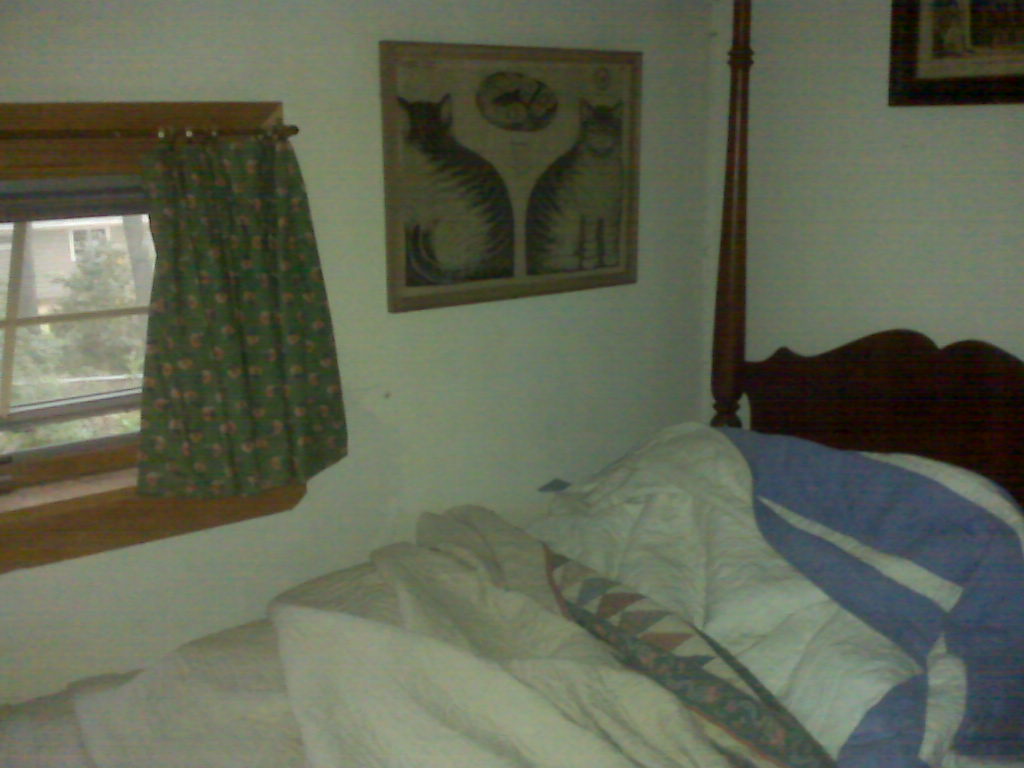
I slept last night in the room that I slept in as a child. My mother now uses the room to store some of the vestiges of her old antiquing business. The carpet, wallpaper, and curtains from the 1960’s are gone, but the bed is the same one in which I had slept. The picture on the wall is a kit for making a stuffed animal that my Grandma Rose had bought me (probably when I was about 8) at the Brooklyn Museum of Art that my mother decided would be better as framed art than a sewing project for me.
The neighborhood looks different–it is far more developed as is everywhere near a big city–but the bones are the same.
It is a challenge not to feel the weight of my history and ancestry when I return. Taking the time to meditate when I woke helped me stay fully in my adult self.
When we meditate, we ideally dissolve our individual consciousness into the luminous spaciouness of universal consciousness. In that space, where we are temporarily not experiencing ourselves as an individual, we are also not experiencing our individual self in the sequence (krama) of time. The luminous spaciousness of meditative consciousness is sequenceless (akrama) and, as universal consciousness, is the place in which the sequences of being in time and space arise.
What I experienced this morning when I meditated was that I did not have to be flooded with the emotions of my, to try to graciously describe, emotionally challenging childhood. In the space of meditation I could bring to my day an acceptance of all of my life and be where I am at present, coming to a place of recognition that although I lived all of my history, it neither defines me nor binds me from expanding into a space of growing love and light.