Similar Posts
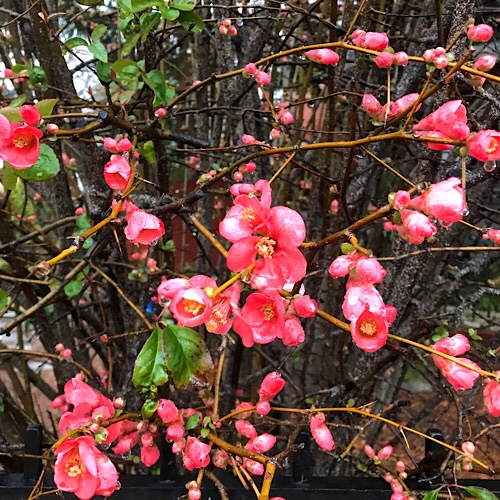
Extreme Pink
A friend who was a skilled gardener whose taste in gardening ran to the subtle and quiet (think Vita Sackville-West’s all white garden at Sissinghurst), used to tease me for my attraction to lush, tropical blooms.
There is a time and place for everything in this world–the quiet and demure, the loud and outrageous.
The wider range we can appreciate, and the better we can know the optimal use and place for things, the better we will flow and dance and integrate into the joyous possibilities in the fabric of being.
Peace and light, E — Posted with WordPress for BlackBerry.

- Asana, Pranayama, and Yoga Practice | Community and Family | Food for the Body | Gardening | Meditation | Quaker
Today I Was Overwhelmed With Grief
I practiced, including a Zoom class led by my friend Suzanne Lynch, I asked for help, I expressed appreciation to various friends and colleagues, I went out into the garden at lunchtime, made several more donations, and sat under the cat. And I re-centered enough to be able to persist.
I hope you all are finding your way in this. Let me know if you want to practice–on-line.1

Sthira-Cara (of the stationary and moving living beings)
A number of years ago, I attended a week-long workshop with Rod Stryker. He invited us to meditate on absolute stillness — cara sthira — meditation. Sitting comfortably, still the skin, the muscles, the bones. Draw the attention to stillness. The breath and heart will still move, but the concentration is on stillness rather than on any movement. Rod Stryker discussed the next day the challenges of this meditation, especially for those who are intellectual, who enjoy being active in the mind. I found it difficult at the time and even dreamed about the issues the meditation brought up for me. Meditating on stillness can be very challenging in a way that meditating on a mantra or the breath would not necessarily be.
I believe the origin of the meditation comes from the principle of sthira being the absolute unmovable, the essence of being (not dissimilar to Kant’s unmoved mover). We invoke pure stillness, pure potential out of which movement comes because that is part of our essence and a place where we can rest our spirit. See, for example, the Srimadbhagavatam.
I discovered absolute joy in this meditation a couple of years after I learned it. I was suffering from a severe sinus infection and bronchitis simultaneously; I joked that I was fine as long as I didn’t breath through either my mouth or my nose. In the midst of my suffering, I remembered the teaching. For a few days I stayed in the meditation for hours at a time. I found the place where I did not really need the breath. Enough came to survive, but I forgot about wondering how to breath or finding a place for it or my struggles with it. In the stillness, there was space and peace and supreme bliss. Ever since then, I have chosen this form of meditation when I have a cold, a sinus infection, or other challenges with breathing. Meditating on the breath, obviously, will not be soothing when breathing is a struggle. But when even breathing is a struggle, peace can be found in complete stillness.
Afternoon Walk
I meant to go somewhere else. When I got outside, I found my feet taking me to the river.