Found Quotations
Last night I went to see the National Theater UK’s simulcast (tape-delayed) of Helen Mirren performing in Ted Hughes’ translation of Racine’s Phedre at the Shakespeare Theater. The tragedy of Phedre is misinformation, misguided helpers, and passion that has gone beyond sweet engagement to maddened attachment.
A stage production is intimate and designed for the small audience of those present in the theater. When it is merely filmed (instead of being turned into a movie), it sometimes feels forced because it is watching a film of a stage production, instead of being invited in as one is when one is either at the stage production or the filming is done as a movie, which is designed to include the viewer in a manner for the film.
What was hard about watching the filming of the stage production, was being forced to have the camera’s and director’s perspective; there was no ability to turn my head and shift which part of the stage to give my attention. At the same time, I felt appreciative of the miraculous offerings of technology: the filming made something that is usually limited to those who can afford theater of that extraordinary quality and who are able to be in a certain place at a certain time available to tens of thousands around the globe, including me and my friend. In that way, the filming both took away the intimacy of being physically present, but simultaneously created a unifying experience for a much bigger group of people.
I was inspired to think about the limitations and differences among the perceptions of the characters, of the critics (talking about the play and the film), of the smaller, elite audience (the actual theater goers’ — I’ve been at that theater in London), of the technologically broadened audience, and of mine in response to the essence of the tragedy, the story and substance of the play, the delivery of the play, and my own life as informed by the play.
It seems an interesting lesson on many levels on how we can choose to live with our passions, how we can react to limits and changes in our ability to perceive our own selves and the world around us, and on how and what we invite in through the doors of our perception.
In 2000 or 2001, shortly before I started practicing Anusara yoga, a teacher who regularly played music in class, played for us a recording of Alice Coltrane singing a tantric chant to Siva and the Goddess Bhuvaneshvari. I only heard the chant once while we were in savasana — corpse pose/final relaxation. Although I only heard the chant once, for several months afterwards, I found myself having a recurring dream that I was wondering in a neighborhood that looked like the one where I grew up and went to high school and chanting the full chant. At the time I merely found it curious that I seemed to have learned the sanskrit just by hearing the chant one time. I have since learned that the recording may have been done right near my high school; that is where the Coltrane’s had a recording studio. I also learned that the chant was a tantric chant. At the time, my teachers were coming from a classical yoga perspective. Did I actually learn the chant by osmosis? Was having the very vibration of the chanting near where I lived and studied the catalyst for me, as a receptive being, discovering a path of tantric yoga?
I have found other recordings of the chant. One is Atman’s “Dancing to the Goddess” on the Eternal Dance CD, which is an electronica version. The other is Ragani’s “Om Mata” on the Best of Both Worlds, which is a very nice kirtan/pop version. I have several of Alice Coltrane’s recordings, which are great jazz, if you aren’t familiar with Alice Coltrane as a fabulous musician in her own right. Recently I searched again on the internet to see if the bootleg had become available. There was nothing on YouTube (though some good Alice Coltrane things to watch). I bought Alice Coltrane’s “Radha-Krsna Mana Sankirtana,” which was originally recorded in 1977 (when I was in high school) and reissued in 2005, as I thought that was a promising source. It has some good things on it, but no luck finding the recording I wanted to hear.
The chant goes like this:
Samba sadasiva, samba sadasiva, samba sadasiva, samba shambo.
Om mata, om mata, om sri mata, jagade mata.
Om bhuvaneshvari, sri bhuvaneshvari, hari parashakti, devi bhuvaneshvari.
It is a chant to the benevolent, auspicious one within, the radiant goddess, the creatrix of the world. Bhuvaneshvari is one of the ten wisdom goddesses.
Please advise if you have access to the Alice Coltrane or another recording of this beautiful chant.
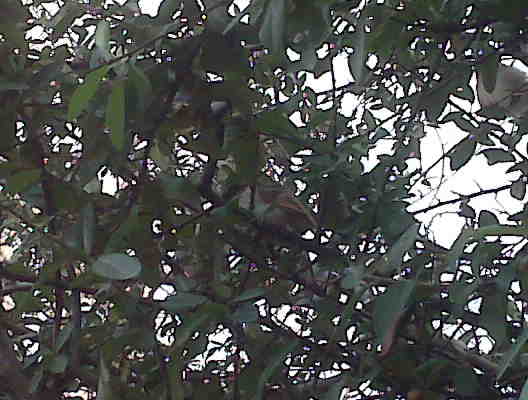
This bush was full of tufted titmice and sparrows. They were all simultaneously chirping with excitement.
I imagined some of them agitated and anxiously saying of the unseasonable warmth hat it was not normal and something needed to be done.
The rest of them were loud drunks on the spring warmth. “Life is short. Enjoy what has come.”
Perhaps there was one truly wise bird who was saying that both of those are true and that recognizing both truths was a door to harmony.