Signs Around Town (and the Power of Positive Thinking?)
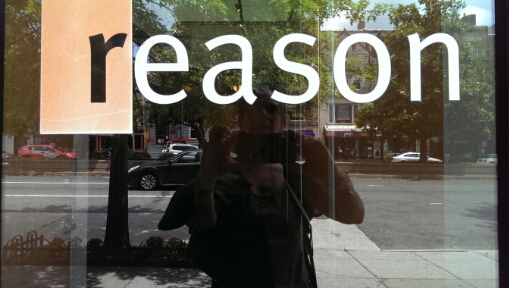
Words can and do lead us to spirit, Yes they can. (Of course they can drive us from it, too. Let us strive for true poetry in all we express.)
In this society, we tend to think of softness as a negative. If being soft is collapse, laziness, inattentiveness, etc, then it would indeed be a hindrance to growth inner and outer.
We need to soften, though, in order to open or change. When baking a cake, we allow the shortening to soften so that we can cream it with the sweetener. When a seed germinates or a fledgling emerges, the shell softens so that the new life can burst forth.
When I soften as part of the first alignment principle, it is not a collapse, though it does have an aspect of easefulness. It is necessary to soften to invite the support of the subtle energies, to fully experience all the pose has to offer, to expand with light from the inside out. Softening when we start a pose is like the softness of early spring that allows the vigor of full growth to expand.
Being soft in this way — on or off the mat — makes possible the growth of inner brightness and strength that actually makes us less vulnerable then would creating or keeping a hard and brittle shell that can bind or break.
This ad, which I saw while I was riding the train to NYC last week, reminded me of a primary reason I practice yoga. The sincere yogin doesn’t negate the spaces between opportunities to vacation, but seeks to live fully each day.
It might be more enjoyable to play or adventure than to have a stressful day at the office on any given day, but I’d hate to think I am a better person only when I have vacated work and home.

Here’s the text of an email we received earlier in the week from building management:
As a result of sequestration, effective Friday, March 8th the Frances Perkins Building (FPB) Facilities Management Office will be modifying the hours of operation for the FPB heating and cooling systems to achieve required savings detailed in OASAM’s sequestration plan. Normally, the FPB heating and cooling systems are operational for 14 hours, from 5:00 a.m. to 7:00 p.m. daily. In order to achieve the reductions required by the sequestration, the FPB hours of operation for the heating and cooling will be adjusted to the General Services Administration standard 10-hour operating day, from 7:00 a.m. to 5:00 p.m., Monday through Friday.
We encourage you to prepare for the building being cooler/hotter in the morning and evening hours by:
–making sure that window blinds are opened or closed appropriately to maximize the sun’s effect,
–leaving private office doors open to maximize air circulation, and
–dressing appropriately, layered clothing that can be added or removed during the day.
We appreciate your cooperation as we implement these sequestration-driven cost reductions.
We apologize for any inconvenience.
Here’s what I wrote back (restraining myself from noting that when President Obama called upon federal workers to make suggestions for how to save money two years ago, I suggested that we change the dress code and the building temperature to reflect the season, not some outdated notion of what is “professional” dress and was resoundingly ignored):
This is fantastic news. I have long advocated making the inside temperature more consistent with the outside weather for our health and for the environment. I hope that you will keep a policy of spending less money and precious fossil fuels on heating and cooling even if the budget picture improves.
I’m thinking that building management doesn’t usually get positive feedback. 😉