| | |

Murtis Around Town (and Dana and Seva)

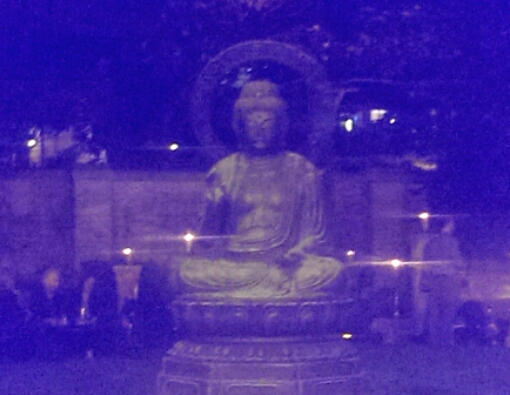
This evening I went for the first time into the Anderson House of the Society for the Cincinnati.  I was attending an event for supporters of Casey Trees, one of my favorite local charities, which is devoted to protecting and expanding DC’s tree canopy. 

I give because I believe it is an important part of a living practice (dana–charitable giving is a companion to seva–volunteer service).  Getting to discover this garden was an unexpected delight, but not the goal.

image

Similar Posts

  • | | | |

    Another Self-Induced India Photo Flashback (Roadside Temples)

    Another self-induced India photo flashback after a long work day reading and writing at the computer with breaks only for shoveling snow and for eating and cleaning up.

    We were traveling on the bus when I saw the Durga temple (the fifth photo–the one with the white glare and flat sky, but an incredible Durga).  I suggested to my seatmate that he take a picture with his better camera.  I recall it quite reasonably and correctly being pointed out to me the flat, white heat of the midday, humid sky and the glare off of the window would make it impossible optimally to show the intricacy and vividness of the temple.

    I snapped a picture anyway.  I was seeing things at angles coming and going and with whatever the light was at the moment.  I likely wasn’t ever going to be there again and certainly not any time soon.

    Sometimes the bus would pause in just the right place for a perfectly composed shot, but mostly it didn’t.  In this, the act of taking these photos was much like other aspects of life and practice.  Our path is not always certain.  Sometimes it is hard to see because there is too little light or too much.  Sometimes we have something obscuring our vision.  Sometimes we are going too fast and only notice just before it would be too late for that turning.

    But even with vision turned or obscured, we are always experiencing something.  How can we make the best of each moment of experience?  For me, it is meditating and bringing the spacious awareness of meditation to what I am witnessing.  Taking photographs helps me witness in a certain way, too.

    roadside temple 1a roadside temple 1b roadside temple 1c roadside temple 1d roadside temple 1e roadside temple 1f roadside temple 1g roadside temple 1h roadside temple 1i roadside temple 1j roadside temple 1k roadside temple 1l

  • |

    Daylight v. Day Lights

    A year or two before Al Gore’s An Inconvenient Truth was released, I went to a panel discussion and film (alas, I cannot remember the title of the film) about global climate change.  One of the speakers was a Nepalese attorney who was working on a case in the World Court that sought to address the impact of various corporate practices on the Himalayan snow cap.

    One of the things this man said continues to resonate with me:  “Why is it,” he asked, “that Americans are always turning on lights in the day time?  Do you ever think about how much energy we could save and dangerous, climate-changing emissions we could stop, if we just relied on day light during the day instead of adding unnecessary electric lights?”

  • | | |

    State of the Garden

    One of the key teachings about yoga sadhana (practice) is that results best or sometimes only can possibly come with steady commitment for a long period of time.

    The red maple in my front garden (really more of a giant tree box) was barely the height of the porch roof when I bought my house.  Now, almost 25 years later, it is as tall as the house.  And even more stunningly, blazingly, Kali-like red every fall.

    red maple

  • | |

    Only a little rain (and vimarsha)

    My gardening friends have been commiserating and worrying about the abnormally dry weather.   For the past couple of days, we have all been concerned that this storm has brought so little needed rain, although we are grateful to get whatever rain comes.  Other acquaintances were complaining yesterday that it still wasn’t sunny.  When I mentioned drought conditions, they had not noticed.  If they noticed once it was pointed out, they suggested reasons why for them personally, it would still be a better thing for it to be a sunny day.  Part of the reason I garden is to keep me connected with the rhythms of the seasons and the weather.  If we do not grow our own food and depend on the fruits of our labors, nor are taught the relationship between the weather and our survival, there is no reason to know it.  We become disconnected from nature and from the earth.

    For me, connection to the earth deepens my connection to myself and to spirit.  How can we know ourselves if we do not know how the earth nourishes us and how we relate to the earth?  How can we recognize the light within ourselves, if we are disconnected from nature?  At the same time, the practice of yoga, with its inward questing (antar-vimarsha — the quest to touch or reveal the true Self), by revealing to us the subtle energies and knowledge of the relationship of body and mind, can lead us back to yearning for a deeper understanding of the world around us and for a healthier relationship between the give and take between us and the earth.  We can thus reach spirit both by being more aware of the outside and seeing where we are disconnected in our practice off the mat and by reaching inward using our spiritual practice (the Anusara principles are designed to be a pulsation of reaching outward and inward for an ever growing expansion and understanding of mind and spirit) and then knowing the outside is not aligned and needs to be shifted.  All this is the process of vimarsha, like a little more rain in the drought to nourish and encourage the unfolding of spring.

Leave a Reply

Your email address will not be published. Required fields are marked *

This site uses Akismet to reduce spam. Learn how your comment data is processed.