| |

State of the Garden (Rescue Orchids)

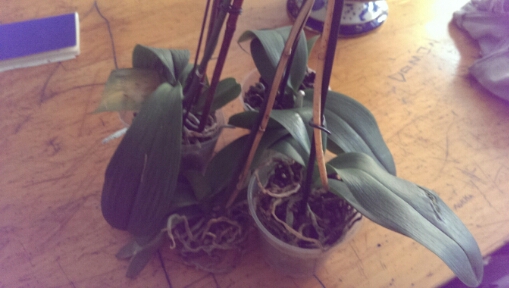
These orchids were left out with the trash in the neighborhood yesterday.  Though my bags were full from a walk to the farmers market, I did not want to leave them to perish when they could yet offer more beauty.

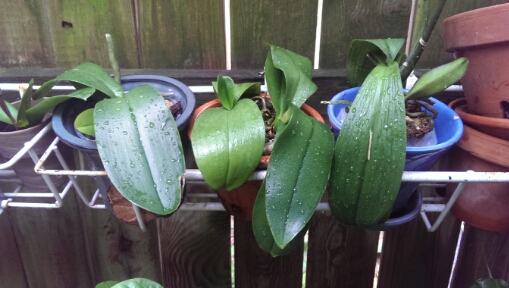
Despite what looked like months of neglect–the plants evidently owned only for their blooming time and not their full growing cycle–there was optimistic new growth. 

Time will tell whether they will rebloom.  For now, they look pretty happy to have a new home.

image

image

Similar Posts

  • | | |

    “American Veda” (and some recollections)

    I am reading Philip Goldberg’s American Veda–From Emerson and the Beatles to Yoga and Meditation; How Indian Spirituality Changed the West.  It is another of the recently published works on the interplay and inter-influence of east and west.  What distinguishes American Veda is that it is more about how Indian spirituality influenced western/American society overall, than an analysis of the yoga that we practice in the west.  Much that one might expect to be in the book is there:  Emerson, Thoreau, Swami Vivekananda (and the Parliament of the World’s Religions), Ramakrishna, Paramahamsa Yogananda, Osho, Muktananda, the Beatles, Maharishi Mahesh Yogi, but there are other connections that are less well-known.

    As one generally familiar with the history of Indian philosophy and yoga practices coming to the West, it reads more like a survey or overview than an analysis to the extent that it tries not to leave out any one who could have been an influence and goes into little depth regarding any particular influence.  (Note:  the author himself says that the book is limited to Vedic/Hindu influences; he refers the reader to other sources, in particular, How the Swans Came to the Lake, for the transmission of Buddhism to the west).

    What is most interesting to me about reading American Veda is that it reads like old home week.  I recognize the names and the philosophies and the way people speak about spirituality and religion, and the author lovingly and thoroughly shows how profound and widespread is the influence of Vedic thought in America, even where no attribution is given.  I recognized even when I first discovered Indian philosophy texts in high school the interplay between how me and my fellow unprogrammed. liberal Quaker friends were talking about mystical experience and understanding of God/Spirit and the Indian philosophy, and it is lovely to have a book where someone went out and did all the research and gathered the sources.  By the time I was thinking about anything at all really, Indian philosophy was already something in my consciousness thanks to the Beatles and the Beats.  The Beatles discovered Maharishi Mahesh Yogi when I was six, which was the year that Sgt Pepper’s Lonely Hearts Club Band and Magical Mystery Tour came out and my parents for some now unfathomable reason gave them to me for my Christmas present.  My older sister and I played those albums over and over again on our portable record player, whirling ourselves into states of dizzy ecstasy with the sitar grooving in the background on our favorite songs.

    I was moved to read the Bhagavad Gita by reading J.D. Salinger’s Franny and Zooey. I do not remember whether this was in 9th or 10th grade, but I read Salinger because was what cool, smart kids read.  What I remember is that I read both Franny and Zooey and Catcher in the Rye (probably read the latter first) before Catcher in the Rye was assigned reading in 10th or 11th grade and that while I was not particularly impressed with Holden Caulfield, I really wanted to be as brilliant and educated and extraordinary and talented and philosophical as the children in the Glass family, and so I tried to read what they read (though alas, I read it in translation, where they were able to read the Greek and Latin and Sanskrit, etc.)   By 11th grade, a teacher had given me J. Krishnamurti to read, and his anti-guru guruness appealed to my Quaker sensibilities.

  • | |

    6:50am flight from BWI (I’ll be off of the computer until Monday)

    I am lucky to have a non-stop.  The storm is supposed to have passed through.  So I can enjoy myself know matter what travel brings, I pack up a variety of reading materials — philosophy, handouts for the workshop, and fiction.  I switched my ankle warmers to bamboo knitting needles so I could get through security and knit (the ankle warmers are on size 2 needles, so it is taking me as long as a sweater).  I have my journal and a pen.  Best, I am traveling with two friends (all different flights, but no one waiting alone in the airport) with whom to visit, who are going to the same retreat.  Takes the edge off of the early wake up time.  Starts the retreat when I leave the door instead of when I arrive at the retreat center.

  • | | |

    Being Present in the Present

    Much is made by Westerners of the exhortation in Eastern practice to be in the present moment, but it often is used as justification for a feckless disregard for others, for our history, and for our own power to change and grow.

    Being fully in the moment at all times (easier said than done) by virtue of the fullness of presence itself, leaves no room for belaboring the past or being anxious about what might not come to pass, which is wonderful indeed.

    To be truly present, though, to live in the “now” is an artful dance. It requires being fully in the moment, while simultaneously honoring and learning from the past and taking responsibility for the future. It is thus that we live best–both recognizing ourselves as beings in the fabric of space and time, yet simultaneously experiencing the universal joy unbound by the limitations of space and time. This is, I think, the ultimate point of the practices.

    Peace and light, E — Posted with WordPress for BlackBerry.

  • | |

    Walking and Shopping in the Neighborhood (and brahmacharya)

    Yesterday afternoon when I came home from teaching I wanted to be out for a walk in the neighborhood more than I wanted to be alone in the garden, but I also wanted to be serving the garden.  I combined the two by walking the ten blocks to Gingko Gardens — our wonderful Capitol Hill nursery.  It is a little more expensive than some of the nurseries out in the burbs, but I know the owner and have friends in common, I always bump into neighbors when I am shopping there, and they are experts in what grows and works in our little urban gardens.  I was thrilled when they opened a number of years ago and want them to continue to thrive, so I make a point of shopping there.  I bought some seeds and some planting medium for starting seeds indoors and ordered a few containers and organic potting soil for delivery.

    In addition, after having done a bunch of research on rain barrels over the week, I also asked whether Gingko would deliver and install rain barrels from Aqua Barrel, which is located in Gaithersburg.  Answer, “yes.”  (For those of you in the suburbs, Amicus Green also carries and installs them).  It took me a long time to assess what style barrel would work for me and where it should be placed.  I was hoping to support a local manufacturer to cut down on wasteful transportation.  I also know that given my circumstances it is critical that it be installed correctly with a good diverter system.  It is good for me to do the research but then bring in a professional to make sure it is right.  I made an appointment and am looking forward to being able to align a little better with nature (by using rain water run-off instead of scarce, potable water for the garden) and to support the neighborhood (by buying locally and hiring resident professionals).  And I bumped into a fellow yogi and gardener while I was shopping; inspired by the chat, she, too, made an appointment to discuss rain barrel installation.

    To me, this is one way of bringing yoga off the mat.  One of the key principles in Patanjali’s yoga sutras is the practice of brahmacharya, which literally means aligning with Brahma.  The classical translation is celibacy.  Many modern translators substitute “moderation.”  This way of living, is of course, moderate.  It is living a western lifestyle on the grid, but choosing to consume in a way that supports friends, neighbors, and manufacturers who use recycled materials to create products that will help us all to be a little kinder to the environment, while nurturing my home and self.

Leave a Reply

Your email address will not be published. Required fields are marked *

This site uses Akismet to reduce spam. Learn how your comment data is processed.