| | |

A Good Week for Sadhana

This morning, when I was reviewing in my head some of the meetings and other work matters upcoming this week, I thought, “what a good time to practice all the things I have been studying.”

It felt like progress to think that and then notice my first thought was not, “this week is going to be awful,” or even, “this week is going to be challenging,” instead of thinking the latter and reminding myself of the former.

And having a homemade popsicle after a long day certainly helps make this heat wave more enjoyable.

image

Lime, cucumber, mint popsicle (cucumber and mint from the garden)

Similar Posts

  • |

    An Opportunity

    image

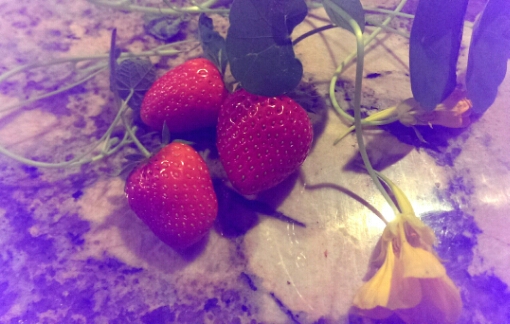
    That there were just three
    Perfectly ripe strawberries
    Gave rise to an exquisite
    Opportunity to practice
    Mindful eating.
    To enjoy the sun on my back and the weight of the berries in my hand as I picked them.
    To linger with their delicate, promising scent.
    To enjoy their shape, the patterns of the seeds, the ripe redness.
    To taste each one as if it were the only one.

  • | | |

    Green advertising (and viveka)

    One of the important principles of yoga practice is viveka — discrimination.  The longer and more steadily one practices, the greater ease with which one will find path that leads towards recognition and remembrance of our own light and the light in others.  In modern culture, I think one of the critical aspects of practicing viveka is having a healthy doubt and willingness to question claims that consuming certain things will make us happier, or better, or will make the world better.  Paying too much attention will probably just create a tangle of intellectual confusion that will not lead to a greater openness of spirit.  Learning to listen well to your body and mind and what and how you feel and hear on and off the mat will help you start to know better your body and mind and how they interrelate with all around you, is likely to shift your choices and actions.

    It is now fashionable to be “green.”  Discerning what that means, though, is where we need to practice discrimination.  For example, claims of “natural” foods, “organic” foods, and “green” products are now ubiquitous by companies that are part of the existing Wall Street profit-driven industrial and marketing complex because they think they are money-makers and expect most consumers not to question the claims.  We are also seeing more and more articles and stories debunking these claims and calls for regulation so that consumers will understand what is bunk.  If we stop and pause, we can probably figure out some of this without reading about the pros and cons.  Do you know who is selling it to you?  Does it come in packaging with a lot of small print?  Is the packaging recyclable?  Are shareholder profits critical to the entity selling you the food or garden supplies or other consumer good?

    Taking the example of the success of the big companies, small entities are using “green” in their names and advertising without discrimination.  Around town I see fairly regularly, landscaping companies with cozy-sounding “green” names.  When I watch them working, though, they are using Round-up or other chemical weedkillers, throwing into the trash compostable yard waste, and planting non-native shrubs.  They may be making a garden the color green, but they certainly aren’t doing “green” gardening.

    Here’s some great information on having a “climate-friendly” garden from the Union of Concerned Scientists.  The tips are more helpful for a yard large enough to have a lawn, and do not fully apply for my small patio (though I have a tree in front, don’t leave bare soil, and do not use pesticides or chemical fertilizers.  I haven’t yet tried planting winter crops in my containers, but I’ve rearranged the patio so that I have a place for a raised bed (to sit on the brick where the table and chairs once were).  This winter, I’m hoping to add the bed and a cold frame to lengthen the growing season.

  • |

    I hate [insert name of pose or class of poses] (and the kleshas)

    One of the aims of yoga, according to Patanjali’s classic eight-limbed path of yoga, is to be free from being torn between the pairs of opposites — pleasure and pain.  We cannot be free if we are always grasping at pleasure or acting to avoid pain.  From a tantric perspective, we are not trying to disengage or transcend body and mind and the natural arising of pleasure and pain, but we still want to be engaged without an attachment or aversion that leads us into entanglement and suffering rather than towards openness and light.

    One of the kleshas (afflictions) is dvesa, which can be translated as hate, dislike, abhorrence, enmity, avoidance.  Why wouldn’t we want just to avoid something that we dislike?  Sometimes we have no choice, and one of the benefits of yoga is helping us make peace with having to face or be engaged with things that are painful or distasteful.

    I often hear students say, “I hate [insert name of pose].”  Last night, I heard it twice.  I am no stranger to the “I have to go to the bathroom poses,” the poses which are so challenging or uncomfortable, that I feel the need to leave the room. One of the most profound ways I have grown with yoga, though, is staying present for the poses that did not initially appeal to me, usually those that pushed my fear, trust, strength, anxiety, worthiness buttons.  One of the obvious superficial benefits of staying present and practicing the “I hate” poses is that they can yield an extra sense of accomplishment when we get them.  We can also learn more about our friends and colleagues by starting to understand why the poses are the ones that naturally draw them and thus expand our perspective on the fullness of life.

    For example, arm balances are still most challenging for me, partly because I am more flexible than I am strong, and partly because I am fearful of falling.  I’ve started to appreciate how another person could be drawn to them for the exhilaration, the rush of danger, the excitement, the challenge, the very topsy-turvyness of the poses, although those aren’t sensations to which I am naturally drawn.  But I have learned how much practicing arm balances fuels the energy in my core and heart and when I get them, what it must feel like to fly.

    The teacher’s duty (and I have been blessed with wonderful teachers who have given me this gift) is to offer the full range of experiences (within the parameters of the class level, style of yoga, and class description), so that every student gets to practice both favorites and least favorites.  This is not so much to make sure that every student gets a favorite sometimes and so is happy in the class when the favorite shows up, but so that the students are invited to be present, grounded, and open to his or her own light through the full range of delights and challenges.   On a day when I just get my favorites, I feel like I have been to the spa.  The real pleasure from yoga has been from the challenging poses over the long term.   It has been steadily coming to the challenge that has started easing my reactions off the mat to the inevitable challenges, pain, and losses of a full and active life.  In being less reactive to challenges, I also find I crave specific pleasures less, and so enjoy the pleasures that come all the more.

    Yoga home practice challenge: pick one pose for which the phrase, “I hate…” usually proceeds it and make it an element of your weekly home practice for a month.  Witness your reactions on and off the mat.  Enjoy what happens next time the pose comes up in a class.  Maybe the phrase “I hate” will stop arising as soon as you hear the teacher name the pose.

Leave a Reply

Your email address will not be published. Required fields are marked *

This site uses Akismet to reduce spam. Learn how your comment data is processed.