| | |

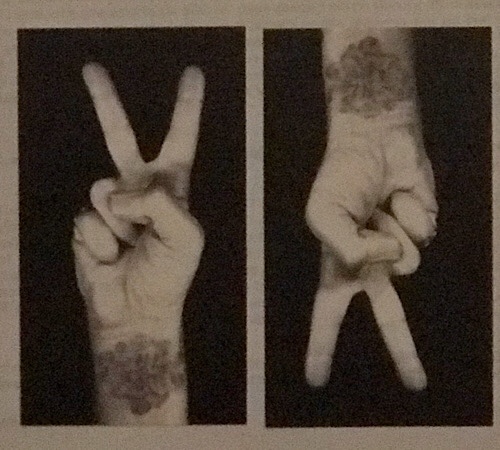
Signs Around Town (in Lambertville After Attending a Workshop With Desiree Rumbaugh At Dig Yoga

Yesterday, I had the good fortune to be able to attend a workshop with Desiree Rumbaugh at Dig Yoga.

Desiree asked what inspires our commitment to practice.  For me, it is that practicing consistently helps me feel better in this embodiment and puts me into a space from which I can better face what comes.  What keeps you committed to your practice, whatever that practice might be?

image

Similar Posts

  • | | | | |

    “I See It Every Morning” (and Jnanam Bandaha) (DWTD)

    When I walked out of the back of the hotel through the pool area just after day break, one of the pool side assistants was out getting things ready for the guests. “Windy,” he said, as I was wrapping and knotting my meditation shawl around my neck into the face of a strong breeze coming from offshore. “But look,” I replied, pointing to the sun rising over the ocean, “it’s so beautiful!”

    “I see it every morning,” he answered, partly with a shrug of weariness and partly with a grin of delight. I guessed he was in his mid 50s–hard for me to tell, his skin was so leathery from the sun. Probably an old stoner surfer was my thought, and the shrug of resignation was for the fact that taking care of the lounge chairs and umbrellas for endless legions of tourists was what he needed to do to eat and still be with his dearest love–the sea and the sun. The smile was for the sun and the sea itself and to be able to share their beauty once again with someone who is seeing them with fresh delight.

    During the course this week of study, we spent time discussing the Shiva Sutras. The second sutra–jnanam bandahah–literally means “knowledge is bondage.”

    “Why do we automatically assume bondage is a negative?” John asked us at one point. Any time we make a choice, we are to some extent binding ourselves because we are, by making a choice and being limited by space and time as we are in this human form, forgoing other possibilities.

    The Sutras also say that knowledge is freedom. Though the sanskrit words are different for the knowledge that binds (limited knowledge) and knowledge that leads us to freedom (highest knowledge or knowledge of the divine), using logic equations, one could say that if knowledge is bondage and knowledge is freedom, then at some level, bondage, too, is freedom.

    If the pool side attendant regards himself as being utterly beaten down by his job, feels stuck with drudgery because he had nothing else he could do to survive, and then forgets about the beauty surrounding him, that would be an example of knowledge constricting or limiting us, putting us into bondage that takes us away from spirit.

    If, on the other hand, he looks at the ocean each morning with joy in his heart and recognizes that he chose his job to be able to be with the ocean and sun every day, that would be knowing that bondage can actually free us (in our limited form) to dwell in and from the heart.

    What the tantric yoga and meditation practices that come out of such teachings as the Shiva Sutras are designed to do, is to help us find the freedom in our limitations, to make choices in our associations and actions — our bindings — that lead us to love and wonder rather than disappointment and fear.

    What do you choose?

  • | | |

    The Exquisiteness of Order (Winter Theme)

    By order, I mean how things are arranged in space or time.  Even chaos theory presumes order in that sense.  On and off the mat, there is a certain order to things that is optimal.  We do not plant seeds and then till the soil.  Or think of the difference between peeling and chopping vegetables and then cooking them or cooking them and then peeling and chopping them.  One or the other is not necessarily wrong if you do not have a specific dish in mind, but which you choose will dictate the results. Once you have gotten started in the sequence, though, the path shifts and is partly set.  To reach an exquisite rather than a disgusting result, the next steps are ordered by the initial choice.

    If only one musician is playing a single note, then there is no possibility of discordance.  Add more musicians and more notes and who plays what notes when can mean cacophony, a catchy tune, or an extraordinary and ecstatic work of art.  None of us are alone and none of us are playing just a single note, so in the great fabric of our being, it is best to understand how to make music.

    Sequencing on the mat is more subtle than what poses should be done in what order in a particular practice to emphasize backbends v. forward bends and twists to be able to do the strongest poses with the least possibility of injury, as important as that is.  The order in which we apply the Anusara principles not only aligns the physical body, but brings symmetry to the physical and energetic bodies, helping us to feel more in harmony in everything we do on and off the mat.  I am, in this, a decent musician and not Bach, but the more I pay attention to the optimal sequence of things (keeping in mind that over most things we have no control as to when, whether, and how they happen) and the more I learn and appreciate the exquisiteness of order, the more I feel, understand, and experience the subtleties and joys of harmony.

Leave a Reply

Your email address will not be published. Required fields are marked *

This site uses Akismet to reduce spam. Learn how your comment data is processed.