Signs Around Town
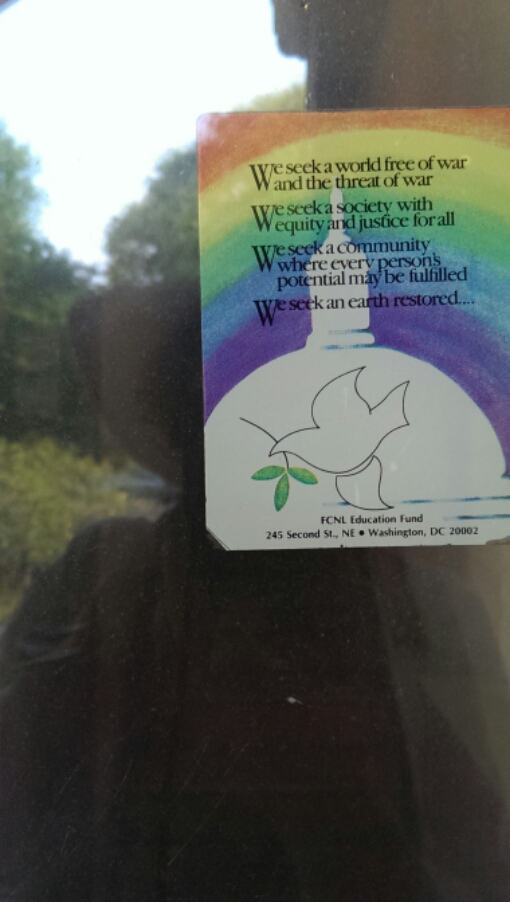
Peace and light, E — Posted with WordPress for BlackBerry.

I was volunteering today at William Penn House, which was providing a comfort station for marchers during the day, as well as being full to capacity with guests.
I was doing some work in the office when a woman who looked about my age came who was in town with a group of women from Long Island for the March.
She came in to William Penn House for a bathroom, not because of any connection to Quakers or the house. But while she was waiting in line for the bathroom she ended up in conversation with the executive director, who said that the board member volunteering downstairs was also from Long Island–perhaps she knew me. It turns out that we went to the same elementary school and lived near enough to each other that we rode the same school bus.
It is just one of the reminders I’ve had this weekend of how connected we are.
Dear Friends,
One of the most captivating elements of dance as artistic expression for me is that it has the capacity to show the beauty in the full range of emotions. Whether the choreographer is telling a story or sharing an impression, making a political statement or expressing a feeling, the dancer’s inherent grace can show us that there is beauty in all things, helping us through the artistic medium to abide with what might otherwise seem emotionally intolerable and to celebrate more fully that which would naturally make our hearts sing.
Since I first began practicing asana, it has been for me an embodiment of the dance. The exquisite technique of the Anusara® principles of alignment transformed healing work into a dance of exploration. The expansion of my strength and flexibility in middle age — when because of my dance history I thought only would contract with age — allowed me to express progressively more fully the joy I find in my body.
This year, John Friend’s overarching theme for his workshops and trainings around the world is “Dancing with the Divine.” The theme resonated especially fully for me because I started attending regularly last fall the Sunday contact improv jam on Capitol Hill and have been re-exploring dance after all the shifts I have made with an ever-deepening asana practice. It has been with an eye towards not only my own dance, but the connection of the community, and our dance of relationship with our living planet that I am choosing which trainings and workshops to attend this year.
When deciding what my study priorities are for the year, I look first at where my practice and teaching could benefit from some deep attention and wisdom offerings. I look to the local offerings to deepen my connection to my home community and to minimize the environmental impact of getting to be in the same room as the teacher. I am thoroughly appreciative of how wonderful it is to have a burgeoning and dedicated local community that has incredible teachers and draws others. When planning which workshops or trainings with John Friend I will attend, I look at whether there is an opportunity to combine a training with a visit to friends or family or an opportunity to see art exhibits or museums that are of particular interest to me. I like to go to any trainings that I can get to by train and, like even better when it happens, where I do not need a car once I get to the training/workshop location.
Next dance for me with the bigger community is the Anusara Grand Circle in Stratton, Vermont for the summer solstice. My heart expands with the anticipation of being in the mountains of Vermont with clear, starry nights and bright, vivid almost endless days for a gathering of fellow yoga dancers, those I already know and love, those whom I will get to know better, and those I will meet for the first time.
It is especially exciting to know I will have the opportunity to study with some of the incredible teachers in the international community I am honored to know, but from whom I have not yet had the privilege of taking a class. It is also a great opportunity to be with people who are just beginning to get excited about Anusara (gatherings like this are a great opportunity to study with John Friend without having the formal application process.)
Local yogis, I look forward to seeing you in regular class offerings in the neighborhood and Willow Street, including just until the end of May, Thursday night restorative yoga. I expect delightedly to see you, too, as fellow students at many of the incredible offerings both in and around DC and the country.
And if any of you are interested in coordinating a trip to the Grand Circle to celebrate the solstice, send me an email.
Peace and light,
Elizabeth