Untitled

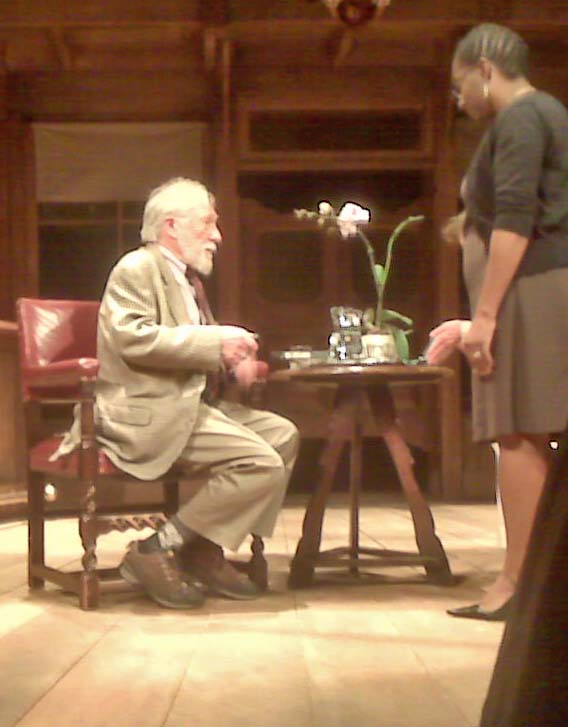
Last night I had the singular pleasure of hearing Gary Snyder read his poetry at the Folger Shakespeare Library. At the end of the reading, Mr. Snyder answered a few questions. In response to one question about advice he gives to aspiring poets, he said: “Don’t be journalists. Do hard physical labor that leaves y0ur mind open.” This is not surprising advice, coming from one who has chosen a life requiring regular manual labor. “Meditate only for its own sake,” he added, in an apparent non sequitur and without elaboration.
Gary Snyder’s poetry is evidently influenced by his dedicated study and practice of Buddhism. The insight and clarity of his poetry surely reflects not only his intellectual study, but the deep wisdom of a dedicated, long-standing, and steady meditation practice. The advice to “meditate for its own sake” seemed almost the offering of a koan by the master (poet) to his pupils. Meditation, in my experience, definitely enhances clarity, insight, creativity, and health. Meditation is not meditation, though, unless when engaging in meditation that is all one is doing and without any goal (like the “actionless action” of the Bhagavad Gita). It is the deepest of practices to engage fully, but not be doing except for the sake of doing itself (and in alignment with the deepest truths).
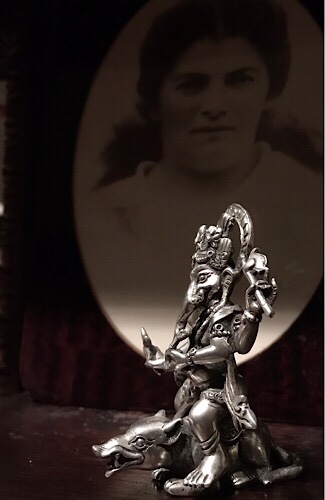
I don’t have much family, and I know little about the family I have. I am the one living with this photograph (the only one I’ve seen) of my maternal great grandmother because we are the only two with frizzy hair. The story I heard about her was that she gave birth to my grandmother en route from Eastern Europe and carried her across the ocean to the lower East Side.
This Ganesha makes me think about that level of determination –what we can do when we figure out how to turn a rat into a ride.

One of my favorite practices is to find the wonder in things, if only the outrageous complexity of experience and relationship.
The clouds of drought-ridden skies have an uncannily alluring beauty, like that of fairies who, though exquisite, are heartless and dangerous by human standards.

Peace and light, E — Posted with WordPress for BlackBerry.
We all (or at least most of those who would be reading this blog) have heard the Buddhist-inspired saying: before enlightenment, the laundry. After enlightenment, the laundry. The question is whether after the moments of enlightenment can we infuse doing the laundry with more joy, acceptance, and peace. A young adult acquaintance asked me the other day whether I was readjusting ok. I did not know to what he was referring, and he had to explain that he was asking how I was doing on my return from my India trip. “It was just a vacation–albeit an extraordinary one,” I replied. “Life continues.”
“The good experiences just slip away like dry sand through my fingers,” he made a motion of letting something slip away.
“When you practice and when you get older, it will be easier to bring the temporary, good experiences into your life without feeling they are lost when you have moved onto the next thing,” I said with hope that would actually be true for him, he seemed so bereft.
The yoga teaches us neither to be out searching for the highs nor actively avoiding the lows; the dance of grasping and avoiding is what makes us suffer. That does not mean that the highs, the times of wild abandoned joy, the experiences of utter fulfillment, of exquisite understanding are of no value. What brings joy is a thing of wonder and an opportunity to deepen our ability to love and be generous. They are only a problem if we ruin our time by vainly clinging to or trying to repeat the sensation. As our practice (and our understanding of a life well-lived and loved) matures, we understand that there is no readjusting in the return to the day to day. We welcome what we have had, try to remember what we have learned, including how much joy and delight we are able to drink in, and approach each day as another opportunity to seek and share connection.

Cloud on cloud, light and
Shadow. When we are open
To it beauty comes.

Peace and light, E — Posted with WordPress for BlackBerry.