| |

Orchids

image

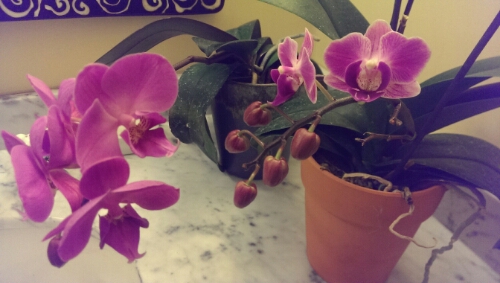
I had open all day, while I worked from home, the windows that are protected from the rain.  Having the scent of Spring rain and the brightness of my indoor garden helped provide balance to a 14-hour day of editing.  Meditation and regular stretching help, too.

Tomorrow I plan to go outside for the clean up phase. With vigor and enthusiasm. I expect that though I’m stiff and sore from too much computer time, hard physical labor will feel good.  I’ll get to remind myself of my yoga for gardening tips.

Similar Posts

  • Shins In/Thighs Out (and Rabbi Hillel)

    Rabbi Hillel is famous for having said, “If I am not for myself, who will be for me; if I am not for others, what am I? If not now, when?”  Taken in its best light (and not as the recruiting technique for going to war this quote has served), this means we must, as they say on the airplane, “put on our own oxygen mask first before helping others.”

    I often think of this principle, when I am emphasizing the fundamental physical alignment principle of shins in/thighs out.  If you have taken even just a few Anusara classes, you have probably heard the teacher say “shins in, thighs out.”  It is really short hand for the action of muscular energy that hugs the legs to the mid-line, followed by the spiraling upward and backward expansion of inner spiral.

    When applied with enthusiasm and in the right sequence, “shins in/thighs out” protects our knees and opens the groins, hips, and pelvic floor in a way that gives us greater access to finding the strength of our pelvic floor, low back and abdominal muscles.  It is a perfect example of an appropriate personal boundary:  it leaves us open and available to receive and observe all that is good, while creating a protective and appropriate boundary from which we can grow safely better to serve.

  • | |

    It’s a Fine Line Between a Grimace and a Smile (and satcitananda murtaye)

    The New York Times just published a blog entry on the perils of faking happiness.   The first problem with the article was that I could not get to the study to see if I agreed that the actual premise was that “faking a smile” was what led to a deterioration in mood or feeling unduly pressured by a need to do so regardless of what was going on inside was the problem.  The second is the definitional problem of what it means to “fake” a smile.  I think it not unlikely that contorting the face into a fake smile (i.e., grimacing) because one feels one has to do so does not improve mood when one is in physical or emotional pain.  According to the little cover blog, though, those that made an attempt to smile from the inside by thinking a positive though–even though it was a conscious effort– did experience an improvement in their mood.

    Any good method actor will tell you that to make an outer expression believable, one has to cultivate inner thoughts to go with it (though that is still “acting”).  Having been taught by my mother by age six in preparation for my first school play performance, that to act I should try to “be an apple” a la Stanislovski, I disagree that intentionally putting a smile on your face cannot help improve your mood. It’s all in how you fake it ’til you make it.  I have long advocated to my yoga students, based on my personal experience with the practice of smiling whether I think I mean it or not, to try smiling on the outside improve mood.  Even leaving aside the inner experience, just walk down the street with an open posture and a smile on your face and see how people respond, though I caution to do this at your peril in New York.  When you smile at people and be polite, they generally respond in kind.  You are then much more likely to feel good than if you are scowling and rude and people respond back in kind.

    What on earth (or in heaven’s name) does faking a smile until you feel one have to do with satcitananda, you may find yourself asking yourself at this point.  The second line of the Anusara invocation is “satcitananda murtaye.” Murtaye, from the same verbal root as murti or statue, here is usually translated as saying that Siva (from the first line) embodies the characteristics of satcitananda, being (what I like to call is-ness), absolute consciousness, and bliss.

    Another way of looking at this phrase, though, is that when we open to the possibility of discovering our siva nature, which is the reason we practice yoga, and when we use the principles of alignment to help do so, then we discover how to be, if even for a moment, simply present, fully conscious, and blissful with the consciousness of the ultimacy of being.  In a word, when we soften and look within, using the knowledge and experience of our teachers and our practices, a smile of recognition lights us up.  If we start out having a bad day, feeling stressed or anxious or in pain, or just plain grumpy from reading the news, we just have to practice with more depth and sincerity to find the smile and not beat ourselves up if we are struggling to find the smile despite our desire and the intensity of our practice.

    Is that faking a smile or being the smile?  Does trying to smile when we are feeling blue really make us more unhappy?  I think it is all in how we do it.

Leave a Reply

Your email address will not be published. Required fields are marked *

This site uses Akismet to reduce spam. Learn how your comment data is processed.