Asana, Pranayama, and Yoga Practice | Food for the Mind (Yoga Philosophy, etc) | Meditation | Photos
Signs Around Town?

Om, shanti, shanti, shanti.

Om, shanti, shanti, shanti.
In yoga practice the concept of diksha — initiation or threshold — carries with it a sense of right timing and conscious understanding of readiness for the next level. For example, knowing I was not yet strong enough, this past weekend I chose not to try to jump from adho mukha svanasana (downward facing dog) to svanasana (headstand), but instead concentrated on doing the poses one at a time, even though I was surrounded by people who could do the transition with ease and my ego was challenged. Until I am stronger and better able to hold the alignment in poses at that level, I would be too much at risk of hurting my neck and shoulders.
In the garden, it is easy to be fooled by a beautiful weekend to move right to activities that are still 3-4 weeks premature. Even though it will hit 70F this weekend, it is not time to plant (other than perhaps an experimental row or pot of kale, chard, or beets, which like the cold). The best gardening you can do in the beginning of March when the weather is swinging wildly from below freezing to unseasonably warm is to read and plan and start seedlings indoors, just like it is best to warm up and work on strength, alignment, and flexibility before going for harder asana in your yoga practice. It will be tempting to get out this weekend, but do the prep stuff and the clean up.
Here are some favorite books of mine to get ready for planning. It is mostly more practical stuff (rather than the super glossy, beautiful garden as splendid art and architecture picture book reading) with some food and yoga overlap and a bias for small urban gardens.
The Yoga of Herbs — An Ayurvedic Guide to Herbal Medicine, D. Frawley and V. Lad (Lotus Press, 2d Ed. 1988)
Gardener Cook, C. Lloyd (Willow Creek Press 1997) (OK — this one is kind of cooking, gardening porn)
The Edible Container Garden — Growing Fresh Food in Small Spaces, M. Guerra (Fireside, 2000)
The Bountiful Container, McGee and Stuckey (Workman Publishing Co., 2002)
Small-Space Gardening — How to Successfully Grow Flowers and Fruits in Containers and Pots, P. Loewer (The Lyons Press, 2003)
Kitchen Herbs — The Art and Enjoyment of Growing Herbs and Cooking with Them, S. Gilbertie (Bantam, 1988)
The New Kitchen Garden, A. Pavord (Dorling Kindersly Ltd., 1996) (Also pretty and glossy, but still practical)
When I read Kate Swift’s obituary yesterday, it lead me to think more deeply about a recent conversation I had about the Bhagavad Gita. The Bhagavad Gita, not surprisingly, is required reading for most yoga teachers. It is an integral part of the history and philosophy of yoga thought and practice. It is, though, about a battle in the middle of war, in a time and place where a woman’s highest and best (and arguably only role in life) is to be obedient first to parents and then to husband. Purity, obedience, and beauty (as decided by society) are the great virtues of women. As a dialogue between a male warrior (Arjuna) and a male incarnation of the deity (Krishna), all of the spiritual and social teachings are presented in terms of men and males, right down to the pronouns. The translation that was being discussed was that by Juan Mascaro. As a mid-twentieth century translation by a Spaniard at Cambridge University who has lectured on “Literary and Spiritual Values in the Authorized Version of the Bible,” the translation no doubt perpetuates (without any specific or willful intention to do so) the inherent sexism that is also found in the English language and in the Bible and its notion of God.
The question raised was how a book that perpetuates sexist stereotypes could be required reading to be a yoga teacher. (See my previous blog entry on how we, as yoga teachers, can rely on a book that is primarily about war.) How would it read, it was suggested, if all the pronouns in the Gita were changed from he to she? The person raising the question said that making this change made the spiritual guidance more accessible to her. For me, shifting the pronouns from male to female does not address the challenge because I do not believe in spirit that can be given gender. I read the Gita and other yoga texts in two ways: (1) as historical and literary/philosophical documents that are products of the author’s time and place in history; and (2) as a source of universal human truths. The Gita, as a dialogue between a warrior and a male avatar of “God,” does not have much place in the ideals I hold dear. Neither the caste system nor the roles for women espoused in the text support my own beliefs about equality, justice, fairness, or love. The extraordinary teachings of yoga, though, transcend the history out of which they arose. To do justice to the yoga texts — and not just the yoga texts, but the great teachings and texts that are an integral part of our social fabric — we must both recognize their historical context and be open to learning what has transcended history and cultural boundaries to make them living words.
In attempting to make the shift to a modern interpretation that allows for “feminism,” I know many who try to address some of the challenge for modern readers by saying that we all have characteristics of the masculine and the feminine, and so we can read the guidance in the texts as being valid for both sexes. The problem I have with that is Kate Swift’s point. If we label various personality traits and characteristics as being elementally male or female, we are still perpetuating sexism through linguistic bias. It is not enough for me to make the warrior female and allow her “male” characteristics. What I think is that all human characteristics are gender neutral. If the teachings are not to be biased when we as teachers transmit our reflections on the texts to our students (after recognizing how history has done it), then we need to say that all people can be assertive or passive, strong or sweet, rigorous or soft, etc, but not just say that some are masculine and some are feminine and that in having all of these traits to some degree, we are showing that we are both god and goddess, masculine and feminine.
Or we could just not do any labeling at all, instead concentrating on the truly universal yoga teachings of right action, selfless service, and deep abiding love–none of which have anything to do with gender.
One of my father’s joke bits of wisdom is “everything in moderation, including moderation.” When I first studied philosophy academically, I was very much taken with Aristotle’s concept of the “golden mean,” which (this is a gross oversimplification) advocates living in moderation as a way of right living. Pantanjali in the niyamas in his Yoga Sutras invites the yogin to balance effort (tapas) and surrender (ishvara pranadhana) in our practice. The Bhagavad Gita suggests that extreme austerities are just as indulgent as wildly excessive consumption of food, sleep, and comforts.
What does that mean in our modern, middle class lives in a time when we are being confronted head-on with the impact on the earth and our fellow beings of the way we, as a society, have been consuming?
In part, I think it is mindfulness. It is not denial, but balance — choosing ways to consume less, but still not feel deprived. I am fortunate in that much of what we are learning now about both lifestyle and impact (the stuff under the “green living” umbrella) is not new to me. My parents were children of the Depression and my father had a modest income. I went to Quaker youth camp in upstate New York in the 1970s, and I did volunteer work for the first Earth Day when I was in college. We turned the lights off when we weren’t in the room, we turned off the faucets when we were brushing our teeth, or lathering our hair in the shower. We creatively changed what we cooked out of Julia Child, Craig Claiborne, Virginia Lee, or Diana Kennedy or the New York Times Food Section with what we learned from Diet for a Small Planet. We wore warmer clothing inside to be able to keep the heat down. It is important for me to try to live mindfully, but I also very much like to be warm and comfortable, love the feel of beautiful fabrics, and one of my greatest pleasures is eating well.
I have a number of reasons I like to keep the heat down in the winter: it feels better on my sinuses because the air is not as dry and I do not like to have to run a humidifier (yet another electrical appliance); it costs a lot of money to keep an old row house at even 65F in the cold months; and I am concerned about my carbon footprint. I can get really cold when I am working at my desk or getting ready for bed. I don’t like being cold, and it seems silly to insist on being miserably uncomfortable just so I can feel better from the perspective of some perceived moral ground. So I try to create a balance.
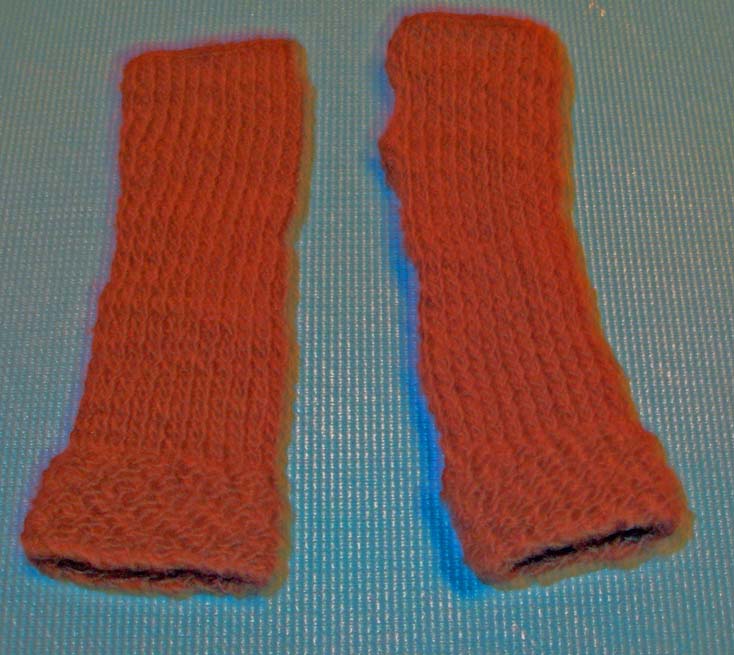
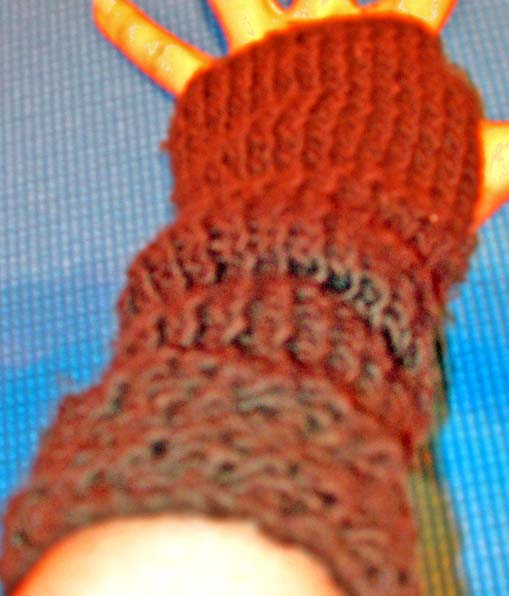
Hot water bottles and wrist warmers are part of the balance. Two hot water bottles taken to bed (and then I use the water on the plants the next morning) makes going to bed toasty and delightful, but not too hot in the middle of the night. If I am working at home and it is midday, I can warm myself up with a two-minute handstand or a few sun salutes or some abs work or other arm balances. That’s not an option if I am on a conference call or at the office. Nor does it make sense after dinner when it is time to get energetically quiet. The wrist warmers, though, make an amazing difference (I also enjoy wearing them when I start practicing until I warm up as another layer that easily can come on or off. I kind of like the way I look and enjoyed all the complements I got when I was meandering around New York over the holidays. They are a great way to use scrap yarn (especially if you don’t have the time, yarn, or inclination for a larger project — see my post on “Sauca (and the blanket).”
If you want to make your own wrist warmers and you are a fantastic knitter, you can go for four double-pointed needles, multiple colors, and add a thumb section. For those of you who are newer to knitting or who want wrist warmers very quickly, here’s all it takes to make the one’s shown above.
1. Two needles of appropriate gauge and less than a skein of yarn.
2. Measure loosely around your knuckles. That’s the right width for your wrist warmer (notice that the girth of your knuckles and your forearm a couple of inches below the elbow are about the same). Then knit about a two-inch square to make sure you know how many stitches you get per inch horizontally. When you have your gauge correct, unravel your test square to use that yarn in your wrist warmers. I recommend rechecking the gauge about an inch or two into your first wrist warmer to make sure you were right. It is easier to start over at that stage than to try and fix it later or have to give them away to someone larger or smaller (unless you want to).
3. Cast on the correct number of stitches for how many stitches per inch you get with your yarn and needles and the width you measured around your knuckles. It is OK to round to the nearest half inch. First two rows are simple rib — k1, p1. Then do basic plain knitting (k first row, p return row) until the first wrist warmer is about 6-8 inches long and reaches almost the desired length up your lower arm. Then do 6-8 rows of moss stitch (row 1 — k1, p1, row 2, p1, k1) [or you could just do more ribbing]. Cast off. Measure second wrist warmer against the second. Turned inside-out, using the knitting yarn, sew into a tube, leaving a whole for the thumb a the end with just the double row of ribbing. The sewn part at the knuckle end should be about 2/3 to 3/4 inches, then there should be about a 1 1/2 to 2 inch whole (just hold it up on your hand to make sure it fits).
4. They will stretch out as you wear them, but if they are a little too wide or tight, you can wet them and then make them either longer and thinner or shorter and wider by blocking.
4. Bored with the colors you have at home? It’s pretty easy to swap with a fellow knitter.
5. Want to be just a little fancier? Do stripes by alternating colors when you change rows. Want to practice cables. Do one center cable, just remember that it won’t be in the center if you want it to go on the top of your hand; it will start a quarter of the way in.
6. New to knitting? Go into any yarn store, tell them that this is your project, and they’ll tell you a good yarn, what needles you need, and show you how to cast on, knit and pearl. There are farmers at the Dupont Circle Fresh Farm Market on Sunday who have beautiful homespun, hand-dyed yarns. They might not show you how to knit, but they include patterns for hats.
7. Have fun. Be creative. Be part of a fashion wave. Stay warm.
“Life is extremely inventive; it always finds the means to prove to you that you are still a little rigid and tense, still projecting somewhat, still expecting a little, still somewhat vulnerable, and it is this constant dialogue with reality that keeps you from mistaking yourself for a master.” Daniel Odier, Desire, The Tantric Path to Awakening.
Whatever you might think is mastery or whomever a master.
Peace and light, E — Posted with WordPress for BlackBerry.
Paul Muller-Ortega, who teaches philosophy and meditation from similar roots to those that inform Anusara yoga, spoke yesterday of the differences between the path of the renunciate and the path of the householder. He strongly stated that neither path was better. What he suggested, though, was that a householder will better flourish practicing yoga designed for the householder rather than attempting to practice renunciate techniques, while still staying in the householder path.
What does this mean? I think it means that we become unhappy and conflicted if we try attempt the practices of the path of complete non-attachment and transcendence of body and mind while we are still very much staying in society and responsible for family, work, and citizenship. The tantric, householder path, including that of the Shaivite tradition of Kashmir and Abhinavagupta, offers practices that enable one to live liberated in society, instead of suggesting that the only way to true liberation is to reject and transcend work, family, and community. In yoga terms, the householder path is one that realizes moksha (liberation), through ardha (physical and material well-being), kama (love/relationship), and dharma (right work/path) rather than by transcending them.
Taking the householder path does not mean just indulging. It still requires sensitivity, dedication, discrimination, and alignment. I think it may be even harder than renunciation. I know it is easier for me to just stay alone and practice, for example, than to bring yoga off my mat to how I work, consume, relate to others, and participate in society. The householder path, though, is the one for me.
To read a little more about my personal yoga journey, please check out the “Get Local” profile that was just posted by District Kula. Thanks DK.
This site uses Akismet to reduce spam. Learn how your comment data is processed.
Lovely, but is the symbolic message a bit constrained, even distorted by the tumult in our universe?