Similar Posts
Light and Shadow and Color
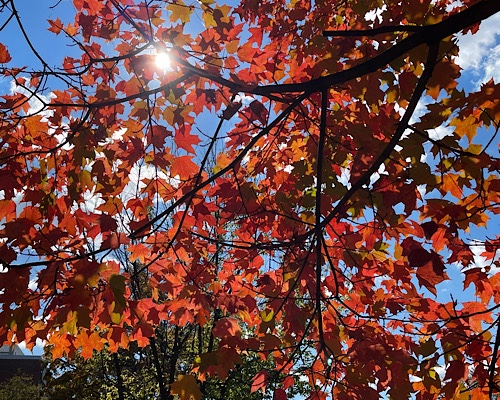
I had to address some stressful/annoying things today. Knowing this, I made sure to take a walk in the bright light.

- Art and Culture | Asana, Pranayama, and Yoga Practice | Food for the Mind (Yoga Philosophy, etc) | Photos
Thoughts on Attribution and Lineage
What do we mean, exactly, when we say a thing is “by” someone? Yes, we are attributing the thing’s creation to that someone. But how is something just by us when it is based on all the input and teachings to which we have been exposed or immersed? How do we give credit when it is due? How do we honor and acknowledge what has influenced us? When is attribution called for?
The yoga sages speak of the parampara, the lineage of teachings. For some the lineage is just that: a linear chain passed on from one generation of teachings to the next, and the attribution is clear. Those in such lineages or who would lead one of their own making often teach that one should pick one path (one style of yoga/meditation) and stick with that form or teacher to succeed (with the mythic goal of enlightenment).
From my unattained perspective, I question who is to say how “enlightenment,” assuming it is indeed something that can be achieved, would or could or should be attained by anyone else? Practice tips for enhancing the experience of human embodiment (is that not the real path?) are nice, though.
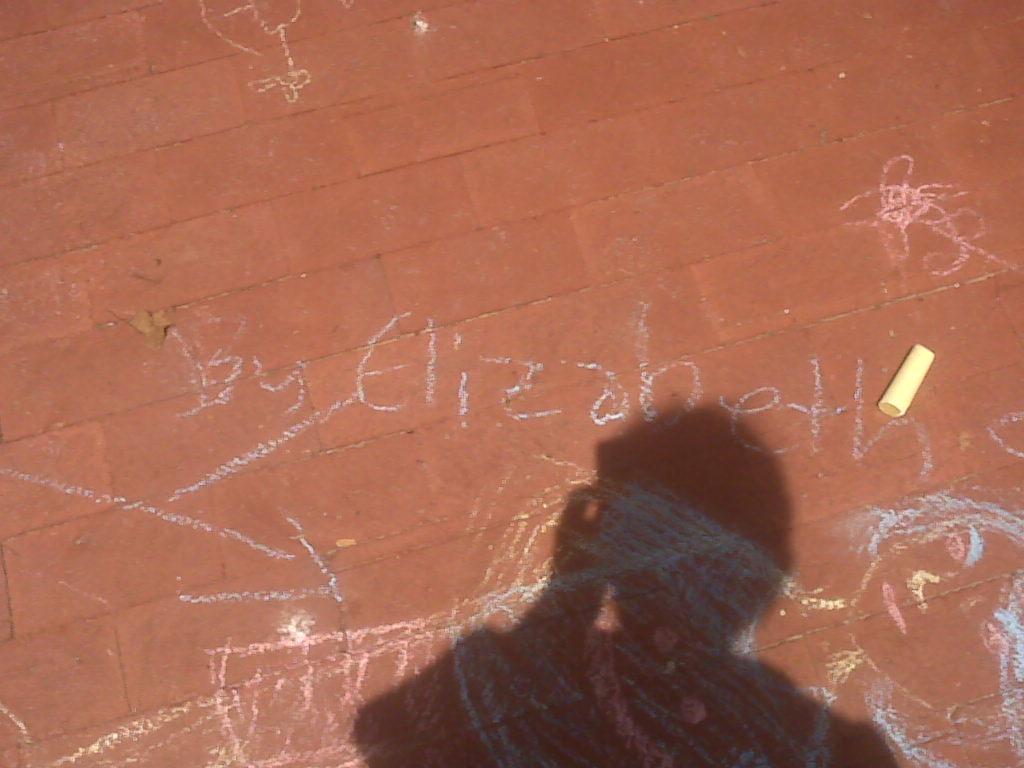
I do not know the Elizabeth who drew on the sidewalk. She is quite possibly about the age I would have been when I first read (not saw the movie) Mary Poppins and dreamed of entering another world through a chalk drawing on the sidewalk.
Peace and light, E — Posted with WordPress for BlackBerry.
- Art and Culture | Asana, Pranayama, and Yoga Practice | Community and Family | Food for the Mind (Yoga Philosophy, etc) | Photos
Expanding to Receive the Beauty, Opening to Grace, and the Isha Upanishad
In Anusara yoga, one of the ways the first principle of “opening to grace” can be experienced and practiced is as a radical expansion of the capacity to receive and appreciate the very wonder of being. During my visit to India with Professor Douglas Brooks, I found myself repeatedly thinking of the concept of radical expansion and also the preamble to the Isha Upanishad (long a favorite of mine; Shantala on their first CD, Love Window, have done an exquisite rendition), which can be roughly translated as saying that adding fullness to fullness is itself fullness (fullness can also be translated here as perfection).
What I believe this is saying that being itself is infinitely full; thus, we cannot make it more infinite by adding to it. Human consciousness of the infinitude of being, though, is limited by the filters of space and time. One of the key reasons to practice yoga (including meditation) is to expand both our capacity to appreciate the fullness and to receive its full wonder by uniting our own consciousness with the infinitude. When we can appreciate ever more the wonder of our being, we will naturally be more joyous, and I believe, led to be more compassionate and generous with ourselves and others.
Day after day on the India pilgrimage, just when I thought my heart and mind were already full to bursting, there were yet more experiences of the beauty and extraordinariness of life and creativity and nature. I found myself chanting the Isha Upanishad—purnamadah, purnamidam, puranata purnamudatacyate. Fullness and fullness is fullness. “Let me expand still more to appreciate to its utmost yet more beauty,” I thought to myself again and again. Though I already thought I’d developed a fairly full understanding of the concept through study and practice, I thought, “this is what John Friend means when he is talking about radical expansion.” I look forward to studying and practicing to experience and share ever more beauty.
Sthira-Cara (of the stationary and moving living beings)
A number of years ago, I attended a week-long workshop with Rod Stryker. He invited us to meditate on absolute stillness — cara sthira — meditation. Sitting comfortably, still the skin, the muscles, the bones. Draw the attention to stillness. The breath and heart will still move, but the concentration is on stillness rather than on any movement. Rod Stryker discussed the next day the challenges of this meditation, especially for those who are intellectual, who enjoy being active in the mind. I found it difficult at the time and even dreamed about the issues the meditation brought up for me. Meditating on stillness can be very challenging in a way that meditating on a mantra or the breath would not necessarily be.
I believe the origin of the meditation comes from the principle of sthira being the absolute unmovable, the essence of being (not dissimilar to Kant’s unmoved mover). We invoke pure stillness, pure potential out of which movement comes because that is part of our essence and a place where we can rest our spirit. See, for example, the Srimadbhagavatam.
I discovered absolute joy in this meditation a couple of years after I learned it. I was suffering from a severe sinus infection and bronchitis simultaneously; I joked that I was fine as long as I didn’t breath through either my mouth or my nose. In the midst of my suffering, I remembered the teaching. For a few days I stayed in the meditation for hours at a time. I found the place where I did not really need the breath. Enough came to survive, but I forgot about wondering how to breath or finding a place for it or my struggles with it. In the stillness, there was space and peace and supreme bliss. Ever since then, I have chosen this form of meditation when I have a cold, a sinus infection, or other challenges with breathing. Meditating on the breath, obviously, will not be soothing when breathing is a struggle. But when even breathing is a struggle, peace can be found in complete stillness.