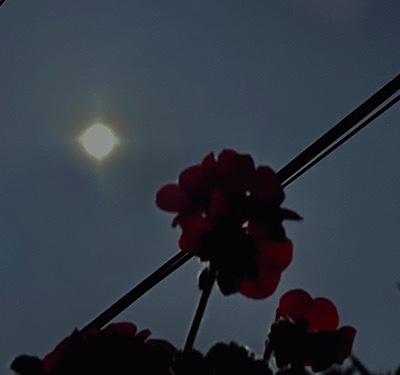
Found Objects Around Town

I have been told more than once that one cannot technically be a true practitioner/believer in the tenets of Kashmir Shaivism without believing in some form of Godhead. As a nontheist who still finds the teachings and practices informative and useful for how best to live, I ask consistently whether that is really true.
I’m sure a purist (religious or academic) would say there’s no anything to the philosophy without being a full believer. But what I think one gets from practices designed to heighten awareness of a divinely connecting universality in the wild diversity of life without a belief that what is universal a priori points to “God” is a recognition that with all that is troubling and difficult and hurtful and evil in this world, the very complexity and outrageousness of being is yet wonderful and inspiring in itself.
In a word, when all else fails, laugh (and create and live) with an ecstatic fatalism.

Painting by Sandra Dooley. Cuba 2014
I think a lot about what leads people to get injured on and off the mat. Often it is that desire for a certain goal or distraction keep us from the sensitivity and mindfulness that enables us to appreciate and act on the principles of cause and effect before the injury or accident occurs. One of the great benefits of a steady practice of yoga and meditation is that it can help us be more sensitive and aware of where and how we and all the things around us relate in space and time, the critical awareness for preventing injuries in the first instance.

Peace and light, E — Posted with WordPress for BlackBerry.

Just ten minutes later, the sky is a flat , grayish white. But I keep paying some attention to the sky–just as I keep sitting for meditation, even though I rarely have visions.