Similar Posts
- Art and Culture | Asana, Pranayama, and Yoga Practice | Food for the Mind (Yoga Philosophy, etc) | Meditation | Photos
What Do You See? (and What Does It Mean to Respond in the Highest?) (DWTD)
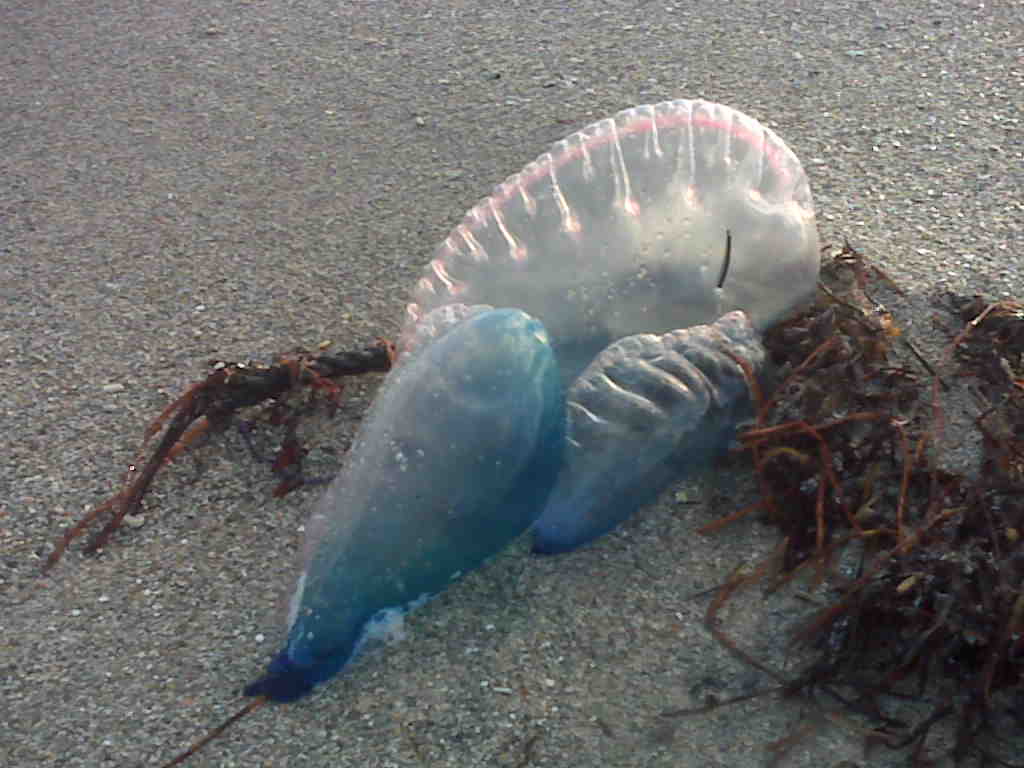
What do you see when you look at this picture? What would you have thought if you had come upon a mass of seaweed and jelly fish, having dressed in a bathing suit for a morning plunge into the ocean while on vacation?
Both my yoga teacher John Friend and my meditation and philosophy teacher Paul Muller-Ortega teach that we want to respond in the highest, to seek always to see the good and to respond from that seeing.
I found myself thinking about this morning when I saw dozens of jelly fish on the shore and contemplating a conversation I had yesterday about the topic with a fellow student.
For some, the t-shirt adage “it’s all good” may really ring true. Most every day is naturally bubbly and bright and difficulties or a need to shift or change to find better alignment is not of much importance. I am not naturally effervescent with bliss, though I find a deep and abiding and growing joy in life that comes from a combination of discrimination (viveka) and appreciation for the wonder and complexity of life.
Some may just not notice the jelly fish and just see the sun glinting on the waves, plunging in to swim with delight, not caring much that it resulted in itching or stinging from the jelly fish. The itching and stinging are just minor irritations that wouldn’t change the joy of the day. That’s a great way to live, but not all of us are by nature that care free.
For those of us who see the jelly fish and know that swimming with them can cause potentially significant discomfort, we have two choices: we can get all bummed out that a care free swim in the ocean is not going to happen. That is not responding in the highest. We can also look at what beautiful and amazing creatures are jelly fish, look down at our feet as well as up at the ocean and the sky so that we don’t step on any (walk with discrimination), and then choose to swim in the pool.
Responding in the highest and looking for the good is not the same as being blind to pain and difficulties. It is how we choose to react and our align ourselves within a world that presents both opportunities for delight and for challenge and pain. Responding in the highest is not being oblivious to pain, but rather, choosing not to suffer or cling to disappointment in the face of inevitable pain or difficulty.
Pre-Season Gardening (and diksha)
In yoga practice the concept of diksha — initiation or threshold — carries with it a sense of right timing and conscious understanding of readiness for the next level. For example, knowing I was not yet strong enough, this past weekend I chose not to try to jump from adho mukha svanasana (downward facing dog) to svanasana (headstand), but instead concentrated on doing the poses one at a time, even though I was surrounded by people who could do the transition with ease and my ego was challenged. Until I am stronger and better able to hold the alignment in poses at that level, I would be too much at risk of hurting my neck and shoulders.
In the garden, it is easy to be fooled by a beautiful weekend to move right to activities that are still 3-4 weeks premature. Even though it will hit 70F this weekend, it is not time to plant (other than perhaps an experimental row or pot of kale, chard, or beets, which like the cold). The best gardening you can do in the beginning of March when the weather is swinging wildly from below freezing to unseasonably warm is to read and plan and start seedlings indoors, just like it is best to warm up and work on strength, alignment, and flexibility before going for harder asana in your yoga practice. It will be tempting to get out this weekend, but do the prep stuff and the clean up.
Here are some favorite books of mine to get ready for planning. It is mostly more practical stuff (rather than the super glossy, beautiful garden as splendid art and architecture picture book reading) with some food and yoga overlap and a bias for small urban gardens.
The Yoga of Herbs — An Ayurvedic Guide to Herbal Medicine, D. Frawley and V. Lad (Lotus Press, 2d Ed. 1988)
Gardener Cook, C. Lloyd (Willow Creek Press 1997) (OK — this one is kind of cooking, gardening porn)
The Edible Container Garden — Growing Fresh Food in Small Spaces, M. Guerra (Fireside, 2000)
The Bountiful Container, McGee and Stuckey (Workman Publishing Co., 2002)
Small-Space Gardening — How to Successfully Grow Flowers and Fruits in Containers and Pots, P. Loewer (The Lyons Press, 2003)
Kitchen Herbs — The Art and Enjoyment of Growing Herbs and Cooking with Them, S. Gilbertie (Bantam, 1988)
The New Kitchen Garden, A. Pavord (Dorling Kindersly Ltd., 1996) (Also pretty and glossy, but still practical)