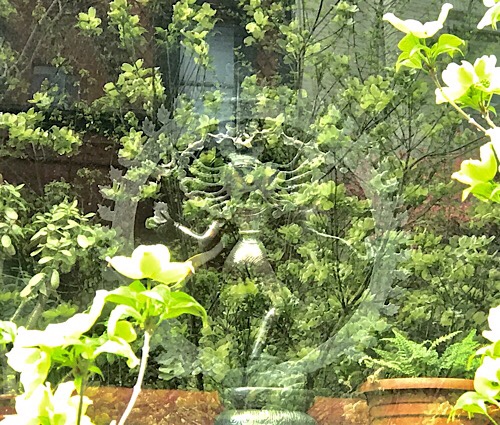
And So It Comes Again
Every year, the blossoms of early Spring are just as exciting and heart-opening.

Peace and light, E — Posted with WordPress for BlackBerry.
Every year, the blossoms of early Spring are just as exciting and heart-opening.
Peace and light, E — Posted with WordPress for BlackBerry.
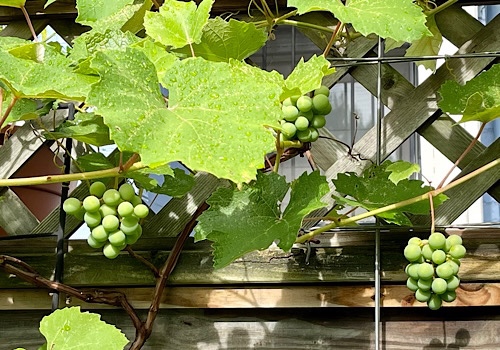
Only five bunches of
Grapes. Who will eat them? Me? Or
Will it be the birds?
One of my favorite fairy tales is the one about the traveler who teaches the old woman how to make “nail soup.” It is a cold, wintry night in the forest, and a traveler comes upon a hut. He knocks on the door and asks for shelter. The old woman who lives in the hut says he can sleep in the shed, but she cannot give him any food. The traveler thanks her for providing shelter. He says he does not need food, but if she lets him in by the fire, he will show her how to make soup from a nail. The woman, who is rather miserly, is excited by the idea of being able to make soup from a nail, so she lets him in and puts a big soup pot filled with snow to melt over the fire. The traveler puts the nail in the soup and says, “what a wonderful broth we will have from this nail. If we only had a potato or two, it would be even better.” The woman roots around in her hoard and puts a potato in the pot. “Now it will be even more wonderful,” said the traveler. “If we only had an onion to add, it would be the most savory soup you have ever tasted.” The woman goes to her winter stores and finds an onion. The traveler sniffs the soup, “mmm, how wonderful it smells, if we had a carrot or a parsnip, it would be gracious enough for any guest.” The woman, trembling with the excitement of creating soup from a nail, adds both a carrot and a parsnip. At this point, the broth is starting to take on thickness and color, and the hut is redolent of bubbling hot vegetable soup. “Oh for some salt and a little meat,” cried the man, “and this soup would truly be fit for a king.” “From only a nail, soup fit for a king!” exclaimed the old woman, “that I must have.” She added a precious pinch of salt and some meat dried to last through the winter. The soup, of course, was delicious, the traveler well-fed, and the woman happy to share (even if she was tricked).
Sometimes we need a reminder of our abundance, both inner and outer, to be invited to bring out all we have so that we can better serve. Just as the traveler with the nail reminded the isolated old woman of how to share her abundance, sometimes we need to remind ourselves of what we have rather than what we are missing. I find that when I am feeling more empty than full, coming to my mat and my meditation cushion and practicing gratitude quickly helps me remember.

Peace and light, E — Posted with WordPress for BlackBerry.
The other night after yoga class, a group of us went out to celebrate a friend’s 39th birthday. During the ambling course of the conversation, I said that I was turning 50 later this year. I added that I would grow my hair another couple of inches longer and lose three pounds, and 50 would be just fine (let’s leave aside for now all the societal conditioning that goes along with feeling that such an age marker wouldn’t feel too old as long as my hair was long and my body at a youthful weight).
“Who goes on a diet to lose three pounds?” asked one of my friends. I find that people sometimes look at me and are shocked that I pay attention to my weight. They have an idea that someone who stays slim is just lucky rather than consistently mindful. My grandmother who was 4’11” in her high-heeled slippers was the one who taught me to be mindful in this way. Once or twice a year, she would moderate her diet to lose the two pounds that crept on after one too many desserts over the course of a few months without any other change in her modest, healthful for those days diet.
Going on a diet to lose three pounds means never having to lose 10 or 20 pounds or more. It means returning to mindfully eating a little extra less for a couple of weeks after a couple of months of having eaten a little more than what is perfectly sustaining rather than having to go through a major lifestyle change. In my middle age, I pay attention to my diet not as much for how I look in my clothes and feel about my body, but more for whether what I am eating is healthy for me and the planet. One of the best and easiest ways to be at an optimal weight, feel healthier, and have less impact on the planet is simply to eat less (though this is a new announcement by the government, any one with even an ounce of common sense knew that, no matter how much exotic, novel, or challenging diets seemed more appealing).
Part of eating the right amount for your ideal fit with your body and its relationship to the planet and society is having food that is not necessary for a healthy body only on special occasions (which is different than rigidly forbidding it to yourself). In reviewing what is sustaining for me and the planet while still enjoying a delicious diet, I periodically take a look at what I am eating and think about what is really fulfilling. One of the things I enjoy, but have known really should be a treat is orange juice (which I stopped drinking on other than an occasional basis several months ago and truly have not missed).
If you are eating multiple servings of vegetables and a piece or two of fruit a day, orange juice processed, packaged, and shipped outside of a grower state provides little more benefit to your diet than does a can of soda. If you kept everything else in your diet consistent and aren’t already eating enough to be gaining weight, eliminating the unnecessary glass of juice would not only diminish your carbon footprint (and if it is not organic, your chemicals into the drinking water footprint as well as your carbon footprint), but you also would be eliminating the number of calories it takes to gain a pound over the course of a month. And if you live in one of those states covered in snow and ice and are yearning to eat something from the land of sunshine, eat an orange or some other tropical fruit–organic if you can get it — and skip the processing, the cooking (pasteurizing), and some of the packaging that goes into it being shipped to your grocery store as juice.