Statuary Around Town
Peace and light, E — Posted with WordPress for BlackBerry.
Peace and light, E — Posted with WordPress for BlackBerry.

Comment or send me a message if you will be coming into DC.
How do you choose what mudra to use when sitting for meditation? Do you shift depending on time of day, ambient temperature, your mood or physical state when you start out, or do you stick to a single one–perhaps because you were taught that is best?
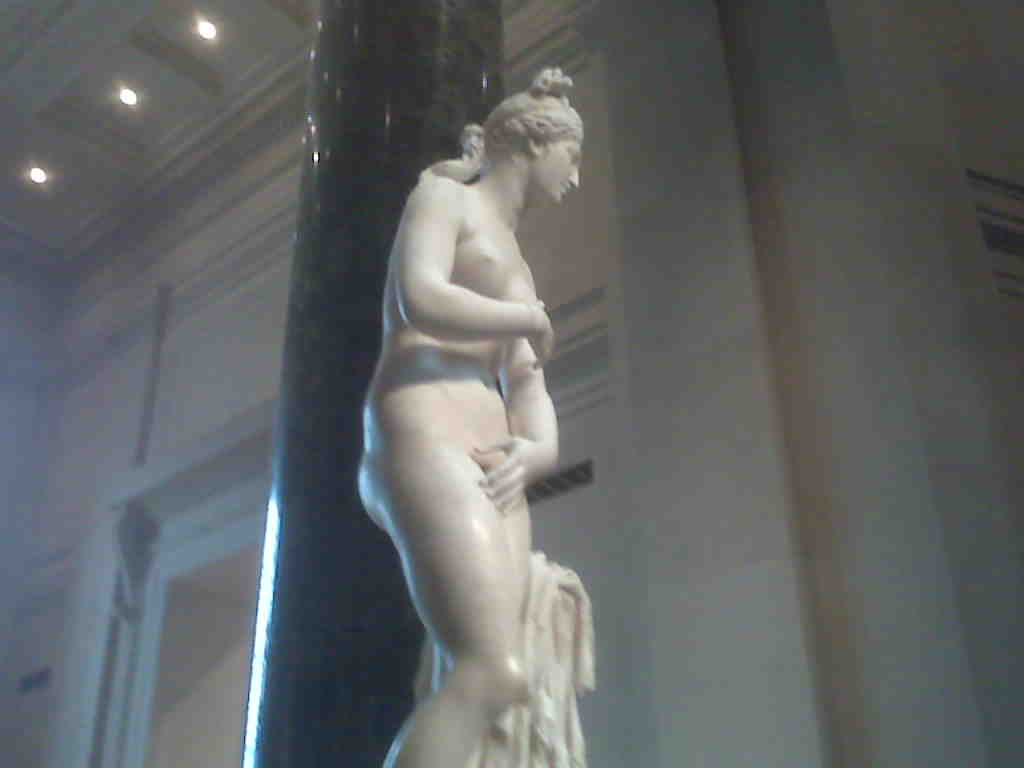
The Capitoline Venus arrived in DC last week from Rome–the first time this circa 200 CE sculpture has been out of Rome in nearly 200 years. What makes it especially beautiful is the apparent softness of flesh of the cool, carved marble, the seeming etherealness of the ancient solid stone.
Looking at the Venus made me think about how carving in stone can help us understand the concept of sruti. The hindu scriptures generally are classified as either sruti (revealed) or smriti (remembered) and until recent centuries were passed on through oral tradition. Those scriptures that are sruti are said to have been revealed by a divine source to the original listener. They were already there as part of the wholeness of the universe and then manifested to a particular enlightened being in a way that could be witnessed and passed on. The essence of the text was always already present, but not tangible, until it was revealed in the mind of a listener, who then passed it on.
Carving in marble takes both the emergence of idea and form in the mind/imagination of the artist and the revealing of that idea from the original stone by the craft of the artist. The sculptor has studied and practiced art and is always open to the emerging into consciousness of a particular image or idea, just as the great yogis continuously meditated and studied, open to what might be revealed.
As the sculptor may find the block of marble first or have the idea and then go looking for the right stone to express the idea, the yogi pulses between experiencing spirit and enhancing the experience through practice. It is not just an act of imagination that builds and creates something out of nothing. To some extent, the form of the final sculpture is already there in the stone. The work of the artist is to remove that part of the stone that is obscuring the witnessing and expression of the exquisite shape revealed from within by the educated and painstaking act of making art.
Peace and light, E — Posted with WordPress for BlackBerry.
World Wide Knit in Public Day is this weekend — June 13th (and 14, 20, and 21). What will you be knitting? I have started a pair of leg-warmers. The pattern was really for ankle warmers, but I have chosen to make them longer than the pattern suggested. The nice farmers who raise the sheep, spin and dye the yarn, and sell it at the Dupont Fresh Farm Market, called them “yoga socks.” The yarn is beautiful. The sample pair looked like something I would want on my feet in colder weather. The project was small enough to tuck into my carry bag. Definitely a go for summer knitting (unlike the three-quarter finished mohair shruggy that has become a lapful of furry stuff).
“Why are they so short?” I asked. “We had originally designed them to be longer, but our teacher said we might need to grab our ankles?” they explained. “When would you do that, when it would not matter whether you were touching fabric instead of your skin,” I puzzled out loud, not out of criticism, but really wanting to know, thinking maybe in Pilates. The farmers could not really think of a reason. I bought an extra skein along with the kit to make the — oh, let’s call them footless socks — calf height. The yarn has a bit of a stickiness to it, so they are not slippery. They will be good to wear for yoga.
I’ve never knitted on double-pointed, size 2 needles, in the round before, though I happened to have four in the house (picked up at a yard sale for a $1 a decade or two ago and put in the sewing box). I tend not to knit from patterns for whole projects. So I had a little learning to do. The pattern did not explain how to use the double-pointed needles; that knowledge was assumed. I am not used to the contraints of following a pattern. Doing so, on occasion, though, forces me to learn a new technique. It took my a couple of hours to get into the rhythm, but now I’ve eased into the project.
I sometimes seek the same type expansion with cooking. Though easily able to cook something delicious without a recipe with most ingredients, sometimes I pick out a complicated recipe just to expand my skills in the kitchen.
Yoga, most of all, benefits from a combination of free exploration and attentive development to the knowledge imparted by a teacher. We are most full and expanded when we combine experience and teachings. We receive the teachings and then we practice again and again to make it not just our own experience, but part of our being. This process is called vikalpa samskara.