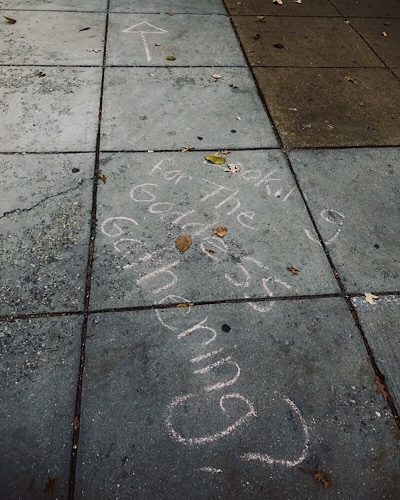
Found Objects Around Town

I confess that I needed to turn over to find the answer. I do not feel any call to learn the Bible for my salvation, but given the influence of religions that claim to be informed/derived from this text in this democratic form of government, it seems to be something I need to know better to be an educated citizen.

Peace and light, E — Posted with WordPress for BlackBerry.

Similar Posts

  • | | |

    What My New Smart Phone Is Teaching Me About Yoga

    I spent nearly three hours talking with tech support just to get the phone authorized.  And once that was accomplished, the guy helping me also was unable to figure out how to transfer my contacts from the old phone to the new.  Last night, on the second full day, I opened every item in settings just to learn about this piece of technology and found another way to transfer contacts than tech support had tried.  Hooray!  I didn’t have to enter them manually one by one.

    So it’s like this:  no matter how brilliant a system, if I didnt learn how to use it, I wasn’t going to get any benefits.  The more I studied and practiced, the more I would be able to use it in a way that enhanced my daily life.  Although a teacher is necessary, it takes our own thorough, steady, and attentive practice to empower ourselves and expand our limits.

    I had thoroughly resigned myself to typing.  Now I will have more time to figure out how to resize photos.  That may feel less urgent.  It’s busy at work, and the garden, yoga mat, meditation cushion, library, and beautiful weather call me to them.

    image

  • | |

    Kvelling and Kvetching

    It started before yesterday’s Tuesday night class.  There was a piece of fuzz next to one of the students mats–a schmutz.  We then decided that the yoga outfit, especially the old raggedy one, was a schmata. Tonight, I was in an uncharacteristically silly mood.  With birds falling out of the sky, fish washing up on the shore, and the Republicans taking back “control” of the house, I could weep or I could find the laughter in small things.  Tonight, with a practice theme of the Anusara’s “first principle” — opening to grace — I spontaneously and giddily came to the latter.

    I mentioned the idea of yiddish for yogis, and the class took off.  We were all women tonight, so it was “yoga for yentas.”  The word one utters when going into the first forward bend of the practice, is of course, oy, which can be lengthened to oy vey is mir. When we are truly opening to grace, we are kvelling; when we are noticing our aches and pains and forgetting to move towards the good, we are then kvetching.

    Just FYI, I learned after doing a cautious internet search before posting this blog entry, that it turns out that the phrase “Yiddish Yoga” has been trademarked.  I am pretty certain we can still have fun talking about using yiddish vocabulary words in yoga class without violating any laws, though it has been over 20 years since I took class in copyright and trademark law.  So feel free to think of your favorite yiddish word and how it should be used in yoga class.  You never know how it will enhance your practice, for whom it will bring a smile or a laugh, and what other thoughts might arise.  I’m pretty sure that there isn’t a yiddish equivalent for satcitananda, any more than there is an English equivalent for weltanschauung or schadenfreude, or a French word for sandwich, but at least one student wants to give it a try.

  • | |

    Statuary Around Town (and Zoomorphic Varaha?)

    I think it highly unlikely that the neighbor who chose to decorate a front yard with a silver-painted pig and wood chips intended in any way to reference Vishnu in his incarnation as a boar. But as I’m caught up in learning about the animal chariots and incarnations of the 330 million these days, that is what came to mind for me.  

    There’s a story that Vishnu incarnated as a boar to kill a demon who could not be killed by man or god (similar to the story about Durga slaying Mahisha, the buffalo demon).

    When in anthropomorphic form, Varaha is often seen with Bhudevi (Earth goddess) and sometimes also Lakshmi. There she is again–Lakshmi–calling to me to remind me to act from my abundance (from there comes my capacity to slay demons).

  • | | | | |

    “I See It Every Morning” (and Jnanam Bandaha) (DWTD)

    When I walked out of the back of the hotel through the pool area just after day break, one of the pool side assistants was out getting things ready for the guests. “Windy,” he said, as I was wrapping and knotting my meditation shawl around my neck into the face of a strong breeze coming from offshore. “But look,” I replied, pointing to the sun rising over the ocean, “it’s so beautiful!”

    “I see it every morning,” he answered, partly with a shrug of weariness and partly with a grin of delight. I guessed he was in his mid 50s–hard for me to tell, his skin was so leathery from the sun. Probably an old stoner surfer was my thought, and the shrug of resignation was for the fact that taking care of the lounge chairs and umbrellas for endless legions of tourists was what he needed to do to eat and still be with his dearest love–the sea and the sun. The smile was for the sun and the sea itself and to be able to share their beauty once again with someone who is seeing them with fresh delight.

    During the course this week of study, we spent time discussing the Shiva Sutras. The second sutra–jnanam bandahah–literally means “knowledge is bondage.”

    “Why do we automatically assume bondage is a negative?” John asked us at one point. Any time we make a choice, we are to some extent binding ourselves because we are, by making a choice and being limited by space and time as we are in this human form, forgoing other possibilities.

    The Sutras also say that knowledge is freedom. Though the sanskrit words are different for the knowledge that binds (limited knowledge) and knowledge that leads us to freedom (highest knowledge or knowledge of the divine), using logic equations, one could say that if knowledge is bondage and knowledge is freedom, then at some level, bondage, too, is freedom.

    If the pool side attendant regards himself as being utterly beaten down by his job, feels stuck with drudgery because he had nothing else he could do to survive, and then forgets about the beauty surrounding him, that would be an example of knowledge constricting or limiting us, putting us into bondage that takes us away from spirit.

    If, on the other hand, he looks at the ocean each morning with joy in his heart and recognizes that he chose his job to be able to be with the ocean and sun every day, that would be knowing that bondage can actually free us (in our limited form) to dwell in and from the heart.

    What the tantric yoga and meditation practices that come out of such teachings as the Shiva Sutras are designed to do, is to help us find the freedom in our limitations, to make choices in our associations and actions — our bindings — that lead us to love and wonder rather than disappointment and fear.

    What do you choose?

  • |

    Ready for EST (and another aspect of refinement)

    About a week ago, maybe even a little earlier in the month, daylight savings time started feeling artificial.  My body started insisting on sleeping nearly an hour later, and I found that I wasn’t really using the hour of light at the end of the day.  It was time to go inside and cook or read or otherwise move inward.  When we change the clocks this weekend, I will already have shifted, and the clock will feel as natural as living by a clock can feel.  Part of the refinement of a deeper yoga practice is learning to pay attention to such subtleties, to learn what is most optimal and when, both time of day and time of year.  This applies to asana practice (i.e., when to emphasize forward bending v. backbending),what we eat and how much, and what kind of activities we choose.

Leave a Reply

Your email address will not be published. Required fields are marked *

This site uses Akismet to reduce spam. Learn how your comment data is processed.