| |

Because It Was a Beautiful Night

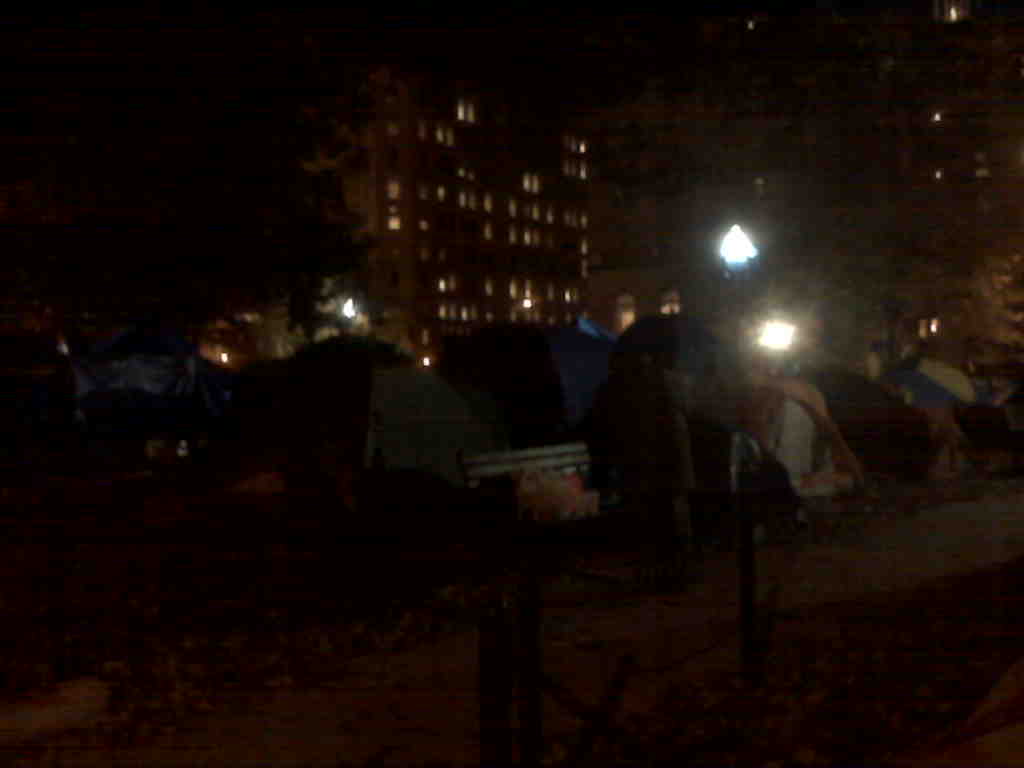
It was a beautiful night, so I went for a longish walk after work. I found myself drawn to the two “Occupy DC” locations — Freedom Plaza and McPherson Square (shown). If it had been cold and cloudy, as it will be later in the week, would I have chosen to be out instead of in my nice house with the cats and a home-cooked meal and a good book? Most likely I would pick home, but still I go out of my way to witness every week or so and to remember that these are real people and this isn’t a one-night stand on only a nice night. I go to witness people who are living the courage of their convictions, to be inspired to serve in my own way, and to ask myself what more I should be doing. I know people questioning the way and the whether and the why of this movement, including those who are sympathetic, but questioning is a form of engaging and is a stage in expansion.
Peace and light, E — Posted with WordPress for BlackBerry.
Similar Posts

  • | |

    Yoga of Eating Part I (what it is and what it isn’t)

    Yesterday, a former student of mine stopped me in the hallway at Willow Street and asked whether the “Yoga of Eating” workshop I will be leading on June 13th  will cover Ayurveda.  “I will mention it,” I said, “but I will not be teaching it.”  I didn’t have time to explain further because I was about to lead class.  As far as I got was to add that I was not sufficiently trained to teach it.

    Ayurveda is a wonderful science, and I honor and respect my yoga friends and colleagues who study, practice, and teach Ayurvedic principles.  Ayurveda is a much broader discipline than yoga, though, and is really medical practice rather than yoga.  Asana are among the practices that might be recommended by an Ayurvedic practitioner for a client or patient, but eating in accordance with the Ayurvedic principles is not the same as bringing yoga to how we eat.  For me, many of the principles of Ayurveda I have read or been taught are useful, but it has not resonated for me as a governing system, just as I do not believe in applying all of the principles of Western medicine to how I heal and nourish my body.

    Bringing yoga to my eating, like bringing yoga to all of my life off the mat,  is both simpler and harder than being taught a science such as Ayurveda with fairly clear, but quite complex, do’s and don’ts and then following them.  For me, practicing the yoga of eating, is practicing conscious eating.  It is practicing reverance and moderation.  It is balancing nourishment and pleasure.  It is knowing deeply when the will to eat is serving us or getting in our way.  It is both simple and subtle.  It is easy to say, but deeply challenging and sometime complicated to practice — just like practicing the Anusara yoga principles of alignment.

  • | | |

    My Own Personal Cloud (and the Malas)

    Last night another storm front passed us by with only a trace of rain, leaving us deeper in drought.  The wind picked up, the temperature dropped, and the clouds scattered, leaving the sky scrubbed bright blue and the air fresh.  Though this morning on my walk to work there was hardly a cloud in the sky, a rather menacing gray cloud hovered directly over the building where I work.  Observing this odd cloud led me to ponder about how I often feel that I have my own personal cloud–everyone else has purpose in their lives and is worthy of love, but not me (this is a bit of an exaggeration, but you get the idea).

    The reality is that all of us get such feelings to a greater or lesser degree some of the time.  It can be a helpful step in clearing away feelings of unworthiness to remember that it is part of the human condition.  The tantric yogis say that there are three cloaks or malas (anava mala, mayiya mala, and karma mala) that result from the manifestation of diversity from the pure universal out of its own play.  The sense of unworthiness we sometimes feel (anava mala) comes from forgetting that we are spirit, and anava mala– in whatever form it appears to manifest–is just because of the loneliness of not remembering our true self.  When we experience or create conflict or unhappiness out of the illusion (maya) that separateness and distinction are the only state of all that is real then we are in thrall to mayiya mala.  When we think we are completely in charge and responsible for everything we do and how it impacts the world, that is karma mala at work.

    We practice to pierce through the clouding of our individual consciousness by the malas.  By inviting ourselves to open to the luminous space of consciousness and to surrender to the very fullness of our being, we reduce the impact of the malas on how we conduct our lives.  Our practice helps us to remember our worthiness so that we can be happier and freer and do our work and engage in our relationships with more love and light.  It helps us remember the light in each being so we are naturally drawn to respond with more compassion and friendliness to everything on the planet.  The grace of dissolving  kriya mala is that when it is not obscuring our vision, we can engage fully on our path, but still accept that we are ultimately not in charge and do not know what the universe truly has in store.

Leave a Reply

Your email address will not be published. Required fields are marked *

This site uses Akismet to reduce spam. Learn how your comment data is processed.