For Everyone

Peace and light, E — Posted with WordPress for BlackBerry.
Peace and light, E — Posted with WordPress for BlackBerry.
I went to a Lenten service for ceasefire that was led in front of the White House today. First there was a Catholic Mass and then an ecumenical service.
I sometimes participate in religious rituals outside of my own, as a way of honoring our shared and diverse experience of being.
This is the first time I have gone to a Christian service on Ash Wednesday. No ashes for me. I was willing to, however, to participate in the invitation to participate in a call and response. The speaker listed the heinous atrocities that our tax dollars are funding, and the response was the acknowledgment that “I have blood on my hands.”
I’m still complicit even if I am letting those with power know that I do not agree, although that is better than being silent. One of the religious speakers suggested that repentance does not mean regret. It means acknowledgement and a change of behavior.

It was a day of meetings and conversations and emails. I’m in the middle of a major project, and it feels demanding. I’m being careful to take good care of myself.
On the walk home, just as the last glimmers of daylight were fading, I could feel the temperature dropping. Any last warmth was being blown away by the wind. I was bundled up and had my computer with me with the intention of working from home. The sky was like a black opal–dark blue-grays with fiery orange streaks. The walk (chanting the Maha mrityunjaya mantra for some of the way) shifted me out of work mode.
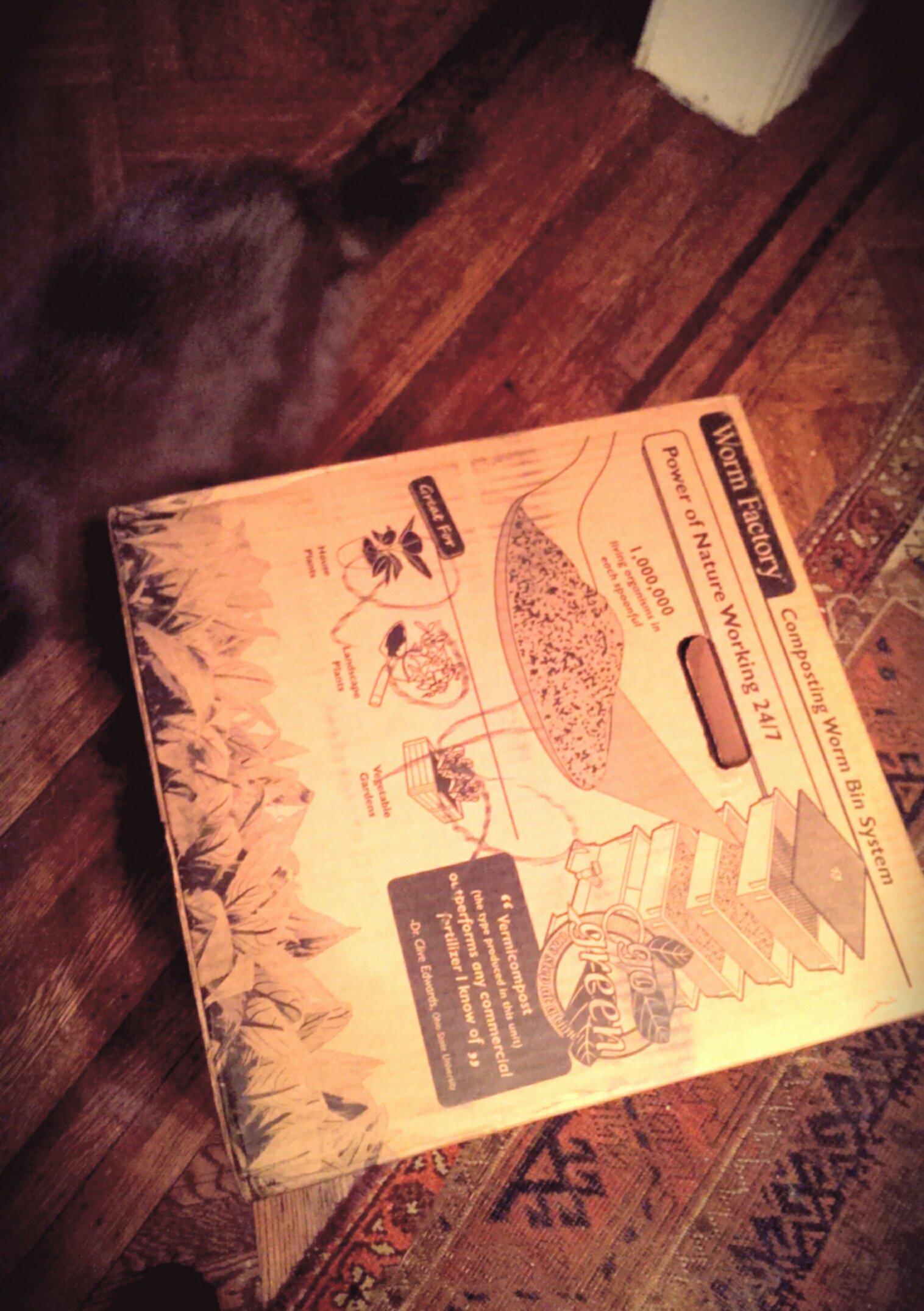
I came home to my newest gardening venture. The worms will arrive separately; they will be held for me at the post office to keep them out of the cold.
Experienced vermicomposters, please feel freee to post your favorite tips for happy, healthy, hungry worms.
A few months ago, I succumbed to the brilliant marketing at one of those yoga studio boutiques filled with enticing outfits that make one feel like part of the in crowd and bought a pair of leggings covered in an allover peacock feather print that made me think of Murugan whose temple we visited on the trip to South India and whose steed is a peacock.
One of the stories about Murugan, who is Ganesha’s brother (Ganesha being the beloved elephant god and remover of obstacles), talks about a competition between Murugan and Ganesha for divine knowledge. (Let’s leave aside for now the question of why a divine being would need to enter a competition to gain divine knowledge as too big a question for a blogger who has no academic or priestly expertise in the Hindu pantheon). In the story, as I have heard it (and as described in the Wiki article that I have shamelessly linked to above, despite all the disdain one might appropriately have for one who cites to a Wiki article), Murugan loses because what he does is try to show off his prosaic prowess by tearing around the world three times. Ganesha wins by quietly circumambulating with quiet worship Shiva and Parvati, the god and goddess, the essence of being, the pulsation of opposites.
When we were out walking in the woods the other day, my friend ER took an incredibly insightful picture of me trying too hard to look like the yoginis who grace the magazine covers and can do the most magnificent asana. The brilliance of the photo is its revelation of the empty ridiculousness of my posing like the beauty I am not, and of pointedly demonstrating how neither wearing wild peacock pants, nor being able to do a tolerably deep backbend reveals anything to the self about spirit. But perhaps it also shows, in its candid and ironic look at an all too human yogini, that like Lord Murugan, who despite of or perhaps because of his absolutely flawed nature is actively and devotedly worshipped, I in my laughable striving may still have in my human being something of the divine. I can only hope.

I have spent most of the last three days working from home so that I could be on site while repairs ensuing from the earthquake and hurricane were done. I’ve been luckier than most in the path. The damages I sustained from these extreme forces of nature can all can be repaired with relative ease. The leak in the living room was from gaps between the house and the windowsill and the porch roof and the house. The leaks in the upstairs bathroom were from screws attaching the skylight to the roof having been shaken loose. The 100-year old gutter pulled away from the house and sprang some leaks, but can get wait another year or so with just being patched instead of replaced. The cracks in the brick and the mortar dislodged and completely washed away call for repointing before winter, but that was going to have to be done in the next five or six years anyway. Several more things got loosened or lifted up or away from where they were supposed to be, but that is why god made caulk guns and foam sealant in spray cans.
What I find interesting about looking at the damage is that the worst of it was at places that previously required repairs during my 21+ years in the house; some of these, based on the way the ceilings had already bulged or cracked when I moved in were evidently chronic trouble spots perhaps since the house was built. Why those places? It could be the soil on which the house sits, the direction it faces, the activities of neighbors, the presence and absence of trees around the house, the minor, but daily tremor caused by the D6 bus. If something was going to come apart at the seams in the house, it is not surprising it came apart where it is inclined to come apart and even less surprising that Hurricane Irene created more damage because the house was already fraying at the seams because of the earthquake (and the continuing aftershocks). The places that came apart under stress were the places where the old repairs did not reintegrate fully into the integrity of the design and function of the house. Those are still are the vulnerable spots, the places most likely to come apart in a blizzard or a hurricane or an earthquake. The better and more thoughtfully integrated into the rest of the structure of the house a repair, though, the more likely it is to cease to be a spot for future repairs. Some old repairs that were done mindfully have ceased even to be remembered as places where a repair was required.
The same sort of pulling apart at the edges, at the weak spots, at the less than optimal repairs of old injuries, as happened with the house in the past few weeks, happens to me when challenges and opportunities for personal growth pile on, as they have been doing for me for the past several weeks, starting with things wholly unrelated to the weather. Although I am taking things in stride and with ever more flexibility and openness the more I practice, I can feel my familiar default setting–anxiety and sadness–emerging at the stress points. None of the personal things that had come up before the earthquake and hurricane, nor the impact of both and the preparation for the latter, alone would have been enough to shake me up much. As they become a basketful, though, I can feel my old tendencies closer to the surface with each thing that gets added into the experience.
Just like the places where the house tends to come apart, my tendency to get anxious and the triggers for the anxiety are familiar spots. They have been there for decades. Perhaps they came from another life. For the house, the original spots may have started with the materials–the character of the trees and stones and mud and ore out of which the house was built. Some of my stress points I recognize in my parents and my grandparents whether or not they come from previous lives of my own, some are related to my physical make-up, some from the exact place and time of my birth.
These tendencies of ours are samskaras — the ingrained patterns that are the results from our actions, impressions — some deeper than others — in the very fabric of our being that shape how we behave and respond to what comes, thus creating more samskaras. The more we respond in our habitual way, the more imbedded become the samskaras and the more they keep us from being conscious of and aligned with the fullness of being. One of the key benefits of practicing (meditation and other practices) is to lessen how impressionable we are, that is, to make it so that new stresses do not deepen old patterns or create additional patterns that take us out of alignment with the flow of being.
As I feel old stuff getting churned up, I seek to dissolve and benignly release it through my practices, while steadily, and as mindfully as I can, doing what needs to be done to get on with this fully-engaged householder life at this wild time. It is one of my intentions to practice sufficiently so that I will be able to be in the flow and respond in the highest no matter what comes. There will likely be more and greater challenges than what I have already in this lifetime experienced.