Dance of the Pairs of Opposites?

Peace and light, E — Posted with WordPress for BlackBerry.
Peace and light, E — Posted with WordPress for BlackBerry.
Peace and light, E — Posted with WordPress for BlackBerry.
Whatever might
have happened
or didn’t happen,
whomever I might
have encountered
or didn’t encounter,
whatever might
have worked
or did not work,
whatever I might
have completed
or left unfinished,
whatever I might
have stirred up
or might have
begun to heal,
whatever might
have been, or was–
still there were
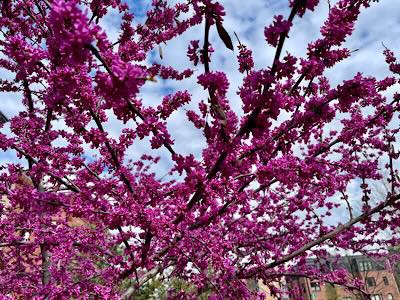
the blossoms,
still the moon.

Peace and light, E — Posted with WordPress for BlackBerry.
Thinking about privilege, including the privilege to choose whether to take time away from the conflict and not think about it. I’m trying to be conscious of that particular privilege whenever I find myself instinctively trying to turn away and then to gather myself from the recognition of my good fortune and reengage.
The key concept of yoga–satcitananda can be elusive, like all abstract concepts in the yoga philosophy and in other philosophies or areas of study. We are given metaphors and analogies in the texts to help us recognize when, through our practice, we experience in our self the manifestation of what had just been theory (book knowledge).
It is hard to describe, for example, what it truly means to be fully present and aware in the moment and thus suffused with bliss
(satcitananda).
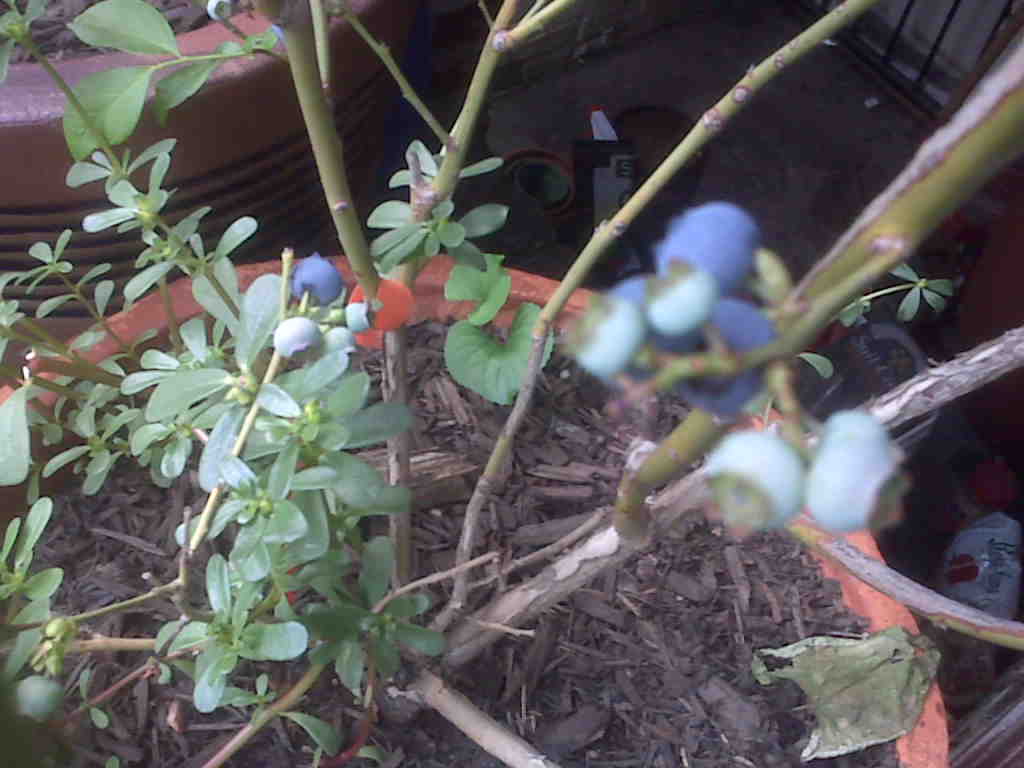
There was a moment, standing in the hot sun, when I tasted a sun-warmed, perfectly ripe blueberry that I thought, this is a moment many of my students might imagine to be able to extrapolate the abstract concept of satcitananda.
Notice also the volunteer purslane at the base of the blueberry bush. Weeding and harvesting greens for salad and stir fry can be coextensive. Don’t poison or discard your purslane (or your dandelions). Pick it and eat it; purslane is a great plant source of omega fatty acids.
Peace and light, E — Posted with WordPress for BlackBerry.
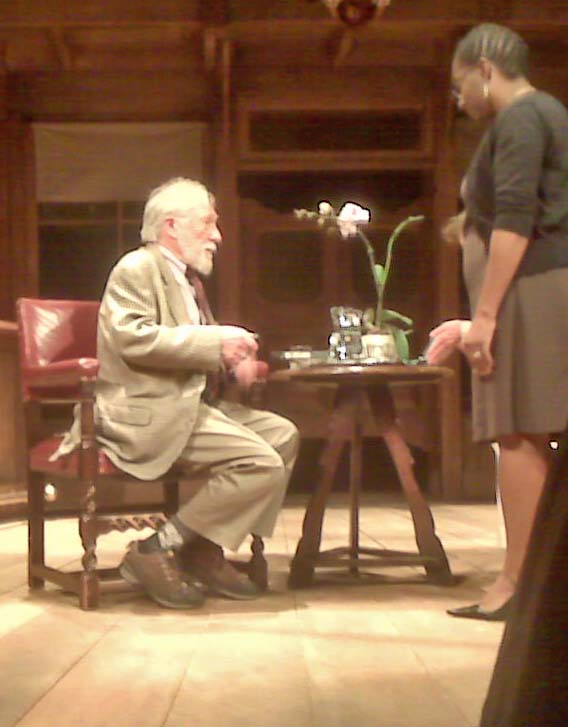
Last night I had the singular pleasure of hearing Gary Snyder read his poetry at the Folger Shakespeare Library. At the end of the reading, Mr. Snyder answered a few questions. In response to one question about advice he gives to aspiring poets, he said: “Don’t be journalists. Do hard physical labor that leaves y0ur mind open.” This is not surprising advice, coming from one who has chosen a life requiring regular manual labor. “Meditate only for its own sake,” he added, in an apparent non sequitur and without elaboration.
Gary Snyder’s poetry is evidently influenced by his dedicated study and practice of Buddhism. The insight and clarity of his poetry surely reflects not only his intellectual study, but the deep wisdom of a dedicated, long-standing, and steady meditation practice. The advice to “meditate for its own sake” seemed almost the offering of a koan by the master (poet) to his pupils. Meditation, in my experience, definitely enhances clarity, insight, creativity, and health. Meditation is not meditation, though, unless when engaging in meditation that is all one is doing and without any goal (like the “actionless action” of the Bhagavad Gita). It is the deepest of practices to engage fully, but not be doing except for the sake of doing itself (and in alignment with the deepest truths).