| | |

What’s For Breakfast?

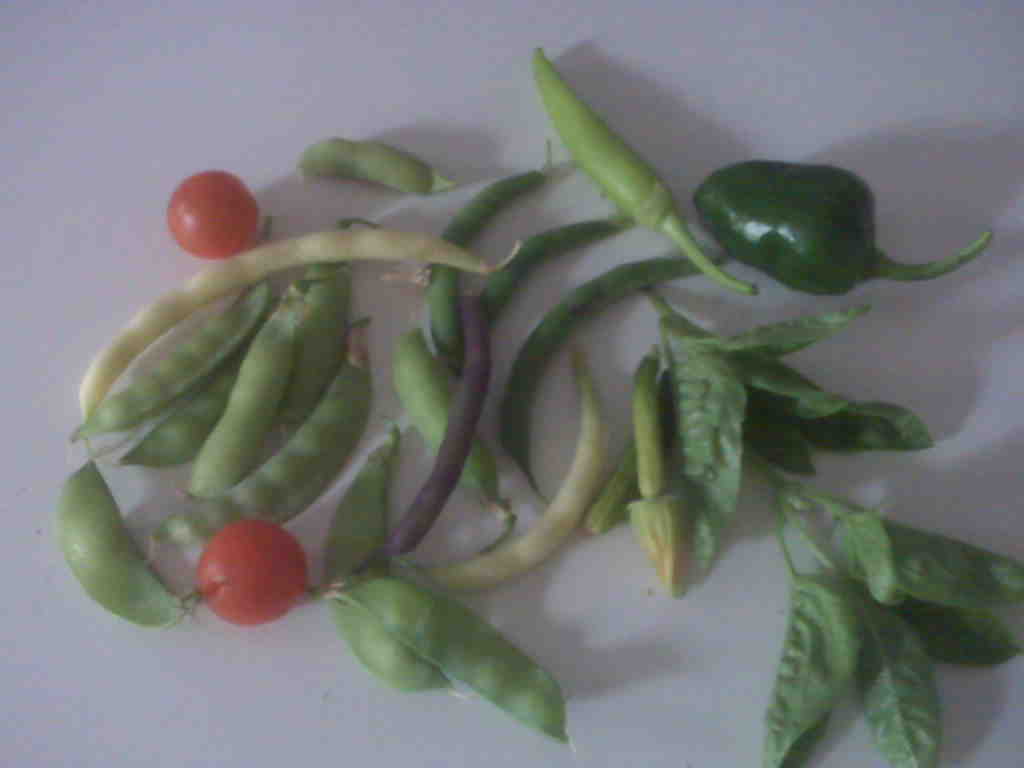
Snowpeas, tri-color beans. Peppers. Cherry tomatoes, basil (blueberries and strawberries did not make it out of the garden).

A student asked me the other day why I garden–was it to save money, he asked, was it for better tasting food?

It does save money to grow food and food eaten straight out of the garden is a foodie’s exquisite pleasure, but those are not my primary motivations.

I garden for the delight it brings through all of my senses and for the joy of knowing that the garden never questions nurturing. The more I give the garden, the more it gives back, without question or judgment.

I garden for the sense of relationship with the deeper seasonal patterns. To experience at an intimate level the impact on health and thriving of variations in seasons, light, heat, and rain.

With the drought and extreme heat in our area, the garden is struggling. Peppers are fruiting before having gotten tall and full. Cucumbers are yellowing and drying, though a couple have grown large enough to eat. There is a surfeit of kale, but the snow peas, which prefer cool weather, barely had time enough to grow enough to flower before it was too hot to thrive.

Part of the reasons some recipes have many ingredients is because they are premised on there not being enough of any one thing to make a meal. I am getting a few servings of vegetables every day, but the blasting heat is preventing the kind of abundance for some things I might have in another year. The grapes, though, may be outrageous; they like this crazy heat.

I want to be conscious of these challenges and serendipities. I want to know how I might need to change and adjust to thrive in a world that is ever more out of balance. I garden because it helps me be aware of crisis and challenge, but always and first providing extraordinary pleasure and beauty.
Peace and light, E — Posted with WordPress for BlackBerry.


Similar Posts

  • | | | | |

    Atha Yoganusasanam (and “Opening to Grace”)

    Earlier this week I was talking to a long-time friend of the family (my father has known him and his wife for over 60 years; they have known me since I was riding around in the womb).  My parents had sent me an email while I was on the meditation intensive with Paul Muller-Ortega last month, to tell me that our friend was in intensive care recovering from an operation.  I waited until I knew he was home to call because it can be so tricky to get the right time at the hospital.  When we spoke, I told him that my father had said that his intrepid cheerfulness was a complete inspiration.  “What choice do I have,” he asked, “what can you do when you wake up in intensive care on your 82nd birthday, but look for the gift it will have to bring?”

    In the past several weeks, a number of other friends and family members have been seriously ill or lost loved ones or home or work or more than one of these.  The outrageous suffering from a seemingly relentless series of natural disasters and war and the financial crisis is a staple in the news.  In trying to stay present for my friends and community, while still taking care of my own needs and emotions, I found myself led to practice bhavana on (deeply contemplate)  the first sutra in Patanjali’s Yoga Sutrasatha yoganusasanam–now begins the practice of yoga and how it relates to the Anusara first principle of “opening to grace.

    Teachers and commenters say of the Yoga Sutras that it was not meant for beginners, but was meant for students who have already established a practice and reached a level of initiation (diksha) that  established they were ready to be given the teachings.  I have also often heard said that one is drawn to the practices because of other experiences in this or a previous life; in some sense, the first time we show up, we are not a beginner and are ready for the teachings.  Whatever knowledge and skill we bring to our studies and practice on any  given day, they start new.  They are starting “now.”

    Now begins the practice of yoga (yug)–of uniting ourselves with each other and with spirit and linking our mind and body one-pointedly to the fullness of the teachings.  The teachings are methods for knowing and experiencing this perfect union.  In that regard, I think that an essential element of the teaching conveyed by  the Anusara first principle of “opening to grace,” is this now, this beginning anew both to know what already is in our hearts and to learn how the practices can make it ever more accessible, whether we are beginners to what we understand to be yoga or meditation or have been practicing seriously for years.  We want this “now” in every moment.  As we get more skilled, and part of developing our skills is challenging ourselves deeply in the controlled environment of class and our own practice so that we will spontaneously open to grace in the moment when, as my friend said, there is no viable choice but to be cheerful (to “open to grace”).

    The “now” of Patanjali, the practice of “opening to grace” in Anusara yoga, is a way to teach those of us (like me) who do not otherwise learn or intuit from living itself that there is no viable choice other than cheerfulness in the face of the most difficult of challenges. The  “now”  conveys that it is now time to go deep, time to expand understanding and practice, time to discover truly how the practices can connect us to spirit and alleviate suffering.  Now is the time to be and to  learn better how to stay grounded in and connected to the flow of energies, not just so that you can face what you yourself might be experiencing, but also to have ever more space for love, compassion, support, and service for others who are in need.  Now is the time to open to grace.

    Photo from exhibit in San Francisco on the 10,000 year clock project.

  • | | |

    Chanting (and the People’s Filibuster)

    After work and before going to an evening asana class, I joined in at the People’s Filibuster on the looming tax bill. Speaking were a mixture of dedicated elected officials and people of the cloth. Several of the latter were arrested today for reading the Bible out loud inside the Capitol–perhaps because instead of reading the passages that support ill treatment of women and those who don’t follow a traditional heterosexual mold, they were reading the passages about how Christ advocated treating the poor and the sick.

    The crowd chanted “kill the bill” and “not one penny,” but it had the resonance of gospel or kirtan.

    Have you called your elected officials (or sent a postcard)? Do you have friends or family you can get out to vote? How are you going to use your voice to further spirit?

Leave a Reply

Your email address will not be published. Required fields are marked *

This site uses Akismet to reduce spam. Learn how your comment data is processed.