Solar Panel Install Progress Report
Permits all approved; grant application confirmed as complete by DC government; Master supplier application received by PEPCO; materials delivered to roof today; electricians scheduled to come tomorrow.
Permits all approved; grant application confirmed as complete by DC government; Master supplier application received by PEPCO; materials delivered to roof today; electricians scheduled to come tomorrow.
Contact your local representatives asking for or thanking them for a permanent ceasefire resolution.
Contact your federal representatives asking for or thanking them for working for a permanent ceasefire, tax dollars for humanitarian aid not bombs.
Learn, listen, talk about it.
Do what you can about one of the crises in our current world.
Enjoy a moment of beauty.
Say something sweet to someone today.

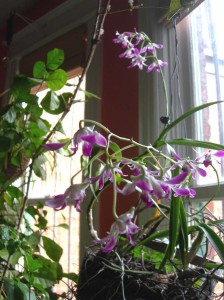 A number of years ago, when he was moving from Capitol Hill to Denver, my friend and former neighbor Robert gave me this dendrobium orchid, which bloomed this year for me for the first time. The dendrobium was just an extra. If you know orchids, you can see that it is planted with a vanda. These orchids came from Robert’s mother’s garden in Florida. When she had to give up her place in Florida, Robert brought home some of the orchids, including the vanda. If I know Robert, he just saw a baby dendrobium in the garden and stuck it in with the vanda when he carried it back north to Capitol Hill. When Robert moved to Colorado, he left the vanda with me because he did not expect it to tolerate the Colorado climate. Even here, the vanda is not likely to bloom. Not enough heat, light, or humidity in DC (really!!!). But after five or six years of steady care, the dendrobium flourished and finally bloomed. Robert inspired my affection for orchids; he had a greenhouse and knew each one of his tropical plants intimately. We would go to an orchid show or nursery, and he would look with love on each and every plant, cherishing their individual traits, no matter how small or large. At the botanical gardens, he had different plants he visited and enjoyed. Now his yard has cactii and peppers. He has a few of his most faithful orchids, which are flourishing and which were delightful to visit, and I have this lovely reminder of a time when Robert was one of my local gardening buddies. This, I think is one of the extra joys of gardening, especially with houseplants that come from cuttings. They have a history with our family and friends that is passed on, cherished, and shared. I also have a night-blooming cereus that was a baby from a plant that started as a baby of one in his mother’s garden. The night mine first bloomed (just a single night in the year), the parent plant with Robert in Denver also bloomed.
Bonus love from this particular dendrobium; it is scented!
For those of us living fully in our modern material world, as I am, it is important to think not so much about denying ourselves things or giving them up, but rather, seeing how we can make shifts to living more lightly. One of my heavy impacts on the environment is computer usage. Right now, I have on my work computer, my home laptop, and my Blackberry.
All of you who are reading this blog are doing so via computer or by a personal device with web access that requires battery charging. I’d hazard a guess that most of these portable computers are not being powered by sun and wind. I am still waiting for Pepco to come and change the meter to hook up my newly installed rooftop solar panels to the grid, and I don’t have a solar charger for the Blackberry.
One thing I thought I could do to help make enjoying this way of connecting have less impact on the environment would be to go carbon-neutral. In the world of plastic, the ideal is don’t use, reuse, repurpose, recycle. In the world of electricity, it is don’t use, use from better sources, off-set. With respect to my blog, I am choosing to use the necessary electricity, but go solar with my house, buy electricity from a source that uses offsets (Clean Currents) for that electricity that is in excess of what the solar panels will provide, and I’m choosing to offset this blog’s impact based on readership through the Carbon Fund.
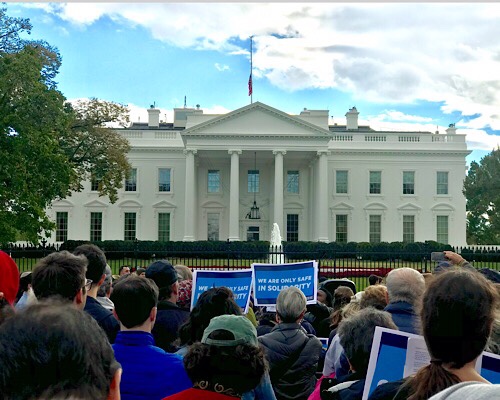
White House, October 28
This site uses Akismet to reduce spam. Learn how your comment data is processed.

Yay! Hope all goes well during installation.