Teacher Feature (Willow Street Spring Newsletter)
Please see the Spring 2010 Willow Street Newsletter to see more about what led me to teach. While you’re reading, check out all the fabulous yoga offerings.
Please see the Spring 2010 Willow Street Newsletter to see more about what led me to teach. While you’re reading, check out all the fabulous yoga offerings.
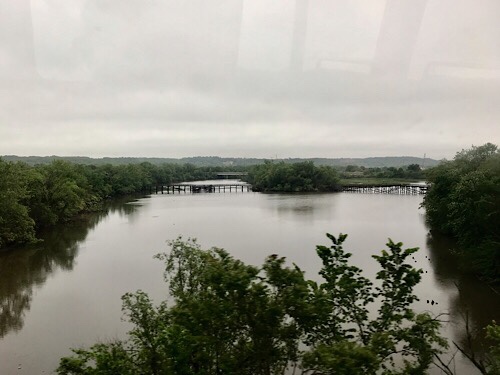
Looking in the opposite direction from yesterday.
I was at Eastern Market earlier today. As kimchee has been on my mind (given the recent and resounding success with homemade sauerkraut), I checked for napa cabbage and daikon radish. I didn’t see it, but decided to ask anyway (after all, if we don’t ask for what we want, it is far less likely that we will get it–whether it is ingredients for kimchee, or help from a yoga teacher, or needs met in relationship).
Yes, they had a gorgeous napa cabbage and a big, beautiful daikon radish. They sell their own fresh made kimchee (it’s delicious), so I thought they might have the other key ingredient I needed: powdered Korean hot pepper.
I said that I enjoyed their kimchee and that I guessed they made it the traditional way, with a rice flour slurry and anchovies.
Yes, indeed, they do it that way.
I said I was making a simpler version, but did want the right kind of pepper. Did they have some?
The woman serving me, said yes, went in the back, cut open an enormous bag of powdered pepper and, along with the vegetables, sold me a few ounces of the pepper. From this enterprise, I’ve already made a deeper connection to one of my local small businesses, and in a week or two, I’ll also have a big batch of kimchee.
ps. I used Michael Pollan’s recipe as a rough guide. What I like especially about the recipe is that it expects variation based on quality and age of produce and personal taste. The cook is invited to pay attention instead of just follow by rote.

As I have discussed with a few of you, I have been contemplating deeply and for a long time the questions of what is a guru and who is a guru. In the context of this contemplation, I read to enhance my background and understanding, deepen my contemplation, and give myself food for thought or additional exploration. Here are some books that I have in my library about gurus or those who have been labeled gurus (in no particular order). Some are written with loving devotion by disciples. Some question or comment on the interrelationship between the status of guru and the sometimes all too human foibles of the guru and his disciples. Some are of the guru’s own experience of practice and his relationship with his own guru.
Be Love Now, Ram Dass, HarperOne (New York, NY 2010)
Miracle of Love — Stories About Neem Karoli Baba, Ram Dass, E.P. Dutton (New York, NY 1979)
Autobiography of a Yogi, Paramahansa Yogananda, Self-Realization Fellowship (13th Ed., reprinted 2001)
The Golden Guru — The Strange Journey of Bhagwan Shree Rajneesh, James S. Gordon, The Stephen Green Press (Lexington, Mass. 1987)
My Guru and His Disciple, Christoper Isherwood, Penguin Books (New York, NY 1981)
Ramakrishna and His Disciples, Christopher Isherwood, Simon and Schuster (New York, NY 1970)
Great Swan — Meetings with Ramakrishna, Lex Hixon, Shambhala Dragon Editions (Boston, Mass. 1992)
Bhagawan Nityananda of Ganeshpuri, Swami Muktananda Paramahamsa, SYDA Foundation (South Fallsburg, NY 1996)
The Buddha from Brooklyn — A Tale of Spiritual Seduction, Martha Sherrill, Vintage Books (New York, NY 2001)
Yoga and the Quest for the True Self, Stephen Cope, Bantam (New York, NY 1999)
At the Eleventh Hour — The Biography of Swami Rama, Pandit Rajmani Tigunait, Himalayan Institute Press (Honesdale, Pa. 2001)
Play of Consciousness, Swami Muktananda Paramahansa, SYDA Foundation (Oakland Ca. 1974)
The Great Oom — the Improbable Birth of Yoga in America, Robert Love, Viking Press (New York, NY 2010)
ps Jess–Yes, the widget for Library Thing is coming for the website. I just need to add more books, so that it is a decent start at a representation of at least the yoga-related portion of my library.
The other day in group practice, someone said they wanted to work on a particular pose; another teacher had people working on staying present with pain.
I questioned whether they should trust someone who suggested that they intentionally put themselves in a painful position and then stay there to learn to be with pain.
I questioned whether creating and staying with pain was in any way healing.
I questioned what they meant by pain. I think it is useful to stay with discomfort, for example staying safely with a strong posture that requires muscular and attention effort to maintain.
But pain is an effective warning system. If the pain is sharp or abrupt or sudden or is in tendon or ligament, etc, there will be no benefit to overriding your body’s message to stop.
Better to build strength of attention and focus and body and then apply the practices when life supplies pain that you have no choice but to remain until it heals.
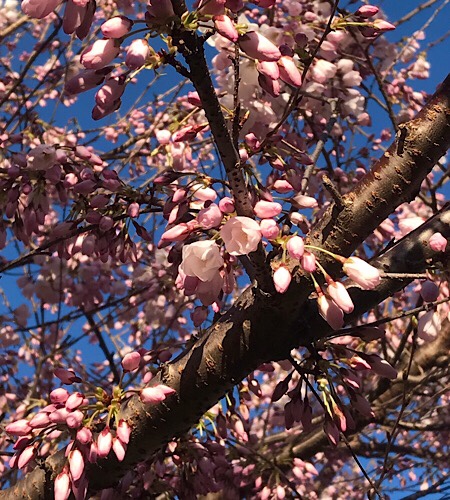
This morning it seemed that if instead of finishing my walk to work I remained still with soft gaze all day, I would be able to see the blossoms opening one by one.
One Comment