|

April News (web version of e-newsletter)

Dear Friends,

The end of March is all sunshine and flowers after a turbulent month.  I’m hoping for some April showers along with the sunshine, so that my garden greens will flourish.  The pulsation between rainy and sunny, cool and warm, is a great reminder of the essential vibration of being!

There will be lots of great yoga opportunities to pulse with the shiva-shakti vibration in the next several weeks:

As always, William Penn House Tuesday classes are on a drop in basis with special pricing to make yoga affordable for public interest workers, students, seniors, and those in between employment.  Invite your friends.  Special for April, bring a friend new to the class and when your friend comes back for a second class, you or your friend get a class for free.

There are two more Saturdays of the winter session at Willow Street.  Registration has already started for Willow Street’s Spring Session.  My Spring session classes start on Saturday May 1st — Level 2 @ 8:30; Gentle/Therapeutics @ noon.  We love it if you register for the whole session, but drop ins are always made welcome.  While you’re visiting the Willow Street web site, check out the article I’ve written for the Spring Newsletter’s “Teacher Feature.”

This Sunday, April 4th, from 3-4:30, come celebrate the uprising of flowering energy at a special $10 community class at Capitol Hill Yoga.  100% of the proceeds benefit City Blossoms.

April’s Serenity Saturday — on April 17th — is certain to be a great way to foster growth of mind, body, and spirit, whether we are getting April showers or summery sunshine.  Visit Capitol Hill Yoga to register.

Mark your calendars for May:  on Saturday May 8th, when I’ll be leading an all-levels workshop on standing balances — Stand Steady in Your Light — as Willow Street’s Takoma Park’s studio.

Finally, a great thanks to all who come to classes regularly and support the monthly giving.  Yoga for Gardeners attendees had a great time and enabled contributions of over $200 for the Youth Garden at the National Arboretum.  The March and April classes will also support the Youth Garden.

Wishing a great blossoming to all.  I look forward to seeing you soon.

Peace and light,

Elizabeth

Similar Posts

  • | | | | |

    “I See It Every Morning” (and Jnanam Bandaha) (DWTD)

    When I walked out of the back of the hotel through the pool area just after day break, one of the pool side assistants was out getting things ready for the guests. “Windy,” he said, as I was wrapping and knotting my meditation shawl around my neck into the face of a strong breeze coming from offshore. “But look,” I replied, pointing to the sun rising over the ocean, “it’s so beautiful!”

    “I see it every morning,” he answered, partly with a shrug of weariness and partly with a grin of delight. I guessed he was in his mid 50s–hard for me to tell, his skin was so leathery from the sun. Probably an old stoner surfer was my thought, and the shrug of resignation was for the fact that taking care of the lounge chairs and umbrellas for endless legions of tourists was what he needed to do to eat and still be with his dearest love–the sea and the sun. The smile was for the sun and the sea itself and to be able to share their beauty once again with someone who is seeing them with fresh delight.

    During the course this week of study, we spent time discussing the Shiva Sutras. The second sutra–jnanam bandahah–literally means “knowledge is bondage.”

    “Why do we automatically assume bondage is a negative?” John asked us at one point. Any time we make a choice, we are to some extent binding ourselves because we are, by making a choice and being limited by space and time as we are in this human form, forgoing other possibilities.

    The Sutras also say that knowledge is freedom. Though the sanskrit words are different for the knowledge that binds (limited knowledge) and knowledge that leads us to freedom (highest knowledge or knowledge of the divine), using logic equations, one could say that if knowledge is bondage and knowledge is freedom, then at some level, bondage, too, is freedom.

    If the pool side attendant regards himself as being utterly beaten down by his job, feels stuck with drudgery because he had nothing else he could do to survive, and then forgets about the beauty surrounding him, that would be an example of knowledge constricting or limiting us, putting us into bondage that takes us away from spirit.

    If, on the other hand, he looks at the ocean each morning with joy in his heart and recognizes that he chose his job to be able to be with the ocean and sun every day, that would be knowing that bondage can actually free us (in our limited form) to dwell in and from the heart.

    What the tantric yoga and meditation practices that come out of such teachings as the Shiva Sutras are designed to do, is to help us find the freedom in our limitations, to make choices in our associations and actions — our bindings — that lead us to love and wonder rather than disappointment and fear.

    What do you choose?

  • | | |

    White Silence is Violence

    Today I worked efficiently, gave additional money in support of racial justice, signed comment letters and petitions, meditated, walked, shared calls to action on social media, picked beans, cherry tomatoes, and herbs in the garden, and made soba noodles in spicy peanut broth with herbs and green beans.

  • | | | |

    A Meditation on Patience

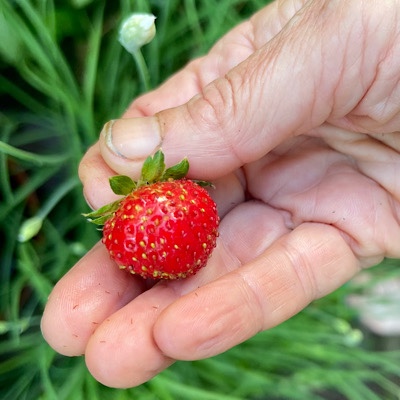
    When I decided to make strawberry towers part of the new sleeping porch garden extension, Niraj Ray of Cultivate the City told me to remove all of the flowers until mid-May to allow the plants to develop leaves large enough to support sizable and sweet berries. He also suggested feeding them every time I water.

    It has been a pleasure nurturing the plants and finally watching plump, juicy berries redden in the sun outside my study window.

    Might this delicious lesson in the benefits of being patient be a lesson applicable to how and when and why to re-emerge post vaccination, but before the end of the pandemic?

    Strawberry shown with old NYC subway token for scale
  • | |

    A Slow Metro Ride, A Missed Yoga Class, and Meditations on the Costs of War

    Yesterday I wrote to my DC elected officials and to the budget office to let them know how important it is to me that local municipalities fully fund public transportation, as the budget year comes to a close.  Metro officials are threatening to close down many bus lines entirely, which will mean that far too many people will be unable to get to work, especially for low-paying jobs.  Hundreds of workers are scheduled to  be laid off, which means (as an icy cold budgetary matter — the budget after all being a moral document) that they will need services and no longer will be paying taxes.  Disrepair, injuries, and accidents will become even more prevalent, and service will be slowed at already overtaxed and overcrowded times.  Our air quality will go from yellow/orange to orange/red from the increase in gridlocked traffic.  I discussed the issue and the urgency of making our voices heard with several co-workers today.

    I left the office at 5:40 pm this evening to go to take Suzie Hurley’s 6:15pm class at Willow Street, Takoma, Park.  I was standing on a metro train at 5:46pm.  The ride is supposed to take 13 minutes from Judiciary Square metro.  We reached Takoma Park at 6:27pm.  I went over to the studio when I arrived.  If the door was open, I would have looked in and caught Suzie’s eye and quietly seen whether I could slip in.  The door was closed, and I could hear that the class had already started doing standing poses.  Under circumstances where being late is clearly not my fault (and I try to avoid those by being willing to be early if it turns out the travel has been optimally sequenced), I will join the class just after centering and before the asanas begin.  As much as I would have liked to have taken a yoga class after the slow metro ride, I felt that I shouldn’t risk disturbing the other students by coming so late.  I instead will be doing a long, deep, slow, inward-moving practice when I am finished writing, corresponding, getting ready for practice and sleep, and doing some preparations for tomorrow’s work day.

    In my growing acceptance that I would be arriving too late to Takoma to take class, I thought about the email I had received earlier in the day about the Friends Committee on National Legislation’s “Our Nation’s Checkbook” campaign.  The email reminded me that a third of my tax dollars are being spent on war.  “What about investing in green jobs, preventing more home foreclosures, and funding diplomacy to prevent wars?” I was asked.  “What about public transportation,” I thought, as I sat on the stationary train between stations.  “How many trains could be operated efficiently and safely for each fighter aircraft?”

    How do I want to live?  What are my priorities?  When does short-sightedness or immediate personal satisfaction impact my long-term health and happiness and peaceful co-existence on a crowded planet?  For what purposes do I practice?  How would I like to invite others to live?

    The ride home, of course, had nary a problem.  A train arrived in under five minutes.  The ride back to Union Station was exactly 11 minutes.  Everyone had a seat, and the car was nearly full,  so it was at perfect capacity.  It was still light, and lots of people were out because of the balmy night and the beauteous blossoms, and I felt safe strolling home instead of taking the bus.  What a beautiful night!

Leave a Reply

Your email address will not be published. Required fields are marked *

This site uses Akismet to reduce spam. Learn how your comment data is processed.