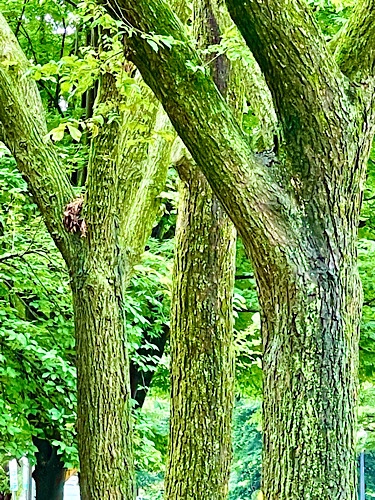
Calf Loop (and enhancing the integrity of the energy flow)

When I think of the Anusara principle of calf loop, I think of playing with drinking straws as a child.  I’d take the straw out of the glass and bend it back and forth.  The straw would end up with a horizontal crease where it was bent — not quite a break — but the place where it bulged at the bend would prevent the straw from serving the purpose of enabling liquid to be drawn up through it.  When our knees (or our elbows for that matter) are hyper-extended, I think it disrupts the energy flow from the periphery to the core, weakening the pose, and breaking the integrity of the alignment.

As one whose legs started out bowed (though less after over six solid years of working “shins in/thighs out”), my natural tendency is to hyper-extend.  I find that using calf loop, I do not hyper-extend.  Calf loop (also called “shin loop”) has us draw energy from the base of the shin, up the back of the lower leg, and loop it through the top of the shin and then back down the front of the leg.  We wouldn’t ever start a pose thinking about calf loop, but in the flow of a pose, after the major principles are activated, including muscular energy, we can enhance muscular energy and the integrity of the alignment of the knees by focusing on calf loop.  When I practice calf loop, I find that it lifts the calf muscle and draws it more firmly into the top of the shin, and moves the top of the shin forward.  These actions do not bend the knee, but firm the muscles behind the lower leg, including the calf and the popliteus (which is the muscle behind the knee that flexes the knee) to the bone.

What is tricky — especially for those who tend to hyper-extend, is that getting the knee in proper alignment feels like bending the knee.  If we have been out of alignment, changing our stance will feel strange and perhaps “not right” at first.  The sweet subtlety of practice (whether trying to expand our ability to do poses, heal and injury, or live in better alignment overall)  is learning what is true integrity in a pose and what is habit, what will serve and enhance and what does not.
Similar Posts

  • | |

    Coming Snowstorm (and Heyam Dukham Anagatam)

    As I think about whether I will be able to get up to Willow Street to teach my last classes of the session, how much shoveling I will need to do , whether the next forecast storm (middle of next week) might create challenges for my planned trip to NY, etc, etc, my favorite (well, in the top 10) sutra of Patanjali, sprang to mind:  heyam dukham anagatam, 2.16, which means roughly:  the pain that has yet to come can be avoided.

    I have several translations/commentaries of the Patanjali’s Yoga Sutras in my library.  All have a different spin on what this means in practice.  What I know is that it is at least partly about being in the present and taking things as they come.  One should still practice and plan.  By practicing and planning, we are better prepared for inevitable pains and challenges.  (For those of you who are giddy with excitement with the thought of a “white Christmas,” this Sutra still helps.  Part of the pain that can be avoided is disappointment when expectations are not realized the way we hoped they would be realized.)  Once we have prepared in a healthy way, though, there is no point in agonizing about what might come, in being in pain in the present because of the possibility (or even inevitability) of a future pain.

    The snow seems inevitable.  I am charging my camera battery.  I’m picking what is probably the last of the chard and the baby leeks from the garden, and I am getting ready for Serenity Saturday restoratives.  As long as I can walk to the studio — eight inches is just plain fun, not impassable — I’ll be there with a warm and full offering.  In the meantime, I am enjoying my day instead of worrying about the potential barriers to enjoyment.

  • | |

    Sauca (Another Perspective)

    My friend and Willow Street colleague Natalie Miller taught a lovely class on Monday night, using sauca as her theme.  She said that she had recently read a book that described the yamas as things we do to be better persons, but that the niyamas were precepts for our spiritual practice to lead us better on the path.  In that sense, she suggested, sauca is about clarity or purity of intention.

    What I love about contemplating and practicing with these concepts is that they are so pregnant with meaning; they have so much to offer wherever we are in our life and on our individual path of spirit exploration.  The more we contemplate and visit and practice and discuss, the more we will discover both about the meaning of the concept and about ourselves.

  • | | | | |

    Eating Local, Annamaya Kosha, and “Human Landscape Dance”

    When my friend Mac asked if I would let my readers know that his dance group Human Landscape Dance will be performing at Dance Place on Saturday and Sunday, July 9th and 10th, I agreed without hesitation.  As I was contemplating what to write, I found myself thinking about the koshas–the energetic sheaths of the body.  The yogis claim that the individual has five koshas.  The outermost, the annamaya kosha, is the “food body.”  “Food” in this context encompasses everything that comes into our body through all of our senses–touch, taste, sight, hearing, smell.  I thought about what it might mean to “eat local” if eating meant everything that we encounter with our senses.

    I am not a locavore (I too thoroughly enjoy avocado, coconut and, in winter, citrus), but I do try to emphasize local food as the mainstay of my diet.  I do it mostly for energetic reasons.  I want fresh food to have been picked as recently as possible and not to have grown weary from travel.  I want as few hands as possible to have touched the food I buy, and those hands to be those of a person who is happy with farming and is paid a living wage by the sale of the produce.  When your food growers, transporters, and preparers live nearby you are getting to know your neighbors and community, and not just getting food from a faceless corporate entity.  Over the years, you get to know each other a bit and learn what friends you have in common.  More threads are woven into the fabric of your community.

    Just as knowing the person who grows and sells you food means you can be more certain that it was raised and offered for sale with nourishment intended at every stage, so too having the art and entertainment we bring into our senses be created within our community creates a network of connection and support that we do not get when we only consume commercially prepared entertainment (though I cheerfully buy music from my favorite “stars,” go to the movies, and enjoy trips to Lincoln Center,and London’s West End, etc., just as I get avocados and citrus along with the greens from my garden and the fruits from the local farmers’ market).

    I feel blessed to be able to connect with Mac as a neighbor (Mac, his wife Jennifer Mueller, who is a student of mine and fellow yoga teacher on the Hill, and their delightful daughter live several blocks from me) and others who are performing next Saturday as fellow dancers at the Sunday Contact Improv Jam.  My dancing and personal explorations are raised up by the company of the wonderful dancers and friends who share that space, including those who will be performing next weekend.

    Why wouldn’t I want to both support my friends and learn more about them by going to Dance Place to receive the dance offering they are so lovingly preparing for all of us?  Such is the nature of feeding mindfully the annamaya kosha to help lead us to the opening and nurturing of our innermost spirit, finding and creating more bliss in ourselves and in the very essence of our community.

    FYI.  I’m looking for company to carpool or walk together to and from the Brookland Metro (for safety on the way home).  Perhaps Sunday CI Jam, dinner on the Hill, and the Sunday night show?

    Photo courtesy of Human Landscape Dance.

  • | | | |

    Tapas, Sadhana,  Demons, and Us

    In the yoga stories, all of those who work, who commit to the arduous practices get boons, including the demons. If it looks like the demons are winning the day because of their efforts, the only way to change the game is to commit and surrender more deeply to our own work and practice.

Leave a Reply

Your email address will not be published. Required fields are marked *

This site uses Akismet to reduce spam. Learn how your comment data is processed.