Off to the Anusara Teachers’ Gathering
I am looking forward to seeing my friends and colleagues, studying, and practicing. I hope to have wonderful things to share on my return.
I am looking forward to seeing my friends and colleagues, studying, and practicing. I hope to have wonderful things to share on my return.
My boss with whom I’ve worked for over 20 years and who has an unfortunate tendency to get agitated (gentle understatement here) at the workplace has just discovered Thich Nhat Hanh. My boss was intrigued by Thich Nhat Hanh’s suggestion that when you find yourself getting angry, “don’t.” Knowing that he is still going to have to take action in response to the things that tick him off (and, as I would add, that not getting angry is distinct from disengaging, failing to act, or being apathetic), my boss still invited us to say to him when we see him getting worked up, “remember Thich Nhat Hanh.” I liked that. I like that he recognizes a need to change and grow and is starting to take steps after years of appearing not to be aware of the impact of his tendencies on himself and his co-workers.
One of the best ways I know to shift our reactiveness is to develop a steady meditation practice. If you don’t already have one, I invite you to begin to develop a daily meditation practice, which could include conscious breathing or visualizations. If your practice is only sporadic, notice how much better it is when your meditation is part of your daily routine.
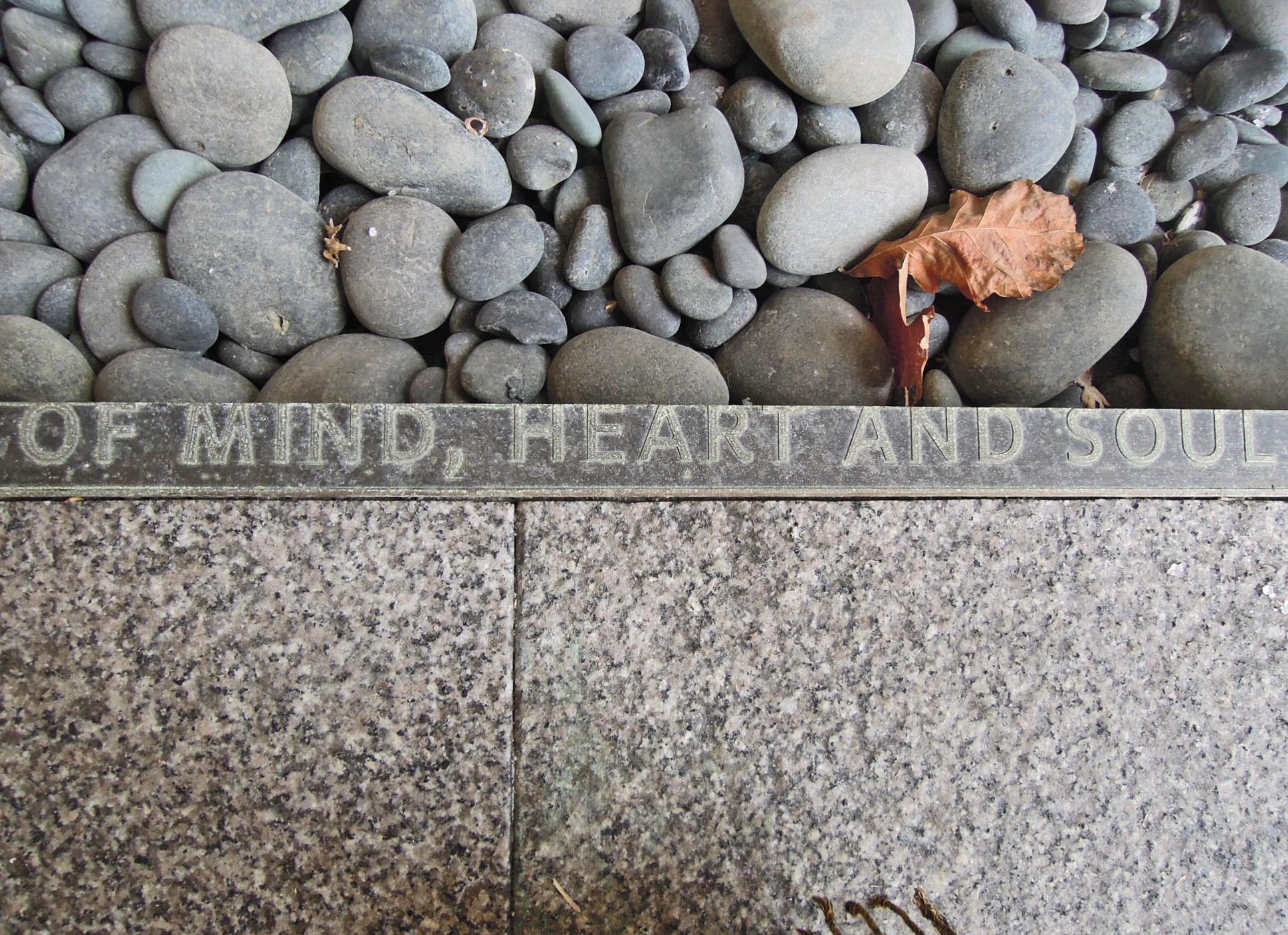
Outside the Barnes Foundation, Philadelphia, PA
John Friend tells us in teacher trainings that when we are observing students, start at the foundation. In order to help a student have the highest, most joyous and expansive experience in a pose, the foundation must be secure, aligned, and basically in the correct form. If the student does not already have a steady and aligned foundation, adjustments to other aspects of the pose will not well serve growth and understanding. When we are practicing on our own, starting with the foundation is also critical. If we do not make sure that we have the physical, energetic, and mental understanding of a pose, at best, we will have little appreciation for our practice and, at worst, risk injury.
Off the mat, the principle of starting with the foundation is even more important. If we do not teach all of our children basic reading, math, history, and civics, how can we have a functional democracy? If a house does not have a sturdy, well-built foundation, what is the point in spending lots of money decorating it? If we do not plant a seedling at a depth where it can be properly rooted and supported, how can it best flower and give fruit? If we do not provide all with adequate shelter, feed ourselves in a way that fosters both the environment and natural health, build an infrastructure that makes drinking water and breathable air for all, and have proper respect for the process of dying, how much true health care can come from privatized insurance, however regulated?
I was staying at a retreat center in Peru on 9/11. I was not with anyone else from the United States. I remember at the first meal after the planes hit, another guest suggesting that the United States deserved it. I also remember the brief moment of gathering sympathy that, as a country, we threw away with the aggressive response.
The best thing about the retreat center was that instead of tea bags, every morning there were fresh herbs from the garden for tea. I continue to make my tea that way as much of the year as the garden is able.