|

Healing (and the Garden)

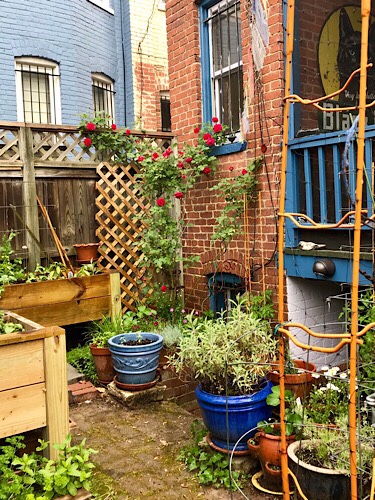
After sitting for meditation and writing in my journal this morning, I went out in the garden in my slippers to see what opened after yesterday’s juicy rains.  My journal-writing is feeling lonely because that was one of the times Becky (and Henrietta before her) and I always sat together.  Once I was in the garden, though, my heart lightened.  The beans and snow peas I planted a couple of weeks ago finally have started germinating.  Some of the seedlings I planted on Saturday have already doubled in size.  There are a few buds on the peppers that were not there Sunday and twice as many leaves on the basil.  The clematis seems to be a foot taller; is that possible?  (The okra still has not germinated; will it ever appear?  I do not know, not having tried okra from seed in a container in my yard before.)

Though, as my sister said to me on Sunday, I will always miss Becky and Henrietta, I appreciate that my grieving is in the time of renewal, new life, and expanding light, and that I can spend the morning time that I used to devote to Becky and Henrietta nurturing the garden and myself in the process.

Similar Posts

  • | | |

    An Excellent Sufficiency, Homegrown Tomatoes (and the Isha Upanishad)

    The Isha Upanishad starts, “That is fullness (purna).  This is fullness.  Fullness comes from fullness.  Take fullness from fullness, and the remainder is fullness.”

    My maternal grandfather died when I was just a toddler, so I never got to know him.  My mother used to tell us that when he had eaten enough at a bounteous meal, he would say “that was an excellent sufficiency and any more would be a superabundency.”

    On Sunday I went over to Lovejoy Gardens to my little plot (approximately 3′ X 7′ raised bed on concrete, half shaded by a fence) and harvested tomatoes.  There were about 15 ripe tomatoes.  The first thought was that it was too many tomatoes.  Then I thought of all the neighbors I had who didn’t have their own tomato plants.  I knocked on one neighbor’s door.  He gave me tea while I played with the cat.  I gave him tomatoes.  I went for a massage in the afternoon.  I brought tomatoes.  I was sent home with freshly made spanakopita.  I invited another neighbor over for dinner.  We at pesto with basil from the garden and cucumber and tomato salad (cucumber, tomato, and shallots all from the garden drizzled with a little of the best balsamic vinegar and seasoned with just ground sea salt and pepper).  We had a lovely visit, and I sent him home with tomatoes.  In the next day or two, I will make a batch of tomato sauce and put it in the freezer and have someone over for dinner another night.

    There is only “too much of a good thing” or a “superabundency” if we hoard it or try to ingest it all ourselves out of fear, greed, or desire for power or control.  When we have enough ourselves and then share the abundance, we simply create more abundance.  Once again, I am given again from my garden another sweet insight into the yoga teachings.  I am also reminded by this small example that I could share even more broadly from my blessed lot of fullness in global society.

  • | | | | |

    After the Exhileration, Work

    We all (or at least most of those who would be reading this blog) have heard the Buddhist-inspired saying:  before enlightenment, the laundry.  After enlightenment, the laundry.  The question is whether after the moments of enlightenment can we infuse doing the laundry with more joy, acceptance, and peace.  A young adult acquaintance asked me the other day whether I was readjusting ok.  I did not know to what he was referring, and he had to explain that he was asking how I was doing on my return from my India trip.  “It was just a vacation–albeit an extraordinary one,” I replied.  “Life continues.”

    “The good experiences just slip away like dry sand through my fingers,” he made a motion of letting something slip away.

    “When you practice and when you get older, it will be easier to bring the temporary, good experiences into your life without feeling they are lost when you have moved onto the next thing,” I said with hope that would  actually be true for him, he seemed so bereft.

    The yoga teaches us neither to be out searching for the highs nor actively avoiding the lows; the dance of grasping and avoiding is what makes us suffer.  That does not mean that the highs, the times of wild abandoned joy, the experiences of utter fulfillment, of exquisite understanding are of no value.  What brings joy is a thing of wonder and an opportunity to deepen our ability to love and be generous.  They are only a problem if we ruin our time by vainly clinging to or trying to repeat the sensation.  As our practice (and our understanding of a life well-lived and loved) matures, we understand that there is no readjusting in the return to the day to day.  We welcome what we have had, try to remember what we have learned, including how much joy and delight we are able to drink in, and approach each day as another opportunity to seek and share connection.

Leave a Reply

Your email address will not be published. Required fields are marked *

This site uses Akismet to reduce spam. Learn how your comment data is processed.