satcitananda

  • | |

    The Danger in Taking Instructions Out of Context (and Satcitananda)

    Those of you who are regular readers may sometimes wonder why this blog, which purports to be about yoga, only on the rarest of occasions goes into any detail about the physical alignment principles for asana.  I just received a comment on a post that I wrote several months ago that reminded me of my conviction that the optimal place to discuss and practice physical alignment principles is in class.  This conviction is not because there isn’t value in reading about the alignment principles–I look at the Anusara Teacher Training Manual on a regular basis–but because it is critical to understand the bigger picture, to have a loving eye on the alignment, and the opportunity to ask questions right away, which we can only get when we practice with a teacher.   In this instance, the commenter said in response to a post in which I had indicated that “thighs out” was shorthand for part of inner spiral that she had heard that “thighs out” in the common Anusara alignment instruction “shins in, thighs out” was just hitting the thighs apart and was something separate from inner spiral.  Would I mind clarifying.

    I found the comment timely as I was recently at a workshop where the teacher had noted the injuries that can flow from overdoing an isolated action that is intended to describe one part of an element of the basic principles of alignment (in that case “taking the armpit back.”)  I agreed with the teacher that just jamming the armpits back can stress the shoulder and limit freedom if it is done in isolation and as the first action in a movement involving the shoulder girdle.  It can be an incredibly helpful alignment instruction, though, if the students recognize (as reminded by the teacher) that we don’t take the armbone back without first opening to grace, including softening and expanding and making the “inner body bright” and also practicing the movement in a way that recognizes the point of the instruction is to encourage students to integrate the head of the armbone into the shoulder socket by means of muscular energy.

    Like taking the armbone or armpit back, I do not believe that taking the thighs apart should ever be treated as an isolated point of alignment.  It should only be done in proper sequence and in proportionate action to the amount the yogi is able to work the other principles.  “Shins in” should not be done without first opening to grace, including softening, expanding, listening to the body, and establishing a good foundation.  It is also only one of the three aspects of muscular energy.  “Shins in” is just one way a teacher might tell students to apply the principle of hugging to the midline, but the student should not neglect hugging the muscles to the bone or drawing energy from the periphery to the focal point of the pose just because the teacher only cued “shins in, thighs out.”  After all, there are only so many words that can be said in a single class and only so much on which we can focus at a time, but that does not mean we should be neglecting the basics as we seek to become more refined in our practice.  Just as “shins in” is only part of muscular energy, the companion shorthand instruction “thighs out,” emphasizes just one aspect of inner spiral — that which serves to broaden the broaden the pelvic floor by means of the movement of the thigh bones.  That does not mean that it is independent of the other aspects of inner spiral–spiraling inward and expansively from the feet upwards and taking the thighs back, both of which sequentially come before the “apart.”

    Wow.  For those of you who read this for the gardening or cooking or to enjoy the photographs, this level of detail might seem mind-numbing.   Part of the danger of getting into the weeds in writing about alignment is just that.  Not only is it distancing, but it gets educated readers into a space of debating the finer points and wondering whether things have been said just right.  It becomes far to easy to lose sight of the point of yoga in the first place, which is to bring us joy on and off the mat.  Remembering the intention to cultivate joy (ananda) when we are practicing actually physically protects us from getting in trouble by over-efforting with regard to one small aspect of alignment.  When we are (sat)  consciously (cit) in the moment with an intention to cultivate bliss, then we are much less likely to do any physical action so hard or so precisely that we forget the big picture and how the principle or the pose fits in with the overall flow and alignment principles and do more harm than good.

     

  • | | | | |

    It Does Not Get Much Better (and Satcitananda)

    The key concept of yoga–satcitananda can be elusive, like all abstract concepts in the yoga philosophy and in other philosophies or areas of study. We are given metaphors and analogies in the texts to help us recognize when, through our practice, we experience in our self the manifestation of what had just been theory (book knowledge).

    It is hard to describe, for example, what it truly means to be fully present and aware in the moment and thus suffused with bliss
    (satcitananda).

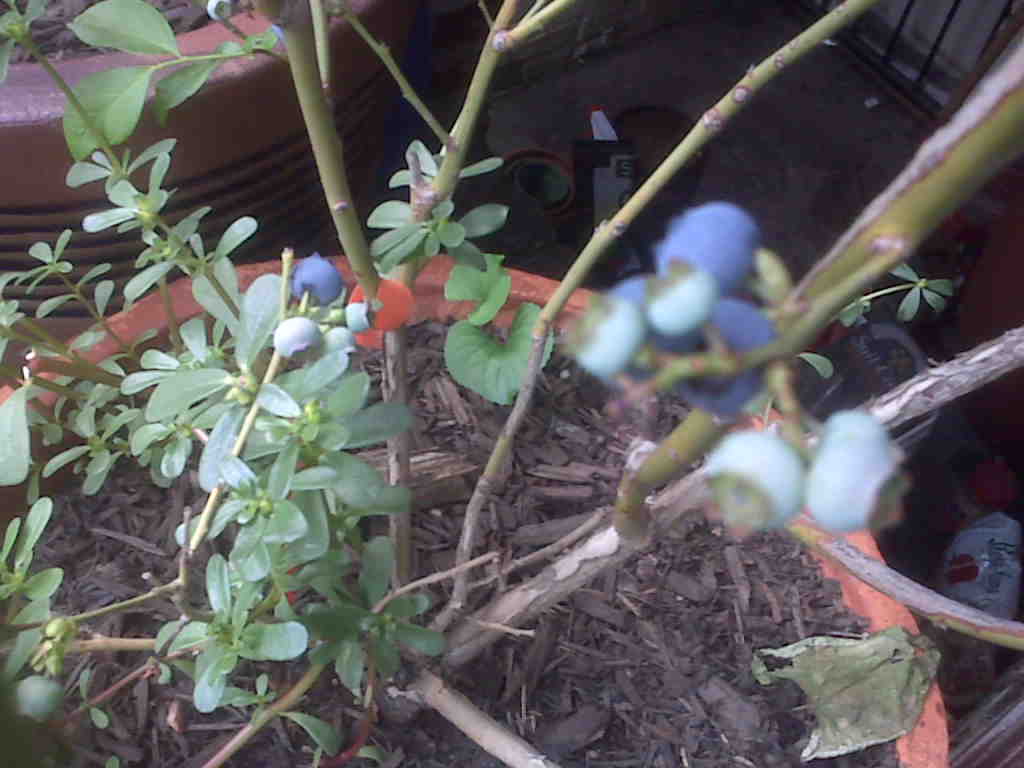
    There was a moment, standing in the hot sun, when I tasted a sun-warmed, perfectly ripe blueberry that I thought, this is a moment many of my students might imagine to be able to extrapolate the abstract concept of satcitananda.

    Notice also the volunteer purslane at the base of the blueberry bush. Weeding and harvesting greens for salad and stir fry can be coextensive. Don’t poison or discard your purslane (or your dandelions). Pick it and eat it; purslane is a great plant source of omega fatty acids.

    Peace and light, E — Posted with WordPress for BlackBerry.

  • | |

    It’s a Fine Line Between a Grimace and a Smile (and satcitananda murtaye)

    The New York Times just published a blog entry on the perils of faking happiness.   The first problem with the article was that I could not get to the study to see if I agreed that the actual premise was that “faking a smile” was what led to a deterioration in mood or feeling unduly pressured by a need to do so regardless of what was going on inside was the problem.  The second is the definitional problem of what it means to “fake” a smile.  I think it not unlikely that contorting the face into a fake smile (i.e., grimacing) because one feels one has to do so does not improve mood when one is in physical or emotional pain.  According to the little cover blog, though, those that made an attempt to smile from the inside by thinking a positive though–even though it was a conscious effort– did experience an improvement in their mood.

    Any good method actor will tell you that to make an outer expression believable, one has to cultivate inner thoughts to go with it (though that is still “acting”).  Having been taught by my mother by age six in preparation for my first school play performance, that to act I should try to “be an apple” a la Stanislovski, I disagree that intentionally putting a smile on your face cannot help improve your mood. It’s all in how you fake it ’til you make it.  I have long advocated to my yoga students, based on my personal experience with the practice of smiling whether I think I mean it or not, to try smiling on the outside improve mood.  Even leaving aside the inner experience, just walk down the street with an open posture and a smile on your face and see how people respond, though I caution to do this at your peril in New York.  When you smile at people and be polite, they generally respond in kind.  You are then much more likely to feel good than if you are scowling and rude and people respond back in kind.

    What on earth (or in heaven’s name) does faking a smile until you feel one have to do with satcitananda, you may find yourself asking yourself at this point.  The second line of the Anusara invocation is “satcitananda murtaye.” Murtaye, from the same verbal root as murti or statue, here is usually translated as saying that Siva (from the first line) embodies the characteristics of satcitananda, being (what I like to call is-ness), absolute consciousness, and bliss.

    Another way of looking at this phrase, though, is that when we open to the possibility of discovering our siva nature, which is the reason we practice yoga, and when we use the principles of alignment to help do so, then we discover how to be, if even for a moment, simply present, fully conscious, and blissful with the consciousness of the ultimacy of being.  In a word, when we soften and look within, using the knowledge and experience of our teachers and our practices, a smile of recognition lights us up.  If we start out having a bad day, feeling stressed or anxious or in pain, or just plain grumpy from reading the news, we just have to practice with more depth and sincerity to find the smile and not beat ourselves up if we are struggling to find the smile despite our desire and the intensity of our practice.

    Is that faking a smile or being the smile?  Does trying to smile when we are feeling blue really make us more unhappy?  I think it is all in how we do it.

  • | | | |

    Two Temptations of Maya

    In classical yoga, maya is the illusion that the tangible world is what is real.  Only atman is real; the world we experience through our senses (and our senses them selves) as reality is an illusion.  We renounce the world to escape the temptation of being drawn into it as reality.  In so doing, though, we ineluctably must come to the conclusion that all that is ill with the world is as much an illusion as that which is tempting.  In turning away from the world we would be also turning away from the pain of seeing inequity and suffering and the desire to seek change in the tangible, sense-experienced world.

    As I was walking around New York City, ankle-deep in slush and being hyper-stimulated by the lights and the noise and the smells and the bustle and the choices, I found myself thinking about maya and that in its classical sense has two surface temptations for me.  The first is the temptation to turn away from the stimulation, to reject consumption of more than needed to exist.  In the face of such excessive stimulation, the idea of nothing, of utter simplicity, of quiet seems desirable.  If the turning away is another form of seeking pleasure or escaping pain, though, it is still in the trap of maya — the worldly illusion that binds us in the pair of opposites–pleasure and pain.  The second temptation, the temptation to withdraw from everything except seeking the light within, is more subtle.  If we truly are to turn away from the world of the senses, we turn away from notions of justice and equality and freedom that are based how we live in the material world as much as we turn away from consumption.

    The true path of renunciation, of pure meditation, is a rare and beautiful path, but to stay in the world and to withdraw ineffectually in such a way might earn the hackneyed epithet “navel gazing.”  My path is not that of the renunciate yogin, nor do I have the fortitude to live a life of Christian poverty, which would reject riches and live for service.  Where can we find the support in the yoga path to stay engaged and yet still live mindfully, fostering the expression and recognition of spirit in ourselves and others?

    In tantric philosophy, maya is understood somewhat differently than in classical yoga.  The maya is not the world itself.  When we think that getting and having and avoiding is all that there is and that it is separate from spirit, then  our lives are cloaked by maya, and we are ignorant (avidya) of the true bliss of spirit (satcitananda).  To know spirit, we must see through maya.  To do that requires discrimination (viveka) in what we take into our senses and ethically responsible action in the tangible world to align our lives in a way that expands the opportunity to recognize spirit, which in my mind includes having less material disparity in society, which disparity most assuredly makes the essential truth of blissful consciousness more opaque (due to the play of maya) for both the haves and the have nots.  While we make our attempt to live with more discrimination and grace and with less cause of conflict or suffering (doing better some times than others), we still try to recognize and savor the exquisite divine in each sight and taste and sound and creation.  How extraordinary always is New York in all its wild manifestation!