Art and Culture

  • | |

    Found Exhortation (Less Clearly Seen Than Would Be Most Optimal)

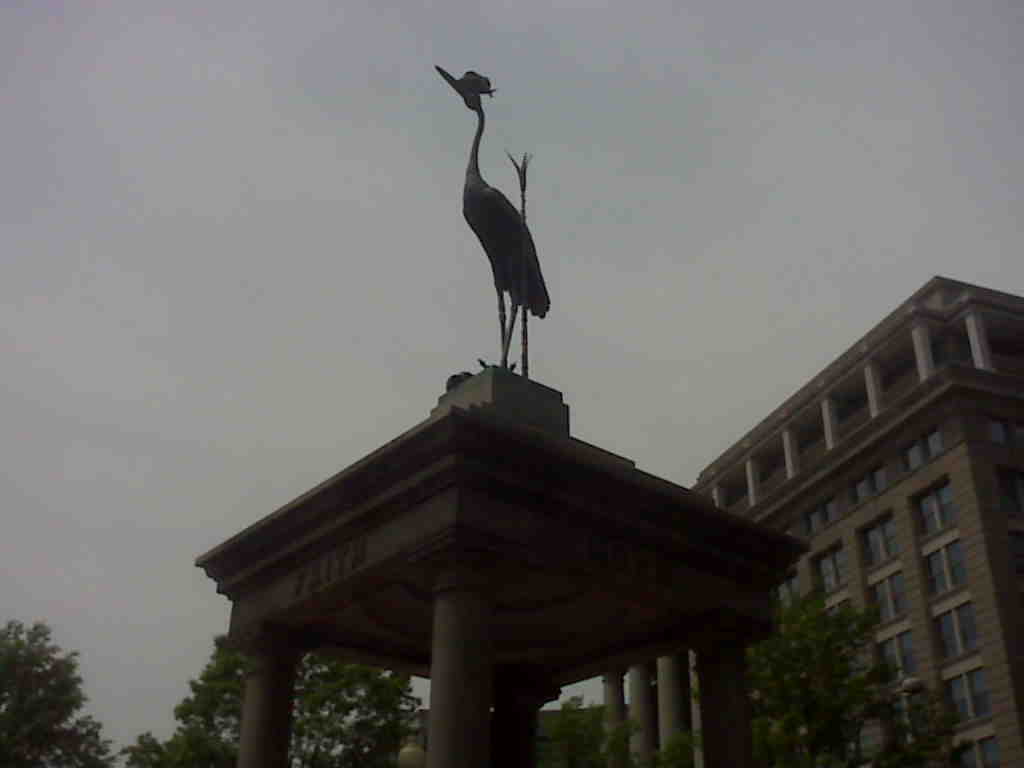
    I cannot tell from looking at the image on my Blackberry whether the words “faith” and “hope” that appear on this statue can be discerned in the photo, but they are there when standing and seeing the statue in person.

    This morning, when I was reading through the news, I came across a curious headline that averred that the killing of Osama Bin Laden had brought us a “rare moment of unity.” This saddened me, as did the reportage of spontaneous celebrations.

    I am calling on my reserves of practice so that my sense of faith and hope for humanity, for peace, and for social priorities is not as faint as the way the words appear in the photograph.

    Peace and light, E — Posted with WordPress for BlackBerry.

  • | |

    In Which I Learn a New Acronym While Away on Meditation Intensive

    On our last day of the intensive, many of us ended up talking about different upcoming events and opportunities for study, practice, and exploration. We all had many things that we would love to do. I do not think that I was alone in feeling twinges of longing when friends shared what gatherings or courses they were planning to attend or considering attending. We knew that we could not possibly fit it all into our lives.

    My lovely and witty friend Emma said, “it’s just f.o.m.o.” That’s an acronym I had not heard even though I live in a town that flourishes on acronyms. “It’s ‘fear of missing out,'” Emma spelled out.

    We never want to miss an opportunity to discover the secret, to learn the perfect piece of wisdom, to experience the most exquisite of delights. The reality is, though, that if we get caught up in the fear of missing out, that we undermine the possibility of experiencing the greatest possible happiness with what fits into our lives.

    Peace and light, E — Posted with WordPress for BlackBerry.

  • | |

    Artha, Kama, Dharma, Moksha (and Politics)

    Last night, Paul Muller-Ortega, as part of the introductory talk for the meditation intensive, spoke at some length about the principles of ardha, kama, dharma, moksha.

    As I have written about before, in the classical yoga view, it is the renunciation of the first three–material well-being, love and relationship, and right work or path, that leads us to the fourth–liberation. From a tantric yoga perspective, it is living and having the first three from the perspective of illuminated wisdom and discerning (viveka) insight (pratibha) that makes us free (jivanmukti) in this life.

    One of the most exquisite things about a steady practice and study, is that each time we revisit a core concept, we hear and understand new aspects to bring into our lives.

    When speaking of approaching these elemental aspects of human being, Paul noted that ardha includes not only material well-being, even wealth, but also the power that wealth brings and how we use it. Although he only mentioned that briefly amidst several other concepts, it really resonated with the current state of my being in relationship to the world and our country.

    I have been contemplating deeply about wealth and power in this time of budget debate, and how they can and should be used to bring nurture, peace, and health to the maximum degree possible. (You might guess that I don’t think increasing spending for war and decreasing spending for education and health is going to bring us freedom).

    Thinking about the power of money as part of our contemplation of our material well-being is something of critical importance at this time. If we shun or disdain in our minds wealth and power while still yearning for our own comforts, than we have lost an opportunity to bring the yoga principles into our lives as optimally as possible. (Of course, grasping and coveting money and power is completely destructive of the possibility of happiness, but most of us think about that, and it is why some say they are bad — money being the root of all evil, etc.).

    If we are really in the world and want to be happy and to share and spread happiness, while living in accordance with the principles of the yamas and niyamas, especially the yamas: ahimsa, satya, aparigraha, brahmacharya, asteya (non-harming, truthfulness, non-greediness, aligning with spirit, and non-stealing), that is when we will start opening up the possibility of true living liberation.

    Imagine, instead of thinking about material well-being as a “guilty pleasure” thinking of ways in which you can use your own well-being (and work through your practice to discover greater health and strength) to be a voice and power for good in your own individual way.

    Peace and light, E — Posted with WordPress for BlackBerry.
  • | |

    Spring

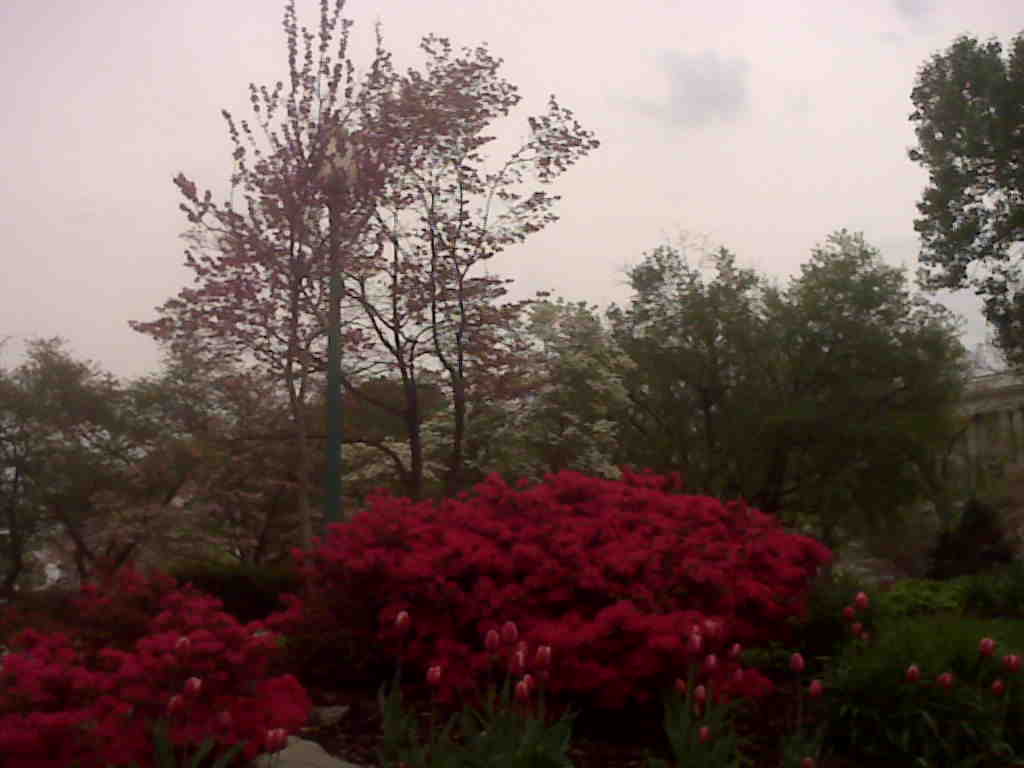
    When I was walking about yesterday, I thought I could not bear to leave the exuberance of DC’s spring. Only my house sitter would be able to watch all the new seedlings coming up in my garden. I would miss the last of the cherry blossoms. Then I thought that it would be spring where I am going–and no doubt gorgeous in its own way.

    In photo from front to back: tulips, azaleas, redbud, dogwood (pink and white).

    Peace and light, E — Posted with WordPress for BlackBerry.
  • | |

    Present from a Vandal

    When I was out walking at lunch time, I noticed several pieces of lilac on the sidewalk. Somebody with nothing better in his own mind to do had randomly picked pieces of lilac sprays and then dropped them on the sidewalk.

    The blossoms were still perfectly fresh. Although I would not have picked any of the lilac’s blooms myself, it seemed a waste to just leave them lying on the sidewalk to be stepped on and to wilt. I picked up a bit, enjoying the scent as I returned to work. It will scent my room for another few hours and then will fade away.

    Peace and light, E — Posted with WordPress for BlackBerry.
  • | | |

    Ignorance is Bliss Only If You Do Not Care What Happens the Welfare of All Beings (Do You Know How Your Tax $$ Are Spent?)

    If you are a true renunciate yogi, then the horsemen of the apocolypse don’t phase you.  The ultimate bliss is leaving your body anyway.  For those of us who are engaged in the world, care about what we eat, care where we live, care about the well-being of family and friends, then learning, understanding, and acting — knowing of course that we can control that and how we act, but not the outcome — is a critical part of a tantric yoga life.

    It’s great to know how to place one’s hands for optimal alignment in downward-facing dog, but do you know how your tax dollars are spent?  Here’s a little overview worth sharing widely.  And perhaps it will make all that noise in Washington about the budget and the debt ceiling seem a little more important.  Check out the “People’s Budget,” which enhances domestic programs, increases participation in paying for our society by the rich, and decreases defense spending and military action.

    And then I highly recommend standing on your head or balancing on your hands or otherwise going upside-down, getting twisted, and knowing that the practice will help you stay sane and steady and able to act.

  • | | | |

    Rosa’s Pizza (and a Planned Trip to India)

    Rosa’s Pizza is on the Long Island Railroad level of Penn Station.  To my best recollection, it has been there since before I started taking the LIRR regularly in the early 1970s, and I still go there occasionally when I connect through Penn Station to visit my parents a few times a year.  Rosa’s makes an eggplant slice that tastes like eggplant parmigiana on decent pizza crust.  Yup, it’s got cow dairy and gluten and lots of fat, but it is one of those foods that is so strongly associated with both place and belonging for me that it gives me great delight to eat it once or twice a year.

    When I was meditating yesterday morning, I had a vision of myself jet-lagged and groggy from landing in JFK and taking the train from the airport to Penn Station to head home after two and a half weeks of a study tour led by Professor Douglas Brooks of Tamil Nadu (including Chidambaram), which I am planning to do at the winter holidays.  In this meditation moment, I was ecstatically happy to be eating an eggplant slice from Rosa’s after taking my seat on Amtrak. I enjoyed the moment and then let go of this reverie to slip deeper into meditation.

    At work, I told a friend of mine about this vision.  He said that was not the right approach to a trip to India — shouldn’t I be eagerly anticipating what I would experience in India itself?  I begged to differ.  The excitement and anticipation of what I will see and experience and learn is a given.  It was sweet to have pierce my meditation how happy I will be to return home.  It helps me remember that for all the ups and downs of my choices, I am comfortable enough with them to be finding meditative bliss in the idea of something that is part of “home.”