Gardening

Growing vegetables, herbs, etc. in a small urban space

  • | | |

    “Who Goes On A Diet to Lose Three Pounds?” (and the Carbon Footprint of Orange Juice)

    The other night after yoga class, a group of us went out to celebrate a friend’s 39th birthday.  During the ambling course of the conversation, I said that I was turning 50 later this year.  I added that I would grow my hair another couple of inches longer and lose three pounds, and 50 would be just fine (let’s leave aside for now all the societal conditioning that goes along with feeling that such an age marker wouldn’t feel too old as long as my hair was long and my body at a youthful weight).

    “Who goes on a diet to lose three pounds?” asked one of my friends.  I find that people sometimes look at me and are shocked that I pay attention to my weight.  They have an idea that someone who stays slim is just lucky rather than consistently mindful.  My grandmother who was 4’11” in her high-heeled slippers was the one who taught me to be mindful in this way.  Once or twice a year, she would moderate her diet to lose the two pounds that crept on after one too many desserts over the course of a few months without any other change in her modest, healthful for those days diet.

    Going on a diet to lose three pounds means never having to lose 10 or 20 pounds or more.  It means returning to mindfully eating a little extra less for a couple of weeks after a couple of months of having eaten a little more than what is perfectly sustaining rather than having to go through a major lifestyle change.  In my middle age, I pay attention to my diet not as much for how I look in my clothes and feel about my body, but more for whether what I am eating is healthy for me and the planet.  One of the best and easiest ways to be at an optimal weight, feel healthier, and have less impact on the planet is simply to eat less (though this is a new announcement by the government, any one with even an ounce of common sense knew that, no matter how much exotic, novel, or challenging diets seemed more appealing).

    Part of eating the right amount for your ideal fit with your body and its relationship to the planet and society is having food that is not necessary for a healthy body only on special occasions (which is different than rigidly forbidding it to yourself).  In reviewing what is sustaining for me and the planet while still enjoying a delicious diet, I periodically take a look at what I am eating and think about what is really fulfilling.  One of the things I enjoy, but have known really should be a treat is orange juice (which I stopped drinking on other than an occasional basis several months ago and truly have not missed).

    If you are eating multiple servings of vegetables and a piece or two of fruit a day, orange juice processed, packaged, and shipped outside of a grower state provides little more benefit to your diet than does a can of soda.  If you kept everything else in your diet consistent and aren’t already eating enough to be gaining weight, eliminating the unnecessary glass of juice would not only diminish your carbon footprint (and if it is not organic, your chemicals into the drinking water footprint as well as your carbon footprint), but you also would be eliminating the number of calories it takes to gain a pound over the course of a month.  And if you live in one of those states covered in snow and ice and are yearning to eat something from the land of sunshine, eat an orange or some other tropical fruit–organic if you can get it — and skip the processing, the cooking (pasteurizing), and some of the packaging that goes into it being shipped to your grocery store as juice.
  • |

    Whispers of Spring

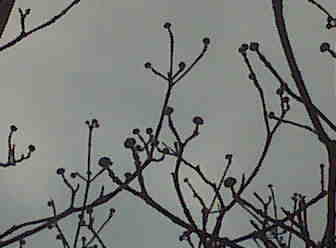
    Look very closely on this wintry day, with ice still caking the sidewalks and the news full of the next winter storm, and promises of spring are visible.

    I have not seen any bulbs coming up yet, though with the rain and higher temperatures on Wednesday, a few may start to appear in warmer spots.

    The buds that set up last fall are starting to color and swell; leaf nodes on early trees are forming. Some of the maples have reddish leaf buds already.

  • | | | |

    Bare Bones of the Trees (and Pratyahara)

    One of the things that I appreciate most about winter is being able to see the bare articulation of the shape of the tree in the absence of its leaves. A dormant tree looks very different from a leafless, lifeless tree. The dormant tree still has a vibrancy to it.

    As I enjoyed the beauty of the trees in Stanton Park this morning on my walk to work, I thought about pratyahara (withdrawal of or from the senses), which is the fifth step of Patanjali”s eight-limbed path of yoga and the bridge between life and physical practice (the first four limbs consist of ethical observances and restraints, asana, and breathing practices) and meditation. I have been led to contemplate the practice and meaning of pratyahara since the last meditation retreat I attended.

    From a renunciate perspective, pratyahara entails withdrawing from that which stimulates our senses. A renunciate would simplify and restrict what he or she takes into his or her system to free the mind from stimulation and make it easier to go into a space of meditation.

    Being careful to eat lightly, avoiding the stimulation of electronic entertainment, finding a quiet place to sit, and shutting our eyes before we begin meditating is part of the practice of pratyahara that all of us who practice meditation do as a matter of course.

    From a tantric perspective, I think pratyahara fits into our practice a little differently than for someone seeking to be on a reunciate path. We may definitely choose to minimize undue or excessive stimulation because certain types or amounts of stimulation feel out of alignment with our practices. For me, more than a certain amount of sense stimulation and certain types of stimulation can numb my celebration of and experience the spirit. Refining what I take into my system so I feel better able to live fully and celebrate and see the play of consciousness is different than renouncing objects that stimulate the senses or sense impressions themselves, as being less real than spirit. It is not renouncing things as unreal; it is picking and refining what to experience to better recognize and remember spirit. For the great siddhas, withdrawal from stimulation would not be necessary because they do not lose sight of spirit by either the cravings of the senses or being overwhelmed by reactions to stimulation of the senses.

    The trees seemed to me this morning to help elucidate this principle. The trees aren’t acting out of ego or greed or yearning to find happiness from the outside because of an emptiness on the inside. They are always open to the light and the rain. In winter, when they are dormant, they are not reaching for the light and rain or hungering for spring. They are there in all of their beauty open to receive nourishment when it comes. In spring, when the leaves start to bud and open, it is because of the light and the rain, but the essence of being a tree does not change or get distorted by going inward and resting or by opening to burgeoning growth.

    When we can simply open to all that is around us as spirit (beyond my capacities except at the rarest of times), then we can be open to the fullness of what stimulates the senses and still be practicing pratyahara. As long as we are swayed from the recognition and delight of spirit by stimulation of the senses, then we need to practice withdrawing on a grosser level to help us find the space of still being where we can be in the world of the senses without being tangled up and bound by it as such.

  • | | |

    A Secret Garden

    I was at a meeting at another agency that was built in the years when civil service was a respected nd honored activity. The garden is clearly maintained, but I have never seen anyone in it, and wonder whether entrance by anyone other than maintenance is permitted. Does the solitary air of the garden make it feel more personal and sweet? Or does it seem isolated and less intriguing because of the absence of people?

    I wonder whether people who are naturally drawn to meditate would be the ones who would answer yes to the first question and no to the second.

  • | | | |

    Lunchtime Idyll

    I did not have much time for a break today as I had a meeting scheduled for 1:30 pm. I always try to take at least a short break from work in the middle of the day, including a walk and some time to sit quietly. I am far more productive and have a better day all around when I do.

    One of my favorite places to go is directly across the Mall to the US Botanical Gardens. When I sit and close my eyes, it feels and smells like I have gone someplace warm, beautiful, and exotic. I had only time to take a few good breaths and write a couple of sentences in my journal, but that brief interlude can be all that I need to bring renewed enthusiasm to my work.

    Do you have an idyllic place you can go for a few moments? If you cannot leave your office, do you remember to close your eyes and breathe or engage in other simple meditation?

  • | |

    Special Holiday Thank You (Web Version of E-News)

    Dear Friends,

    You’ve just received an unexpected gift that does good! rose garden yoga sent you a gift card from Oxfam America Unwrapped.  Follow this link to see your card. And learn about how you’ve made a difference.

    Much love and gratitude.  News for the holiday and new year to follow in a separate e-mailing.

    Peace and light,

    Elizabeth

  • |

    Rainy Morning NYC

    The pouring rain is an inconvenience on a play day when I am toting baggage, writing materials, and electronic devices. It is hard to remember, when surrounded by concrete, glass, steel, and macadam, how urgently we need the rain. I am hoping for the trees, the farmers, and all of us, that it is also raining back home in DC.

  • |

    Too Many Cucumbers? Make Cool, Green Cucumber Soup

    Have too many cucumbers?  Perhaps some of them have grown to enormous, beyond salad-eating proportions?  It’s time for cucumber soup.

    Per person proportions for a generous serving (multiply accordingly):

    1 cup peeled, seeded, diced cucumber

    1/2 ripe avocado

    1/2 jalapeno, seeded and chopped fine (more or less depending on taste or omit for a non-spicy soup)

    1/2 cup unsweetened soy milk, nut milk, organic milk, water, or chilled vegetable broth

    small clove of crushed fresh garlic (optional)

    salt to taste

    Greek style yoghurt, chopped scallions or chives, and minced cilantro or parley for garnish

    In blender or food processor, puree cucumber, avocado, liquid, jalapeno, and crushed garlic until pureed.  Chill for 1/2 to 1 hour.  Pour into bowls.  Put spoonful of yoghurt or sour cream or non-dairy sour cream in center of soup.  Sprinkle scallions and herbs.  I only added the jalapeno because in addition to a superabundance of cucumbers, I had a number of not particularly spicy jalapenos from the garden.