| | |

What’s For Breakfast?

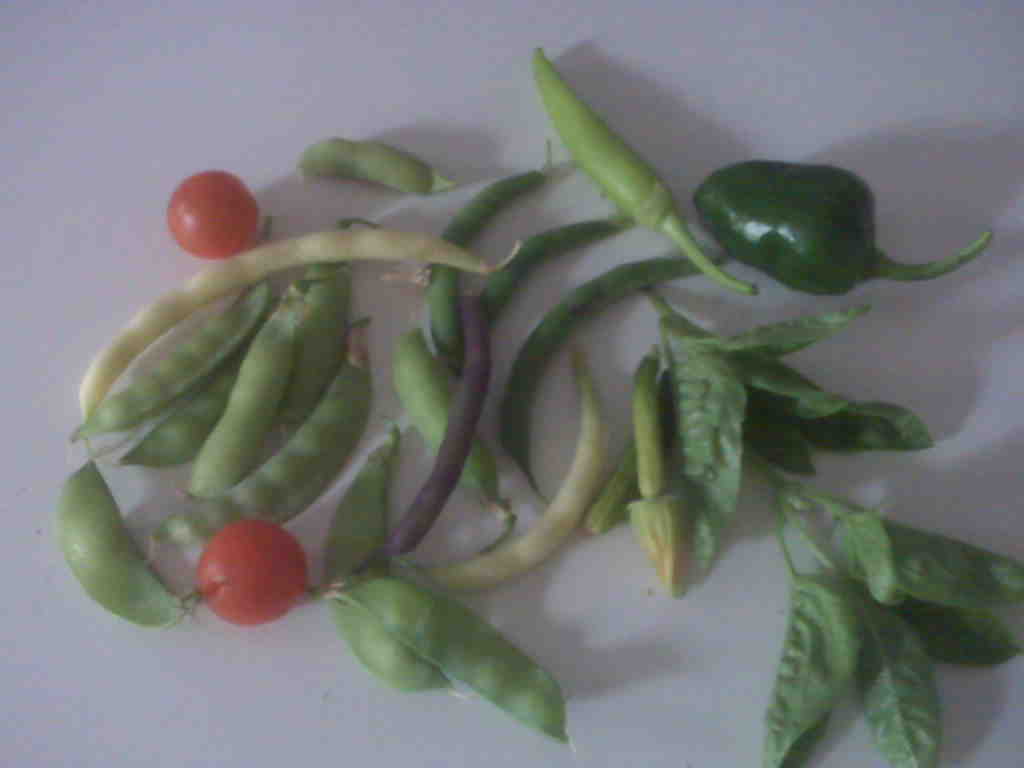
Snowpeas, tri-color beans. Peppers. Cherry tomatoes, basil (blueberries and strawberries did not make it out of the garden).

A student asked me the other day why I garden–was it to save money, he asked, was it for better tasting food?

It does save money to grow food and food eaten straight out of the garden is a foodie’s exquisite pleasure, but those are not my primary motivations.

I garden for the delight it brings through all of my senses and for the joy of knowing that the garden never questions nurturing. The more I give the garden, the more it gives back, without question or judgment.

I garden for the sense of relationship with the deeper seasonal patterns. To experience at an intimate level the impact on health and thriving of variations in seasons, light, heat, and rain.

With the drought and extreme heat in our area, the garden is struggling. Peppers are fruiting before having gotten tall and full. Cucumbers are yellowing and drying, though a couple have grown large enough to eat. There is a surfeit of kale, but the snow peas, which prefer cool weather, barely had time enough to grow enough to flower before it was too hot to thrive.

Part of the reasons some recipes have many ingredients is because they are premised on there not being enough of any one thing to make a meal. I am getting a few servings of vegetables every day, but the blasting heat is preventing the kind of abundance for some things I might have in another year. The grapes, though, may be outrageous; they like this crazy heat.

I want to be conscious of these challenges and serendipities. I want to know how I might need to change and adjust to thrive in a world that is ever more out of balance. I garden because it helps me be aware of crisis and challenge, but always and first providing extraordinary pleasure and beauty.
Peace and light, E — Posted with WordPress for BlackBerry.

Similar Posts

  • |

    Adhikara

    I was first taught that adhikara meant “studentship.”  Although that is not a literal translation, adhikara implies a dedication and steadiness in the student that makes the student worthy of receiving the teachings (of yoga).  As I was steadying myself during this momentous time and working in the garden, I was thinking about how the principle of adhikara applies to so many aspects of life, including gardening and being a citizen.

    One of the literal translations for adhikara is “competence.”  What is the competence one needs to have in order to participate in the study?  As I harvested the last of the peppers and eggplants and pulled up the plants, making room to sow another round of greens (not too late in my sunny, protected yard in the city), and decided to leave the orchids out for another week, I thought about how I knew what to do when in my garden.  By being present and observant for two decades in my yard alone, I have grown competent to know what will likely grow in my little patch of earth and for how long into the season, depending on the year’s weather.  My initial competence, when I started this garden almost 20 years ago, was some basic training in other gardens, reading technical books, and enthusiasm.  My consistent efforts to learn yielded results delightful to me from the beginning.  As I have continued my studentship in the garden, my appreciation grows.  The same is true for me also with cooking, relationships, and my participation in the community (not necessarily in that order).

    The fundamental competence of a student is having the basic skills to participate at the level of the teachings.  For a gardener, it is recognizing our climate, our space limitations, and our soil, and being open to learning what can be changed in a particular space and what must be accepted.  For a citizen, it is knowing basic civics, what are the most relevant issues for us and society at large, and what we can change and what we must accept (I think knowing the subtle differences between what we can change and what we must accept is incredibly difficult).  For yoga, it is much the same:  we must know what are true limits and what are false ones and be consistently present, practice steadily, and be ever open, not only to studying, but to the fruits of study (expected or not).

    I cannot change the weather, nor guarantee how other voters will vote, but I can continue to maintain the adhikara necessary to be a fully engaged student of this life on all days and not just the days it is fun or gratifying.  The yoga, on a day like today, is to act fully, accepting, and perhaps even appreciating, the limits on what I can control.

  • | |

    Alas and Alack (still without my computer)

    Last week my computer crashed.  I have purchased a new one, but it needs to be configured and brought to the house.  With luck, it will be possible to recover all the the data since my last system back-up.  I have everything since May (that’s five years worth) and all my photos since the end of August (that’s most everything), and some more that is stored on email or this server or facebook.

    It is a good opportunity to reflect on attachment.  It is an even better opportunity to think about the difference between necessities and wants and how our current way of living and communicating blurs the two.

     Of course, being human and a product of this society, I am not happy about it.   I’m just trying really hard to approach this in a positive way.  I know I will fully enjoy having an up-to-date system.

    I will be mostly not blogging until I have my own computer, but hope to be back fully soon.

Leave a Reply

Your email address will not be published. Required fields are marked *

This site uses Akismet to reduce spam. Learn how your comment data is processed.