Similar Posts
- Art and Culture | Asana, Pranayama, and Yoga Practice | Community and Family | Food for the Body | Food for the Mind (Yoga Philosophy, etc) | Gardening
Choices, A Cardinal in the Grapes, and Viveka
This morning while I was out in the garden, I heard a chirping right above my head. Within arm’s reach was a bright red male cardinal perched among the grapes effusively talking. (I planted a tiny red, concord grape vine about six years ago, and it has flourished beyond my wildest dreams).
There were enough ripe grapes for me to pick a handful for myself. I have bird netting, but I have not put it over the grapes. They did not do so well this year, many turning brown prematurely because, I think, of the drought-ridden winter followed by the extra wet and cool spring. I am grateful that I will not be dependent on these grapes as food for myself to survive through next winter (I’m pretty sure; if not, I have bigger things to worry about).
For the joy of having the birds come visit so fearlessly and delightedly, and because the grapes are not fantastic to eat, I leave all, but those I get by the small handful a couple of mornings a week for a few weeks, to the birds. Maybe next year I will net the grapes, but then I’ll have to have a canning party to make jam. In the meantime, I’ll marvel that every bird in DC seems to know when my grapes ripen.
We make decisions like this all the time. With how we shop, what we eat, what work we choose, how we travel, we are making decisions about habitat and environment for ourselves and hosts of other beings.
In yoga, the process of ever refining our understanding so that we can be more in touch with how we act impacts our life force and our relationship with all around us, is viveka, or discrimination. Just as the more we practice on the mat, the more we develop awareness of what leads us to feel more in tune and more celebratory of life, so too, we want to use that yoga refinement and discrimination to inform our acts off the mat.

Abhinavagupta (X-Rated or Not?)
As I get deeper into studying tantric philosophy I have taken the time to pause and reflect on how that philosophy originated and grew and who were the people offering and practicing the teachings. The tantric teachings I have received and offer are completely chaste. Put “tantra” into your favorite search engine, though, and you will see that people tend to think it is about intimate physical connection (my first euphemism). What is tantra? Is it one or the other? Is it something one can have without the other?
To help me think through and contemplate the issue, I read David Gordon White’s The Alchemical Body. I followed this with Lilian Silburn’s Kundalinia–Energy of the Depths.” What seems fairly evident–if you want the details, I invite you to read the books yourself (and also on sri vidya, Douglas Renfrew Brooks’ The Secret of the Three Cities)–is that despite the inclusion of those not twice born and women in the rituals, the community of tantrikas was no less sexist than more traditional society. The role of women in the secret rituals, as I have read it described, is one that would be wholly unacceptable to me in terms of equality, gender neutrality, and respect for women as human beings and not as archtypes and means to an end for male practitioners.
I did not get into the depths of knowing the historical details before I had been strongly drawn to the metaphysics of Kashmir Shaivism, which has been an integral part of my yoga studies. As I think about how a feminist, pacifist can find the universal teachings while still acknowledging the historical and social context in other texts such as the Bhagavad Gita and the Bible, it seemed given tantra’s rap in today’s society, I should see what my answer is for the tantric teachings as well. In thinking about the issue, I contemplated how I see the teachings in and out of the historical context (as you can see from the link to Swami Lakshmanjoo, the philosophical teachings are presented today without a hint the secret rituals).
I also asked the following, among other questions: How important is it for the student to take the teacher for the whole of the teachings and his or her human strengths and weaknesses? Is it ok to just really believe in one aspect of the teachings? Can we pick and choose what to learn and still be faithful to the lineage? Can we love and respect someone fully even if we disagree with his or her way or life and/or way of participating in society? Is extraordinary grace and genius enough to make what might otherwise trouble or even appall us seem irrelevant? Is it easier to come to terms with this issue for those teachers from different time periods or cultures and thus for whom our own choices or “modern thinking” might not have been available?
I think that the Wikipedia entry for Abhinavagupta, which mentions that the community would have engaged in secret (my spam-avoidance euphemism) ritual, but avers that “[w]e can only speculate about whether he was physically chaste, and either answer to this question is not very meaningful in the context of his life and teachings” gets it half right. It seems to me that it would be meaningful when looking at his life, but not of import in the modern receipt of the teachings. I think, for me, the very resonance of the philosophy and the practices with which I am familiar are not less meaningful for the historical concomitance of the hidden practices.
Happy Thanksgiving
May your holiday present opportunities for gratitude and generosity. I am looking forward to sharing delicious food with good friends. My contribution is dessert. As I am currently limited to the toaster oven for baking, I’m exploring how many tasty and varied things I can make in an 8×8 pan.
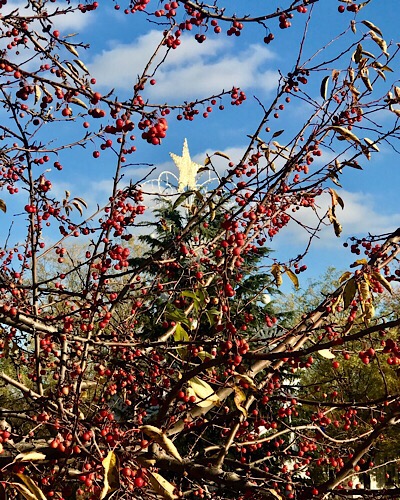
I also found time for a walk. It was a bright and breezy afternoon..

20 Years
This week marks 20 years since I moved into my house. I have been thinking about how grounding myself to living in one place has shaped my life. In some ways, it has narrowed my path, in others opened it.