|

Roasted Brussels Sprouts and Other Vegetables (and the Goddess of Sequencing)

Cooking is not only an exquisite opportunity to notice and appreciate the various characteristics of the elements of our meal and how they react to heat and fat and cooking times and methods, but a wonderful way to appreciate how everything is ordered in time and space and to honor Kali — the Goddess of Sequencing.

Brussels sprouts seem to be fashionable this year.  I’ve always liked them.  My preferred method is to braise them:  saute lightly in olive oil and/or butter in a heavy pot with a lid, splash some dry sherry, wine, or vermouth into the cooking pot and stir until the liquid is absorbed, add some broth or water (not quite to cover) plus salt and herbs of your choice, simmer until the brussel sprouts are tender and the liquid is absorbed.

My friends are gushing about roasted brussels sprouts.  I think the tenderizing, fat-adding delight of roasting has made the much maligned brussels sprout more accessible:  toss with olive oil, salt, garlic, and herbs such as rosemary and thyme.  Roast at 400F until tender and browned (15-20 minutes).  Use peanut oil, ginger, garlic, and soy sauce or Braggs amino liquids for an Asian meal.  Try safflower oil, turmeric, ground ginger, garlic, and ground coriander seeds to serve with Indian food.  Use just butter (or if vegan a light, relatively flavorless oil such as safflower or canola), salt, paprika, and pepper for an Eastern European flavor.

Whenever I roast vegetables, I toss in an extra head of garlic (separated into cloves), and serve some with the vegetables and reserve some for cooking something else with roasted garlic.  Include a variety of vegetables.  Just remember that different vegetables need different cooking times.  To recognize the mysteries of the Goddess of Sequencing in time and space — you have two choices in roasting vegetables.  You can cut the vegetables into different sizes (so you would leave brussels sprouts whole, cut winter squash or turnips into cubes a little smaller than the brussels sprouts, and potatoes into wedges or rectangles that are narrower than the brussels sprouts for them all to be golden and tender, but not overcooked at the same time.  As an alternative (as we do with sauteing or stir-frying), you can add different vegetables at different times.  You might need a combination of both techniques.  If you wanted to add mushrooms to the mix, since those would need to be larger than brussels sprouts, you would want to add the mushrooms later lest they get withered — how much later depends on the size of the mushrooms relative to the other vegetables.

Enjoy (and give homage)!

Similar Posts

  • | |

    An Armload of Radishes

    This morning I went to my community garden plot around the corner before I got ready to head into Georgetown to volunteer at The Lantern Bookshop.

    I ws delghted to find enough snowpeas for a good-sized stir-fry and several zucchini almost ready to be picked (I only get zucchini at the very beginning of the season before the squash borers invade, but if I start early enough, I can get a few pounts of squash and a couple of meals worth of blossoms before I surrender and plant something else).

    The tomatoes were flourishing (no sign of blight. If you have your own plants, keep an eye close for blight; it’s aleady been seen in Maryland. Cherry tomatoes are more resistant, so I’ve concentrated on those).

    I should have the first cucumbers big enough to pick next week, and I have plenty of lettuce.

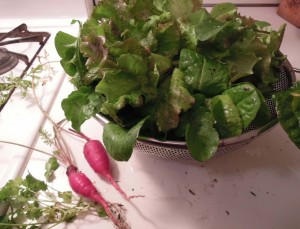
    The radishes, though, had exploded. “Should I have a radish-themed dinner party?” I thought. “What am I going to do with all of them?” I am not especially fond of radishes. I plant them because they mature very early, they thrive on benign neglect, I have friends who like them, and they give the same crunch I’d prefer from a cucumber weeks earlier.

    I’ve also discovered I like them cooked. Just as you can prepare turnips and their greens together, it also works well with radishes.

    As I was walking home with a bunch of radishes that I could hardly get my hands around, I bumped into a neighbor. I don’t know her well, just recognize her face. “Do you want some radishes?” I asked, hoping I did not sound like I was begging. She hesitated, but then seemed to realize that she would be doing me a great service by accepting them. “You can cook the greens,” I said as I handed her a nice-sized bunch, “and also the radishes themselves if they are too strong.”
    “I’ve never done that,” she said.

    Here’s the recipe I gave her on the street (with a little more detail here):

    Wash radishes and their greens well. Cut radishes into thick coins (this works best with oblong radishes sich as French Breakfast). Cut off the white part of stem nearest radish. Then cut the bunch horizontally so that you have half inch wide shreds. Mince some garlic, onion, and ginger. Stir-fry aromatics in peanut, safflower, or canola oil until translucent. Add the radish coins and stir until well-coated with oil. Add greens, stirring continuously until all the greens are wilted. Add some rice wine vinegegar and cook until absorbed and the grrens are just tender. Take off heat and sprinkle with soy sauce or Bragg’s Amino Liquid and toasted sesame oil to taste.

    “What a nice morning,” my neighbor said, “fresh radishes from the garden and a recipe.

  • | | | | |

    Sunchokes (and Anusara “first principle”) (a bit out of date, but not really)

    I realize that this blog entry was in my drafts page; I never hit the publish button.  As I ponder the few intervening weeks of snow (in some ways it feels as if time just stopped, except for the work that piled up and the lengthening of the light of day), I treat this as a reminder to myself to come back to “first principle” to respond with the most light — even in this unusually harsh winter:

    On my way to Friends Meeting yesterday, I stopped at the Dupont Circle Fresh Farm Market yesterday to buy whatever was fresh.  When I got in line with a daikon radish, a bunch of turnips, and a couple of leeks, I noticed the way the woman in front of me in line was holding her selection:  sunchokes.  Her hands were held as if she had just received prasad — the offering sometimes made after a puja so that the fruits of worship may actually be tasted and injested, incorporated with our senses and our whole bodies into our being.  “Your hands and those sunchokes are so beautiful,” I said, “may I take a picture and use it for my blog?”  “Sure,” she replied, “and shifted her hands a little so that it would be easier for me to frame the picture.”  We talked while we waited in line about potential ways to cook sunchokes and how happy we were that the farmers (these particular farmers’ must be incredibly good at working with cold frames) were out all year.

    Seeing this offering of the earth itself, the farmers who tended the earth and grew the vegetables, the workers who made and repaired the vehicles that enabled the food to be brought into the city, the city and neighborhood for allowing the market to block off a street, the shoppers for supporting it, brought me back to my contemplations this week of what “first principle” means to me.  I mentioned in an earlier post that my focus for winter classes would be Anusara sequencing principles.  No matter what else we are doing or focusing on, it always starts with “first principle.”  The “first principle” is what we call in Anusara “opening to grace.”  For me, a large part of “opening to grace” is a recognition that all the nourishment we receive is a gift.  When we practice such a recognition, then we practice receptivity, openness, gratitude, courtesy, respect, delicacy, and reciprocal desire to serve and make offering.  How could one mindfully receive nourishment such as this fresh, beautiful food on a bitterly cold winter day, and not want to celebrate it by giving thanks, nurturing the earth, supporting the farmers and the market, learning how to prepare it as tasty and healthful as possible, and share it and other things with those around us?

    gift

  • | | |

    Tulip Mania

    Whenever I see extensive plantings of tulips, it brings to mind the tulip mania of the 17th century Dutch. At the height of the mania, single bulbs could sell for several times the annual income of a skilled worker.

    Now, the tulip is just another beautiful flower. How could it ever have been the focus of such outrageous extremes of lust, gambing, greed, and social mania?

    It is a great contemplation to examine what leads us to desire and seek and value particular things–either individually or collectively. Do the desires bring us to a place of greater good and true fulfillment or is the desire just fueling the unhappy dance of craving and loss?

    The tantric philosophers point out that desire itself is not bad. After all, it is what gets us out of bed in the morning and can turn us to the good. But if it is driven by external opinion and emptiness of self, then it yields suffering–the suffering from which yoga seeks to free us.

    Peace and light, E — Posted with WordPress for BlackBerry.

Leave a Reply

Your email address will not be published. Required fields are marked *

This site uses Akismet to reduce spam. Learn how your comment data is processed.