Similar Posts

  • | | | |

    Yes, I Knew Him (and the Maha Mrityunjaya Mantra)

    When my students arrived at William Penn House last night for class, I said, “yes, I knew him; they are both my co-workers.”  I didn’t need to say anything else.  All of them read the Washington Post and know that I work for the Department of Labor in the area of pension benefits.  I said that I was shaken by the news, and I would offer the best practice I could.  At my invitation, we worked on grounding, being heavy in the best meaning of heavy so that we would feel the stability to rise and to stay graceful and open as we practiced some challenging standing poses and backbends, leading to a modified version of natarajasana (dancing in the cosmic fire).

    One co-worker is dead (either suicide or murder in his jail cell) after having severely injured another.  Yes, we all worked in the same office for three years when I first started at the Department in 1991 and episodically have worked on common projects for almost 22 years, most recently just three weeks ago. Had it been a fatal accident or a heart attack, a few dozen of us would have been at the funeral and spoken of what we liked about him.  It wouldn’t have been the horrified questioning ourselves and each other of what possibly could have gone so terribly, shockingly wrong.  The grieving and sense of loss are no less present and real, though, for the recoiling from his last acts and the salacious and rapacious local media coverage.

    Quaker practice has me holding those affected in the light–he and his family and she and hers, and our co-workers.  On hearing yesterday that he had died in jail, I was moved to chant the maha mrityunjaya mantra.  I was taught that chanting this mantra every day for 30 days can help a spirit cross-over.  What is spirit and to where it might be crossing was not really explained because how could it be?  But I do think chanting with such an intention can be a useful tool to help focus one’s own emotional process and healing in connection with a death.

    For some background on the mantra, you might want to start with this overview with useful links published by the Himalayan Institute (be advised that though citing to the YI because of the breadth of coverage, to get to the basic details, I needed to ignore the cheesy graphics and the use of the term “Lord” before Shiva in the linked article on what the author says are appropriate uses of the mantra).

    oakleaf hydrangeaMy co-worker gave me this oakleaf hydrangea about 10-12 years ago; his brother had pulled an extra seedling that was an offshoot  from a larger plant in his yard.  It did not start thriving until two seasons ago when I moved it to a different corner of my front garden.

  • |

    Adhikara

    I was first taught that adhikara meant “studentship.”  Although that is not a literal translation, adhikara implies a dedication and steadiness in the student that makes the student worthy of receiving the teachings (of yoga).  As I was steadying myself during this momentous time and working in the garden, I was thinking about how the principle of adhikara applies to so many aspects of life, including gardening and being a citizen.

    One of the literal translations for adhikara is “competence.”  What is the competence one needs to have in order to participate in the study?  As I harvested the last of the peppers and eggplants and pulled up the plants, making room to sow another round of greens (not too late in my sunny, protected yard in the city), and decided to leave the orchids out for another week, I thought about how I knew what to do when in my garden.  By being present and observant for two decades in my yard alone, I have grown competent to know what will likely grow in my little patch of earth and for how long into the season, depending on the year’s weather.  My initial competence, when I started this garden almost 20 years ago, was some basic training in other gardens, reading technical books, and enthusiasm.  My consistent efforts to learn yielded results delightful to me from the beginning.  As I have continued my studentship in the garden, my appreciation grows.  The same is true for me also with cooking, relationships, and my participation in the community (not necessarily in that order).

    The fundamental competence of a student is having the basic skills to participate at the level of the teachings.  For a gardener, it is recognizing our climate, our space limitations, and our soil, and being open to learning what can be changed in a particular space and what must be accepted.  For a citizen, it is knowing basic civics, what are the most relevant issues for us and society at large, and what we can change and what we must accept (I think knowing the subtle differences between what we can change and what we must accept is incredibly difficult).  For yoga, it is much the same:  we must know what are true limits and what are false ones and be consistently present, practice steadily, and be ever open, not only to studying, but to the fruits of study (expected or not).

    I cannot change the weather, nor guarantee how other voters will vote, but I can continue to maintain the adhikara necessary to be a fully engaged student of this life on all days and not just the days it is fun or gratifying.  The yoga, on a day like today, is to act fully, accepting, and perhaps even appreciating, the limits on what I can control.

  • | | |

    On the Way to Dinner in the Neighborhood 

    To make space at William Penn House for a full group of college students visiting DC to take advocacy training and to do service projects, Tuesday Night Yoga practice was cancelled. The regulars decided to go out for dinner instead–a most pleasant way to spend my birthday eve.

    I was asked what I wanted from this year. Hard to know what I want, I said, with all the chaos and tragedy and upheaval. I think I want to find more ways to share my resources–talents, time, and finances–and maintain equanimity and joy, while deepening friendships and connections to community. If this year brings that, I will indeed be among the very fortunate.

  • | | | | | |

    Furlough Week Two — Sutras

    First too hot, now cool.

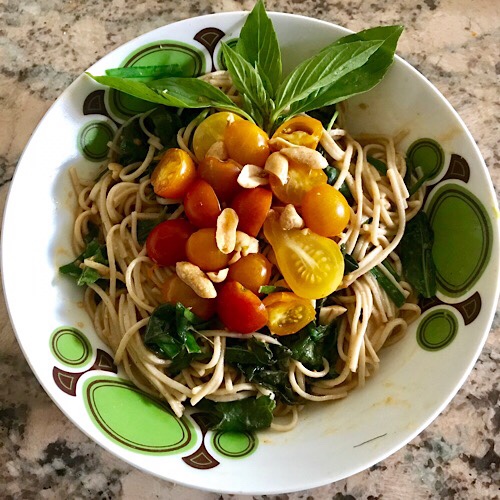
    It wasn’t until the weather cooled and the reality of a second week of work not being done that needs to be done to meet deadlines that the impulse arose to make the first batch of homemade granola of the season.  This batch could be called maple nut granola with raisins.

    Harvested last of the sweet banana peppers and a fire engine red cayenne pepper.  Also picked as a baby one last eggplant before pulling the plant to make way for tat soi.

    Most of the tomatoes I found on the ground still unripe.  With a generous portion of red wine and nice herbs, and the traditional way of cooking them for hours and then running through a food mill, and then reducing until reaching the desired thickness, it won’t matter that the tomatoes ripened on the counter.

    Assorted apples from the farmer’s market.  Dried fruit is different when it goes into the dehydrator within a couple of days of having been picked and early in the season when the apples are best.  An upside of being required to stay around home is that I have been able to experiment with the dehydrator that was a most generous birthday gift.

    There’s a bunch of difficult stuff going on, but there is no need to write about it anywhere except possibly in my journal, for much of it.  And as for the shutdown and its impact on real people around the globe (and all that interconnectedness stuff), I prefer today to write about granola and stuff from the garden.

    Anyway, I’m thinking I would just be preaching to the choir if I wrote another blog post about the importance of trying to keep up and understand as much as possible, speaking with others to shape your understanding and your voice, being in contact with your elected officials and signing petitions, and reaching out to friends and family open to such discussions to invite them to be engaged.

    It is times like these when I think of Patanjali’s sutra:  heyam duhkham anagatam (the pain that has yet to come can be avoided.)  I have contemplated this sutra much over a long period.  It is a good one for when I am reaching into the yoga teachings for insight into how I might respond more optimally under the circumstances at hand, especially that which is entirely out of my control.

    furlough 1a furlough 1b furlough 1c furlough 1d

Leave a Reply

Your email address will not be published. Required fields are marked *

This site uses Akismet to reduce spam. Learn how your comment data is processed.