State of the Garden (Front)
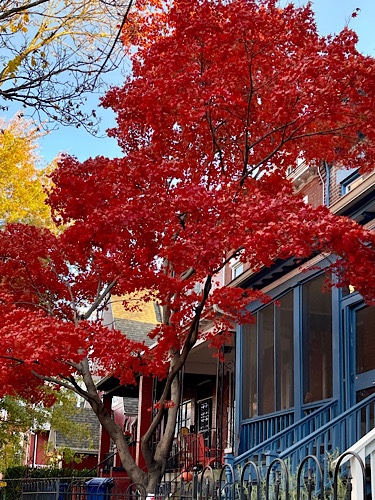
When I saw this headline the other day, the first thought that came to mind was how much pleasanter life would be if those spending huge amounts of effort and money to “fight” gay marriage would pour that energy into educating children, tending gardens, and being friendly with their neighbors. The next thought, which was not unrelated, was that the headline was a prime example of how the action of mayiya mala serves to alienate us and cause unnecessary rancor.
The three malas or cloakings, in tantric philosophy, are aspects of consciousness that prevent us from recognizing the unifying spirit in all beings. We tend to hear a fair amount in yoga class about the first of these —anava mala, which clouds or covers over our recognition of the divine in ourselves, thus leading to feelings of unworthiness–but there is less focus on the other two (the third is karma mala, which is the illusion that we are doing everything all by ourselves–that’s an oversimplification. Perhaps more another time).
At an elemental level, mayiya mala is the distinction between subject and object that leads us to feel separate from other beings. When this separateness makes us feel threatened or needy, then we can behave very badly indeed (mild understatement). I believe that our superficial requirements of outer sameness–think dress codes or neighborhood rules on what one can plant in one’s front yard–are exactly because we fear difference. If we can instead accept difference as part of the play of what actually connects us (see through mayiya mala, then we can more easily love and embrace others and widest variety of creative expression.
On our mats, one of the things that leads to injury is mayiya mala. When we forget that we the purpose of the practice is to seek the peaceful joyous space within ourselves and instead get competitive or acquisitive about postures (or external emblems of “spiritual advancement”), we are getting caught up in the differences and comparisons generated by mayiya mala and get compelled to push and strive in unhealthy and dangerous ways. When we remember the true purpose of practice, we will seek to expand, but with such sensitivity that we do not hurt ourselves. This, of course, is easier said than done.

Peace and light, E — Posted with WordPress for BlackBerry.
I have spent most of my life practicing one thing or the other. What attracts me about practicing in the sense of complete absorption that it brings. For a time, the absorption can be enough. Ultimately, though, the absorption should bring joy. I do not really think that it matters what it is that one is practicing as long as steady engagement brings a sense of inner peace and bliss that enables one to be kinder and to offer service in some way. I have quit some things along the way either because the practice did not bring enough joy or fulfillment or the practice was detrimental to my nature.
I know yoga and meditation are the right for me at this point in my life because sadhana (practice) continues to brings me ever increasing delight. I do not think of practice as work (though sometimes I need to use some self-discipline to remind myself to practice), but as an invitation to greater depth and understanding of not only the practice, but myself.
I have friends for whom the right practice is not yoga, but something else — a visual art, music, law. It is not what one does, but how one does it, and whether it brings a sense of fullness to life, a satisfaction with the engagement in the doing, rather than in what the doing achieves.
The rose is just starting to bloom, the pansies are thriving with the cool, wet weather. These would not have made it through the coming rains, and it is sweet to have some inside blossoms in these times (and I am grateful for such privilege).
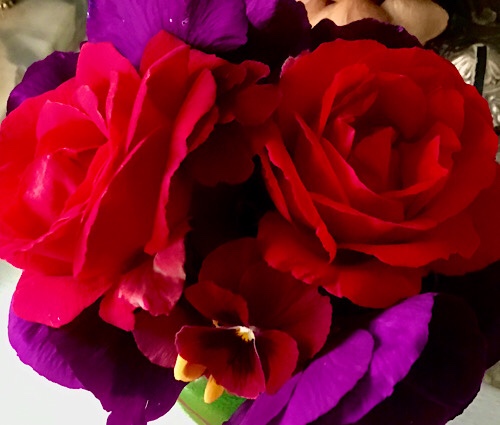
For whatever may come, it is best to have a variety of resources–inner and outer.

Last year, some romaine lettuce must have bolted. I have baby romaine lettuce coming up everywhere. Having reverted to the wild, it is quite bitter. It is also taking up a fair amount of space, so to be able to plant more appealing things (new herbs and greens) I will be pulling it up. It has become, in essence, a weed. Later in the year, I’ll also have a surfeit of volunteer epazote and purslane, which many would pull as weeds. Those, I actively encourage, eating young the ones that come up over and over again through the bricks and confining in containers a few others to grow larger and to reseed.
Even though it is too bitter to be palatable raw, the now “weed” romaine tastes fine cooked as a tender green. So it does not get discarded. I just won’t make myself eat it in its bitter form as the salad green that it is “supposed” to be. Instead, since it is nourishing and tasty as a cooked green, it is a welcome early addition to the garden.
Just I have challenges and tribulations from whatever is my overall plan for the garden, I have my share of aches, pains, challenges, and disappointments, in life and in my yoga practice. The question is how to discriminate (viveka) among those that are poisonous, those that are bitter, and those that can be made nourishing and sweet, through the cooking of understanding, practice, and effort.
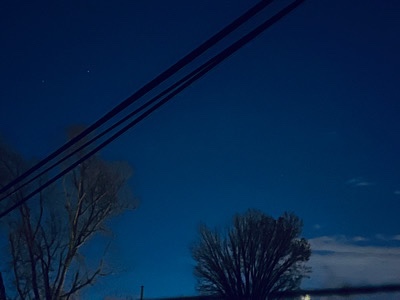
The sky emptiest of moonlight, the darkness of the absent moon of mahashivratri lets the stars reveal themselves and illuminate the fullness of possibility. That it is also the first day of meteorological Spring and was the State of the Union feels like quite a confluence.