Phantasms Around Town

 Last night another storm front passed us by with only a trace of rain, leaving us deeper in drought. The wind picked up, the temperature dropped, and the clouds scattered, leaving the sky scrubbed bright blue and the air fresh. Though this morning on my walk to work there was hardly a cloud in the sky, a rather menacing gray cloud hovered directly over the building where I work. Observing this odd cloud led me to ponder about how I often feel that I have my own personal cloud–everyone else has purpose in their lives and is worthy of love, but not me (this is a bit of an exaggeration, but you get the idea).
The reality is that all of us get such feelings to a greater or lesser degree some of the time. It can be a helpful step in clearing away feelings of unworthiness to remember that it is part of the human condition. The tantric yogis say that there are three cloaks or malas (anava mala, mayiya mala, and karma mala) that result from the manifestation of diversity from the pure universal out of its own play. The sense of unworthiness we sometimes feel (anava mala) comes from forgetting that we are spirit, and anava mala– in whatever form it appears to manifest–is just because of the loneliness of not remembering our true self. When we experience or create conflict or unhappiness out of the illusion (maya) that separateness and distinction are the only state of all that is real then we are in thrall to mayiya mala. When we think we are completely in charge and responsible for everything we do and how it impacts the world, that is karma mala at work.
We practice to pierce through the clouding of our individual consciousness by the malas. By inviting ourselves to open to the luminous space of consciousness and to surrender to the very fullness of our being, we reduce the impact of the malas on how we conduct our lives. Our practice helps us to remember our worthiness so that we can be happier and freer and do our work and engage in our relationships with more love and light. It helps us remember the light in each being so we are naturally drawn to respond with more compassion and friendliness to everything on the planet. The grace of dissolving kriya mala is that when it is not obscuring our vision, we can engage fully on our path, but still accept that we are ultimately not in charge and do not know what the universe truly has in store.
When I was meditating this morning, the last lines of Keats’ ‘Ode on A Grecian Urn’ welled up in my thoughts: “Beauty is truth, truth beauty, — that is all/ Ye know on earth, and all ye need to know.” How odd, I thought, for this to appear, as if out of nowhere. I have been contemplating this week on what it means to be refined, but not in the way of an aesthete. Rather, as I have been concentrating on the Anusara alignment principle of “ankle loop,” I have been thinking about how deepening our practice with repeated exploration and study we are able to refine our understanding and the flow of energy within us so that we can be more connected to ourselves and each other.
As I understand the essential structure of the Anusara principles, the “loops” are really tertiary principles. The primary principles are those of “attitude, alignment, and action,” which are the principles of how we practice. The secondary principles are the fundamental physical and energetic principles — “opening to grace, muscular energy, inner/expanding spiral, outer/contracting spiral, organic energy.” The loops serve to refine the secondary principles. Ankle loop, for example, which starts at the base of the shin bone, travels down the back of the heel and then back up through the arch, energizes the foot, lifts the arch, supports our stance and helps us focus muscular energy. When we are feeling challenged finding as much muscular energy in our feet and legs as would be optimal for a full expression of the pose, we can use ankle loop to refine our understanding and practice of muscular energy in the legs. Keeping in mind the primary principles of practice, though, the refinements should also always lead us towards the heart and not just get us into details. Getting more sophisticated and refined, likewise should not lead us to disdain for that which is unrefined.
Funny, then, that the aesthete’s call to beauty should arise in my meditation while I have been consciously thinking about refinement. What does it mean to appreciate and study refinements, but still honor and delight in a novice’s full expression of “attitude, alignment, and action” as much as an impeccably aligned and skillful pose that does not reveal a yearning for spirit? Beauty may be truth, and truth beauty, but what is “beauty?”
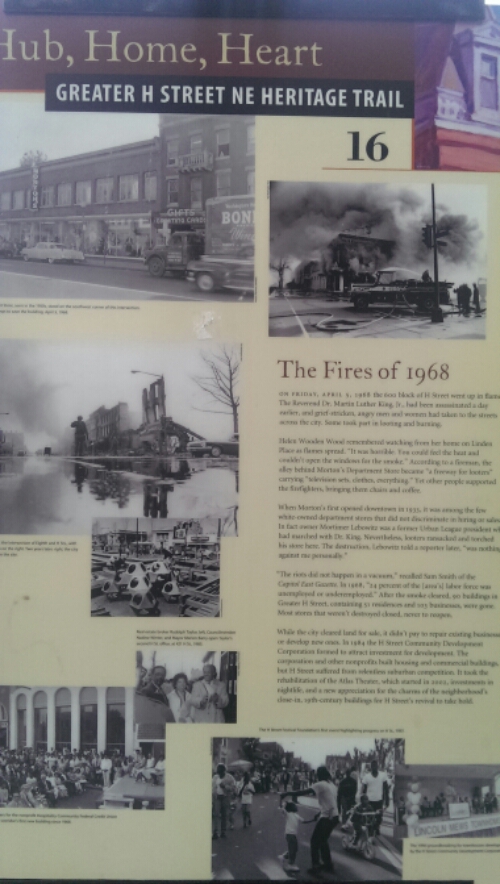
Thinking about Ferguson. Thinking about how there is still evident damage from the 1968 riots in DC, just north of my home and just blocks from the US Capitol.
Thinking about the yoga concept of samscara and the consistent and conscious and intentional efforts and practices it to create new and more life-affirming patterns when we’re stuck in an unhealthy groove.



Today’s walkabout circumnavigated the Capitol, went down to the baseball stadium and then along the Anacostia River Walk past the Navy Yard, and then angled back to the Yes Organic Market for a few things.
Patanjali’s Yoga Sutra II.48, tatah dvandaha anabhighataha is translated by B.K.S. Iyengar as “from then on [after the yogi through steady practice has absorbed him/herself in the practice of yoga), the sadhaka (practitioner) is undisturbed by dualities.” This sutra follows the only two in all of Patanjali’s Yoga Sutras that specifically discuss asana, which Patanjali describes as a controlled and perfect ease and steadiness of mind and body.
I was thinking about the freedom from the “pairs of opposites” — pleasure and pain, etc. — when I read an article in the Washington Post yesterday dividing everyone who was impacted by the blizzard as a winner or a loser. Children off from school were winners, frustrated parents, travelers who were grounded from flying, and politicians sure to be blamed for not having planned in a Southern city to have the snow removal equipment, personnel, and budget of a city like Buffalo, NY, were losers. I am fairly certain (based on the harangues on the blogs) that the author was not alone in seeing everything as winning or losing. To me, though, it feels like one of the “afflictions” described by Patanjali. I was a grounded flyer. I was much looking forward to a trip to San Francisco to see a dear friend from college and then to attend the weekend workshop with John Friend. It would have been great fun to be there. I was disappointed. But it never would have occurred to me to label myself a loser. Do so so would just had me hold onto unhappiness.
Yoga teaches us to look for the good, to accept what we cannot change, and to seek to respond in the highest. In essence, we are changing what we can change, which is how we react. If my only reaction to the storm was pain and sadness from having the pleasure of my planned trip taken away from me, then I would in fact be a loser. If I just accept that no one can anticipate when record-breaking winter storms are going to arrive and then have the best day I can under the unavoidable circumstances, then I am a winner. I am not a winner in a game where someone else is a loser. I am not a winner in that I did not let Mother Nature win. Rather, I have learned that the steady practice of yoga makes life more easeful and delightful even in challenges and disappointments. I am motivated to practice more. The lessons learned from being confined a blizzard when I was warm, well fed, and surrounded by friends are a hopeful prelude for how the yoga will serve when I really face a challenge.
I appreciate my walks to and from work; every one brings some delight. There’s a very friendly dog who’s often out when I walk past his house, and he wanted a good petting this evening. When I was almost home, I spied another four-legged neighbor.