Be Here Now (Var.)

It was gray when I woke and mostly gray—though not raining most of the day. For a few fine minutes the sky called me to watch.
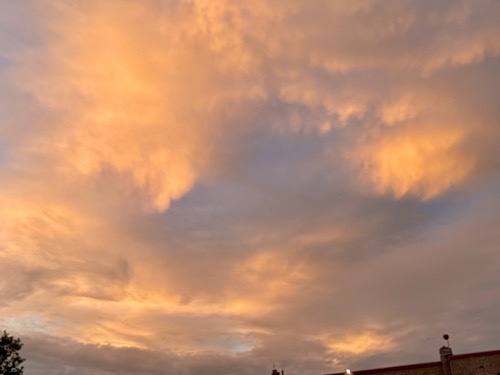
What do you see when you look at this picture? What would you have thought if you had come upon a mass of seaweed and jelly fish, having dressed in a bathing suit for a morning plunge into the ocean while on vacation?
Both my yoga teacher John Friend and my meditation and philosophy teacher Paul Muller-Ortega teach that we want to respond in the highest, to seek always to see the good and to respond from that seeing.
I found myself thinking about this morning when I saw dozens of jelly fish on the shore and contemplating a conversation I had yesterday about the topic with a fellow student.
For some, the t-shirt adage “it’s all good” may really ring true. Most every day is naturally bubbly and bright and difficulties or a need to shift or change to find better alignment is not of much importance. I am not naturally effervescent with bliss, though I find a deep and abiding and growing joy in life that comes from a combination of discrimination (viveka) and appreciation for the wonder and complexity of life.
Some may just not notice the jelly fish and just see the sun glinting on the waves, plunging in to swim with delight, not caring much that it resulted in itching or stinging from the jelly fish. The itching and stinging are just minor irritations that wouldn’t change the joy of the day. That’s a great way to live, but not all of us are by nature that care free.
For those of us who see the jelly fish and know that swimming with them can cause potentially significant discomfort, we have two choices: we can get all bummed out that a care free swim in the ocean is not going to happen. That is not responding in the highest. We can also look at what beautiful and amazing creatures are jelly fish, look down at our feet as well as up at the ocean and the sky so that we don’t step on any (walk with discrimination), and then choose to swim in the pool.
Responding in the highest and looking for the good is not the same as being blind to pain and difficulties. It is how we choose to react and our align ourselves within a world that presents both opportunities for delight and for challenge and pain. Responding in the highest is not being oblivious to pain, but rather, choosing not to suffer or cling to disappointment in the face of inevitable pain or difficulty.

The practice of yoga nidra is a wonderful way to deepen the connection between the full range of consciousness and your physical body. It is enjoyable and helpful to practice it on an occasional basis — we did it for the last class of the session in the Willow Street gentle/therapeutics class and you all are welcome to come to the New Year’s Yoga Nidra workshop on Sunday, January 4th — but it can be even more productive as a regular weekly practice.
Here are some good resources if you have found yoga nidra helpful and want to find out more about it and establish a home practice:
To read more about yoga nidra, I recommend the following books, both of which I believe are available at Willow Street Yoga Center.
These CD’s lead you through yoga nidra practices of various lengths and emphasis: