Editing Gertrude Stein
“She” is a whole lot better than “he” in this context, but why use a pronoun at all?
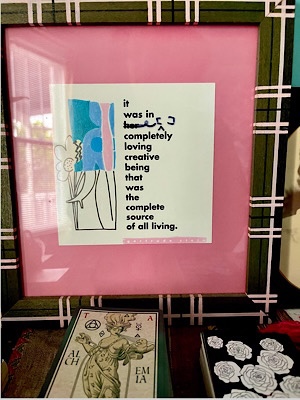
“She” is a whole lot better than “he” in this context, but why use a pronoun at all?
Thanks to the generous Cate Stillman for this podcast. What I like most about Cate’s perspective is her teaching that truly practicing Ayurveda is paying attention at the deepest level, including paying attention to what in the classic teaching of Ayurveda work for you and what do not–being that they are imbued with cultural elements of the Indian subcontinent that do not necessarily support or resonate with our culture or individual constitutions.
As I study more, I find that it turns out that I had been practicing Ayurveda already by keeping to a regular daily and weekly routine, eating seasonally and locally, eating with sensitivity to impact on my digestion and energy level, and by having a steady practice. Not being interested in detox (more some other time on the dangers of detox) or constitution types, or arcane herbal remedies (many of these, by the way, are becoming endangered species), it turns out, does not mean having rejected Ayurveda. I do know that whether I call it Ayurveda or just plain common sense, the more I live in a balanced, sensitive, and steady way in terms of diet, sleep, entertainment, work, and consumption in general, the more I optimize my health and sense of well-being.
 Last night another storm front passed us by with only a trace of rain, leaving us deeper in drought. The wind picked up, the temperature dropped, and the clouds scattered, leaving the sky scrubbed bright blue and the air fresh. Though this morning on my walk to work there was hardly a cloud in the sky, a rather menacing gray cloud hovered directly over the building where I work. Observing this odd cloud led me to ponder about how I often feel that I have my own personal cloud–everyone else has purpose in their lives and is worthy of love, but not me (this is a bit of an exaggeration, but you get the idea).
The reality is that all of us get such feelings to a greater or lesser degree some of the time. It can be a helpful step in clearing away feelings of unworthiness to remember that it is part of the human condition. The tantric yogis say that there are three cloaks or malas (anava mala, mayiya mala, and karma mala) that result from the manifestation of diversity from the pure universal out of its own play. The sense of unworthiness we sometimes feel (anava mala) comes from forgetting that we are spirit, and anava mala– in whatever form it appears to manifest–is just because of the loneliness of not remembering our true self. When we experience or create conflict or unhappiness out of the illusion (maya) that separateness and distinction are the only state of all that is real then we are in thrall to mayiya mala. When we think we are completely in charge and responsible for everything we do and how it impacts the world, that is karma mala at work.
We practice to pierce through the clouding of our individual consciousness by the malas. By inviting ourselves to open to the luminous space of consciousness and to surrender to the very fullness of our being, we reduce the impact of the malas on how we conduct our lives. Our practice helps us to remember our worthiness so that we can be happier and freer and do our work and engage in our relationships with more love and light. It helps us remember the light in each being so we are naturally drawn to respond with more compassion and friendliness to everything on the planet. The grace of dissolving kriya mala is that when it is not obscuring our vision, we can engage fully on our path, but still accept that we are ultimately not in charge and do not know what the universe truly has in store.
Where in your body might you be carrying your fear? Your rage? Your grief?
Are you able to pause and soften and give some love and support to those places?
Be safe out there. And be loud when you can.
The other day I was telling one of my regulars that I’d described the group house practice as starting with receiving darshan — receiving sacred knowledge, sitting in the presence of the divine embodied in a great being — from Uma and Sully, who wait downstairs for the students to arrive and expect a petting before everyone goes upstairs to practice.
” Is it darshan or puja [performance of ritual worship]?” my student asked. The two are intertwined. We naturally offer our gratitude and worship for those in whom we recognize the divine and from whom we learn to know the sacred.
What would our lives be like if we treated all our encounters and relationships as both darshan and puja, if we came to each person and being open to receiving a glimpse of the divine and the knowledge the divine imparts and approached each encounter as an opportunity to make puja, to formally act with reverence? The cats certainly expect it.