Art and Culture | Asana, Pranayama, and Yoga Practice | Food for the Mind (Yoga Philosophy, etc) | Meditation | Photos
Sages
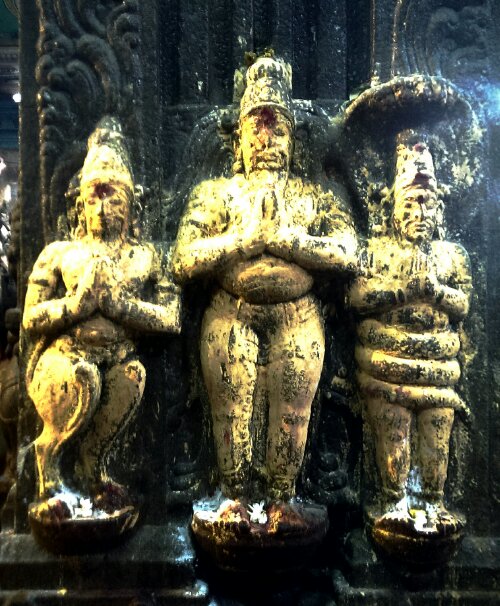
From left to right: Viragyapata, Vashista, Patanjali. At the Meenakshi Temple, Madurai.
From left to right: Viragyapata, Vashista, Patanjali. At the Meenakshi Temple, Madurai.
This morning, woken by the purring cat from an anxious dream in which I was not doing enough to make things better (I am not making this up), my first thoughts were of escalating war in Afghanistan and deepening economic crisis at home. It felt almost strange and abstract to be worrying about these things from my warm comfortable bed.
I think worrying can have a positive place in our lives. If we just get worried or anxious about things and get trapped in not doing or growing or reaching (both inward and outward) for a sense of connection and spirit, then worrying will cloak or limit us. If we recognize worries as showing us limitations, then we can use them to grow and change and spur us to action.
After the 25 tattvas describing the physical world and our being and understanding of the world that correspond in both the classical and Kashmir Shaivist systems, are Kashmir Shaivism’s six kanchukas — cloakings or coverings. The kanchukas are niyati (limitation of place), kaala (limitation of time), raaga ( attachment), vidya (limitation of knowledge), kalaa (limitation of action), maya (illusion of individuality/manifestation).
From a tantric perspective, experiencing ourselves as thinking, individual beings in the manifest world, constrained by time and space, only binds us if we think that is all we are. If we get completely entangled in these constraints, then our sense of spirit is cloaked, just as if we get stuck in worrying, instead of using worries as a spur to work for change, we become miserable.
I meditate and practice asana, as taught by my teachers, to reveal the restraints of physical being as only part of my being. Spiritual practice can serve to enable us to experience freedom of heart and mind, to bathe in the bliss of the essence of ourselves that is universal and unconstrained by the limitations of individual manifestation. The point of these practices not to escape our individual selves or to gratify them (that would still be “cloaked”), but to find the strength and stability to serve better and to work for a world in which all beings have an equal chance to seek the spirit and experience the bliss of connection.
I don’t know how I missed this pickling cucumber before it grew to such enormous proportions. I’ve scooped the seeds and pulp and added some water to ferment for a couple of days. Then I will dry the seeds that don’t float and save them for next year. This plant has been more successful than prior efforts to grow pickling cucumbers. They may have cross-pollinated with the Persian cucumber, but I’m trying to expand my seed-saving beyond the easy herbs and greens.
I won’t know how well I’ve done until next year, when I try to grow cucumbers from these seeds. There is a sense of connection to the cycles of life, with such required patience with the changes of season.
And the cucumber falling from the vine, ripe, and ready to go to seed, is a line in the Maha Mrityunjaya mantra, chanting to release and aid the passage of spirit from this realm of consciousness.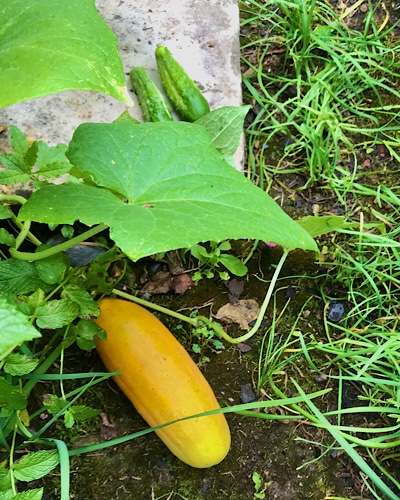
Last week I attended via Zoom a “Yoga for Palestine” workshop hosted by ABCD Yoga. I appreciated the level of scholarship and detail and getting to hear South Asian perspectives and interpretations.
I highly recommend reading Sheena Sood’s paper on “Omwashing” and checking out the offerings of ABCD Yoga.
I walked into the dining room yesterday and caught a hint of an exquisitely sweet fragrance. I knew the paperwhite bulb I was forcing was only in bud. What was it? I went to look and saw that there was a single blossom on the nightblooming jasmine. Inside, in winter, the single bloom emitted as much apparent fragrance as dozens outside. I have had this plant for 12-13 years, since it was in a three inch growers’ pot. The last time I repotted it was several years ago, but I faithfully bring it inside and out every winter/summer cycle, and feed and water it plentifully. In response, it keeps getting fuller and offering blooms. When it is outside, it can have dozens of blooms at once. Sometimes I harvest the buds before they open and use them to scent green tea. When I find open blossoms in the morning, I harvest them by the handful and put them on my alter or in the bedroom, where they will provide scent for a day or two. Outside in the summer, while profuse, the blooms last only a single night. Inside in winter (with an average 24-hour a day temperature of 61-62F), the blooms, though coming more occasionally and only a couple at a time, can last for three or four days.
I think the blossoms of yoga and meditation sadhana (practice) are not dissimilar to the way this plant blooms. With steady care, they will always bloom, though sometimes more than others, sometimes with a different character, and sometimes with just growing periods with no apparent blossoms. Sometimes, there will be a wild profusion of vision and offering, but those tend to be fleeting. The memory of the intoxicating perfume, though, keeps us tending the practice, knowing it will come again. During the time between the wilder experiences, the nectar still comes, and though in less dramatic ways, perhaps all the sweeter for coming in a time wh
en we are just practicing and tending and not expecting any great revelation.