| | | |

When I Wasn’t Looking

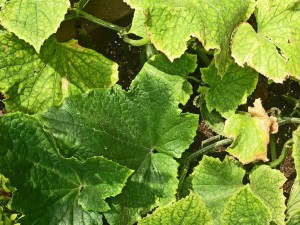
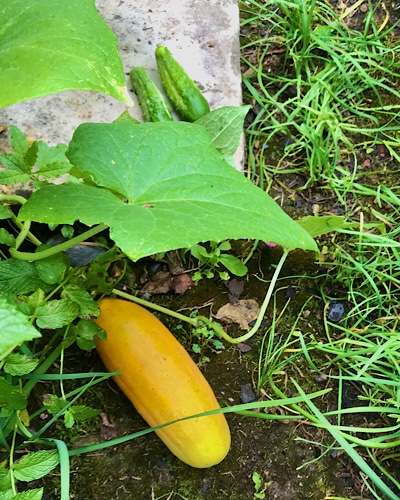
I don’t know how I missed this pickling cucumber before it grew to such enormous proportions. I’ve scooped the seeds and pulp and added some water to ferment for a couple of days. Then I will dry the seeds that don’t float and save them for next year. This plant has been more successful than prior efforts to grow pickling cucumbers. They may have cross-pollinated with the Persian cucumber, but I’m trying to expand my seed-saving beyond the easy herbs and greens.

I won’t know how well I’ve done until next year, when I try to grow cucumbers from these seeds. There is a sense of connection to the cycles of life, with such required patience with the changes of season.

And the cucumber falling from the vine, ripe, and ready to go to seed, is a line in the Maha Mrityunjaya mantra, chanting to release and aid the passage of spirit from this realm of consciousness.

Similar Posts

  • | |

    One Person’s Weeds

    Last year, some romaine lettuce must have bolted.  I have baby romaine lettuce coming up everywhere.  Having reverted to the wild, it is quite bitter.  It is also taking up a fair amount of space, so to be able to plant more appealing things (new herbs and greens) I will be pulling it up.  It has become, in essence, a weed.  Later in the year, I’ll also have a surfeit of volunteer epazote and purslane, which many would pull as weeds.  Those, I actively encourage, eating young the ones that come up over and over again through the bricks and confining in containers a few others to grow larger and to reseed.

    Even though it is too bitter to be palatable raw, the now “weed” romaine tastes fine cooked as a tender green.  So it does not get discarded.  I just won’t make myself eat it in its bitter form as the salad green that it is “supposed” to be.  Instead, since it is nourishing and tasty as a cooked green, it is a welcome early addition to the garden.

    Just I have challenges and tribulations from whatever is my overall plan for the garden, I have my share of aches, pains, challenges, and disappointments, in life and in my yoga practice.  The question is how to discriminate (viveka) among those that are poisonous, those that are bitter, and those that can be made nourishing and sweet, through the cooking of understanding, practice, and effort.

  • | |

    Feeding the Demons (Bali Dana)

    On the last morning of the trip, when we were standing next to the bus (how blessed we were to have a well-driven, air-conditioned bus to take us through southern India; I was most grateful and conscious of its protective bubble) getting ready to head north for Chennai, I noticed that there were limes under the wheels of the bus.  I was standing next to Douglas Brooks, the leader of the trip.  “Why are there limes under the wheels?” I asked.  “To feed the demons,” he replied, “so that they do not feed on you.  We make offering (bali dana) for auspicious memories and a safe trip home.” The offering to the demons, bali dana, recognizes, I think, that we cannot eradicate demons.  We can feed them, though, avert their gaze with our offering to something they find more desirable and delicious than feeding on us.

    On our last day of riding the bus, we were witness to the aftermath of a cyclone that downed trees and shut down power and tore roofs off of houses and rutted roads (thanks to all who noticed that I was in that part of the world and sent emails inquiring about our safety).  When it hit, we were far enough south that all we got was a little rain.  We flew out long enough after it showed, that it did not impact our flight, which went perfectly smoothly.  I do not know whether putting limes under the wheels of the bus made any difference to the external flow of our trip.  I do know, though, that I cannot kill off my demons; they are an essential part of me and my history.  Shifting the gaze of my demons and shifting my own gaze at my demons, though, is another matter entirely.  When we can turn our gaze (drishti) to the auspicious, even when looking through the eyes of our demons, that is when we can truly see what is best in things and better be able to respond with true embrace to whatever life hands us.

  • | |

    What Grows in a Very Small Space (and living freely within limitations)

    Sometimes when I am blogging about my garden — the joys I experience and its wonderful produce — I feel like I might be presumptuous.  I am no Christoper Lloyd or Alice Waters.  I just have a tiny space behind my urban, rowhouse that I have turned into a personal celebration.

    A visitor from out of town graciously commented that in some ways the limits of my garden make it even more wonderful.  In this sense, I know, perhaps best,  from my garden the yoga teaching that ultimately to find freedom in this life we need to celebrate all we are within our limitations to find an inner space of unbounded, liberation.

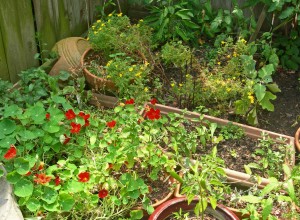
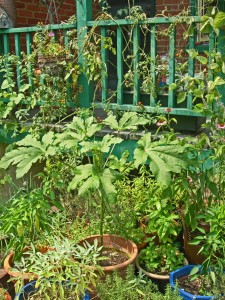
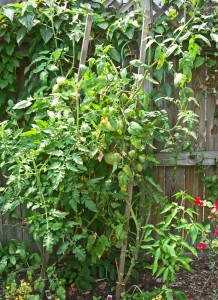
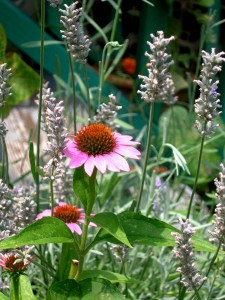
    (Shown here, cucumbers, mint, nasturtiums, peppers, greens, sage, savory, basil, okra, onions, more peppers, red and yellow cherry tomatoes (well picked), brandywine and roma tomatoes, eggplant (slow to start this year), echinacea, lavender, orchid.)

    cucumbernasturtium-pepper-mint-eggplantpot-garden

    brandywine-romaechinacea-lavenderorchid

Leave a Reply

Your email address will not be published. Required fields are marked *

This site uses Akismet to reduce spam. Learn how your comment data is processed.