Jai Ma
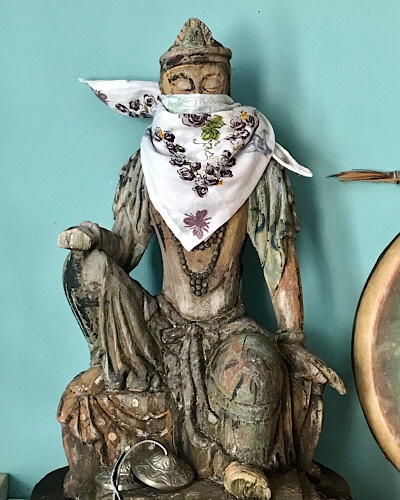
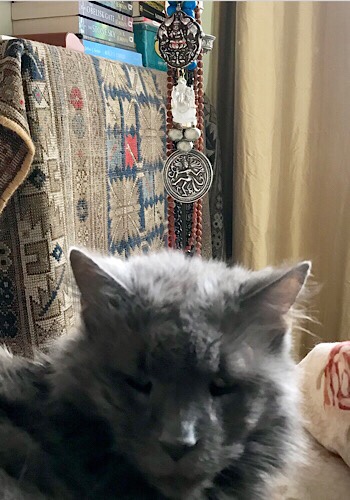
On this mahashivratri , the darkest moon of winter, the night to delve into our dreams, into the rhythms of the wild dance of existence, experiencing the fullest emptiness . On this night, too, the goddess Uma (aka Parvati) incarnate as feline WHO IS NOT SUPPOSED TO BE ON THE BED appears to have been reunited with Siva Nataraja.
Paul Muller-Ortega, who teaches philosophy and meditation from similar roots to those that inform Anusara yoga, spoke yesterday of the differences between the path of the renunciate and the path of the householder. He strongly stated that neither path was better. What he suggested, though, was that a householder will better flourish practicing yoga designed for the householder rather than attempting to practice renunciate techniques, while still staying in the householder path.
What does this mean? I think it means that we become unhappy and conflicted if we try attempt the practices of the path of complete non-attachment and transcendence of body and mind while we are still very much staying in society and responsible for family, work, and citizenship. The tantric, householder path, including that of the Shaivite tradition of Kashmir and Abhinavagupta, offers practices that enable one to live liberated in society, instead of suggesting that the only way to true liberation is to reject and transcend work, family, and community. In yoga terms, the householder path is one that realizes moksha (liberation), through ardha (physical and material well-being), kama (love/relationship), and dharma (right work/path) rather than by transcending them.
Taking the householder path does not mean just indulging. It still requires sensitivity, dedication, discrimination, and alignment. I think it may be even harder than renunciation. I know it is easier for me to just stay alone and practice, for example, than to bring yoga off my mat to how I work, consume, relate to others, and participate in society. The householder path, though, is the one for me.
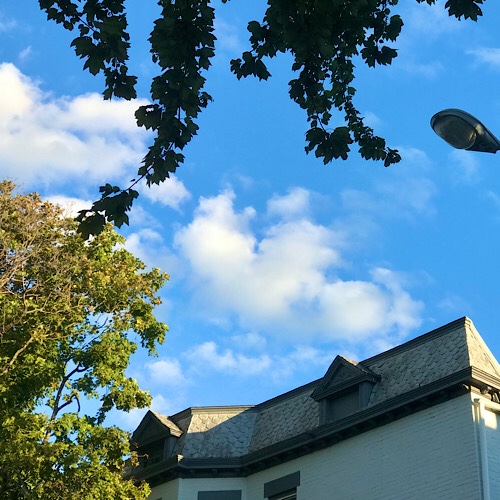
When we know how much of what we perceive is a trick of the light of our own perception, we are that much closer to witnessing from a more spacious, and thus more compassionate, consciousness.


Just ten minutes later, the sky is a flat , grayish white. But I keep paying some attention to the sky–just as I keep sitting for meditation, even though I rarely have visions.
The elevator I rode to my fifth floor office this morning was very full. Several of the people in the elevator were wearing visitor badges. As I walked on, I heard a woman say to a colleague, “…if you get a good one, they can do amazing things. I had a frozen shoulder, and it was just incredible the change from the physical therapist. I highly recommend [don’t remember the name].” Her colleague, who evidently had extremely limited range of motion and a limp from something with his hip, said, “that would be great, but I don’t have time for something like physical therapy.” They got off (slowly) on a lower floor, leaving me and someone I know who works on my floor.
“He obviously does not want to heal or change if he doesn’t have time for physical therapy for something that is debilitating,” I said. “He would vehemently deny it, if you told him that,” replied my co-worker. The reality is that if we want to change or heal or grow, we have to make an intention and then stick with it. Whether it is healing an injury through therapeutic yoga and/or physical therapy or a more internal shift sought through yoga, we must be steady and committed to our intention.