Being Careful

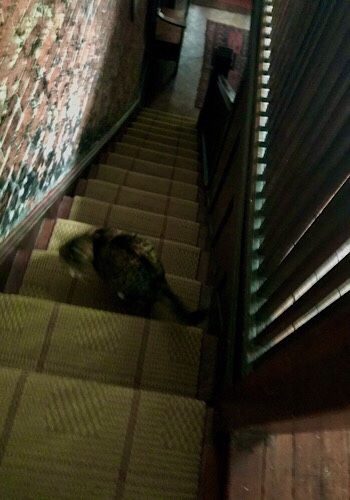
Last week, I was talking to a friend of mine from yoga and mentioned that I was almost embarrassed that I found myself being extra careful on the stairs of the house because I so much want to avoid any need to go to the doctor.

The next day a neighbor posted a picture of her bandaged ankle; she sprained it falling down the stairs.

I felt a little better about my feeling a need for my minor care-taking.

Similar Posts

  • | |

    The Breath Leads the Way (and Atha Yoga Anusasanam)

    I was reminded the other day of a principle of reading the great Hindu philosophical work:  all of the meaning of the text can be understood from not only the first sutra, but the first word.  The first sutra of The Yoga Sutrasof Patanjali’s is “atha yoga anusasanam” — now begins an exposition of the practices of yoga.  Implicit in the “atha,” the now, is that something else has come before.  The translations I have speak of previous study and preparation; the studies offered by Patanjali are not for the novice, but for one who has already been practicing.  If we read Patanjali’s first sutra with the implicit understanding that the first word contains all of the exposition to follow and that we do not need the rest of the explanation and practice if we truly understand the first word and sutra, then I think more must be meant here by “atha” than just this exposition now comes after previous study.

    In this latest contemplation of mine what the word “atha” must hold within it for the practitioner, I thought about the Anusara axiom of practice “the breath leads the way,”  which has been the alignment focus in my classes for the past week.  What does it mean to have the breath lead the way?  At its highest level, it serves to bring us back to “first principle” of “opening to grace.” (As an aside, I note that I  believe can apply to the Anusara principles of alignment the same method of understanding:  the principle “open to grace,” and even the first word “open” holds all of the other Anusara principles.  All the other principles and axioms are explanations and methods for living “open to grace.”)

    When we let the breath lead the way, we start each pose by a deep listening, an openness to something greater, an openness to the pulsation between the universal energies and our individual self.  We invite the subtle energies to support us and lead us like a great dance partner.  We actively surrender to the dance, while still bringing our own skill to our part of the dance, the way the partner being led in a waltz is skilled both in the dance and in being led.  In letting the breath lead the way in our yoga practice, we come to the very fullness of the present moment even as we move through a sequence of asanas in time and space.  Being open to grace in each moment, in each part of the pose, and allowing our self to be led by the pulsation of the breath even as we move with it, brings us to a recognition that in each moment, we are both part of the sequence of time and space and more than time and space (akrama krama).  We come to the  atha of samadhi.  We use the practice of letting the breath lead the way to teach us to open to grace, to find the exquisite timeless fullness of being itself in order to illuminate all of our practice.  If we are already in that atha, that now, then we do not need any of the other practices or explanations, but if we cannot find it on our own, then again and again, the study and practice begins now — atha — so that we can experience in our very heart the fullness (purna) of our selves and better illuminate everything we do on and off the mat with the blissfulness of  that fullness.

  • | | | |

    It Doesn’t Matter At All, But It Matters A Lot

    I am in the middle of reading a book about a movement/organization centered on one of those forms of meditation that was brought to the West by an Eastern spiritual leader and drew millions of followers around the globe in the 1960’s and 70’s and beyond. One of the things in the book reminded me of something said to me several years ago by a long-time practitioner of a similar practice, with a different leader. This practitioner had said, as if he had discovered an actual truth for his meditation practice, that he had learned from the organization and movement that as long as one meditated, it was OK to be a jerk. At the time, I had two reactions: (1) surely that cannot be right; and (2) it is such statements that make people at best skeptical of meditation and the kind of people who invite others to meditate.

    What triggered this memory was a statement in the book, attributed to the spiritual leader, that it does not matter what you do to make the world better if you are not also working on yourself.

    Taken literally, I suppose someone who behaves like a jerk and an irresponsible and callow citizen could use it to feel good about himself for meditating and continuing not to care about relationships to others and the planet, but I do not think that was the intent of the teaching.

    The yoga teachings require us to work on ourselves, which includes how we are in relationship to the world. If we are trying to “do good” for the world, but still treat ourselves and our intimates badly, we will not be the best we can be because we will still be far from individual enlightenment. In that limited sense, it does not matter if we are a “do gooder,” but only in that very limited sense. Also, if we slip up and do something jerk-like, it is said that a guru (for those that have one), like a true friend or loving family member, would not reject a sincere devotee for the slip-up, but would just point again to where the practitioner needs to go on the path. The enlightened guru would still see the good in the devotee, however much work might remain for him or her.

    If we act like jerks and irresponsible and uncaring citizens we are not seeing the divine (whatever that means to you) in all beings and acting in recognition of that universal divinity, which is the point of the practices. We are also building up negative karma that imprints itself and makes our spiritual work that much more challenging. But we are not booted off the path, and we are still worthy of love if we slip up. Thus does it not matter; but truly, it matters a lot.
    Peace and light, E — Posted with WordPress for BlackBerry.
Leave a Reply

Your email address will not be published. Required fields are marked *

This site uses Akismet to reduce spam. Learn how your comment data is processed.