A Conversation About the Current Situation and Gratitude

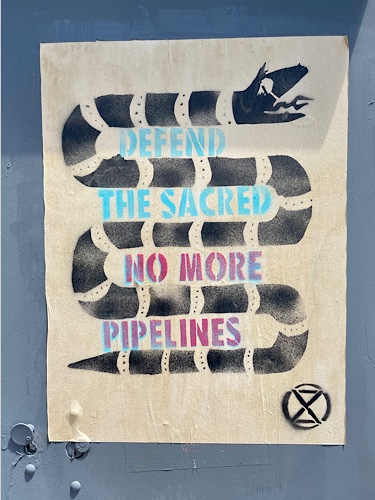
Have you let the President know that you are against allowing any new pipelines and/or engaged in other action?
Last week I attended a work-place training entitled “Conflict Management–Dealing with Difficult Conversations in the Workplace.” I do not do much training at work; the several hours a week I spend doing professional reading generally satisfies the needs of my position. When the offer for this two-day training came into my inbox, I decided that it might be useful. I am responsible for a project that involves several different offices in multiple government agencies all of which have perceived differences in agendas and jurisdiction and real differences in expertise and personality. I am also about to get another new supervisor, and people in my division have been edgy.
The training, which had about 15 attendees even though it was the Tuesday and Wednesday before Thanksgiving started simply enough. We all identified ourselves by name and job function and where in the agency we worked and then took the Thomas-Kilmann Conflict Mode Instrument, which helps give a broad general idea of how one typically reacts in situations that involve conflict. All pretty straightforward workplace training stuff. Then the facilitator suggested that most conflict between people (and within ourselves) arises when our feelings of worthiness are or are perceived to be threatened. My ears perked up. “Anavamala,” I thought. It’s just like what the tantric philosophers teach us, that the unreal cloak of unworthiness is what leads to suffering and discord.
The workshop continued. We did some roleplaying and engaged in discussion to consider how we can better lead the best out of each other and ourselves, whatever type of negotiator we are. It was interesting to see how this fairly diverse group of workers — young, old, experienced, brand new workers of varying levels of seniority in the agency — were able to be engaged and brought together in exploring these issues, but nothing was particularly surprising. It was almost time to break for lunch on the first day, when the facilitator asked, and then let drop the question, without discussion or seeking a response, “what about love?”
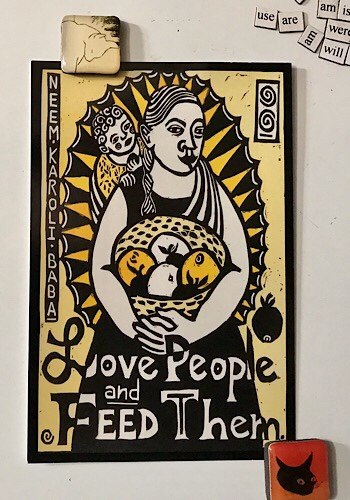
“What about love, indeed?” I thought. That’s a word we do not hear in the workplace unless it is in an interview and someone claims to love their work, or it’s idle conversation and someone declares that he or she loves a sports team or a restaurant. The next morning I commented privately to the facilitator that I thought it a great question, but was not surprised, given the context, that he had not discussed it further. He said that he would bring it up more, and he did. He suggested that when we love, we are more willing to allow, respect, and listen to differences of opinion; when we love, we are also more motivated to resolve conflict in a way that serves best those with whom we are in conflict. This teaching made sense for most of the participants with regard to conflicts with friends and family, but it was harder for them to see in the context of the workplace because they did not think of love (as this society has come to classify it) as something that is part of the workplace.
How can we bring love into our non-intimate relationships (although I would argue that in some ways, the workplace is very much an intimate relationship as it so deeply relates both to our sense of purpose and to our survival)? The tantric teachings suggest that there is a universal ground to all being, one aspect of which is, in essence, love (prem). When we recognize that we are all made of the same stuff and that an aspect of the universal is love itself, then we are invited to see the unity in diversity and to respond in the highest in the face of difficulty or challenge. (Quakers similarly teach us to recognize the light or good in every being and to treat all as divine). Truly loving universally does not necessarily come naturally and can be a challenging and advanced practice , but it has been my experience that it is a practice that is worthy of all our relationships, including those in the workplace. It may be too much to ask us to like our co-workers, but seeking to recognize that they are worthy of love can go a long way to making our work day a brighter, more productive, more effective, and more compassionate place.
Of my friends on facebook, several reveled in staying inside because of the rain yesterday. Others complained about being unable to do things that would have been better on a dry day. Reporters and anchor persons seemed to think it newsworthy whether the rain will impact football or baseball games. How about telling us whether the rain we are getting is optimal for the native flora and fauna and how it is impacting the farmers? We seem as a society to have forgotten the relationship of the weather to food.
When I was out doing an errand at lunchtime, I bumped into a neighbor I haven’t seen in a long time. We did not spend much time talking; I needed to get back home to my work within the short allotted time, and she was meeting someone. “Did I just hear thunder,” she asked. The sky was thick and white with heat and “Code Orange” air. “You might have heard thunder, but there isn’t any rain with it” I replied. We talked about how much we need some good rain. The trees are really struggling. (Note: forget about cleaning any outside things with water. Forget non-edible annuals. Water established trees and perennials very deeply once a week instead of less watering more frequently. Shallow watering in drought conditions promotes growth of fungus and other pesky things.)
As gardeners, my neighbor and I notice how much rain we are getting in any given season and week. We think about whether the rainfall is what the farmers and the trees and birds and wild animals need, in addition to whether it will interfere with a child’s soccer game or a planned outing. We were at the point that we would far rather get caught out in a deluge than miss out on any chance of rain. On the other hand, those in flooded parts of the north are praying for a few warm (but not blazing hot) dry days in a row. Today’s storm is welcome and needed, though one storm does not end a drought. We need some more good ones for days on end.
I think the approach of various classes and intensity levels of asana practice can feel like a whether a thunderstorm is welcome weather. Sometimes an outrageously intense and fierce practice is what will bring me to my fullest possibility of growth and expansion. At other times, I need to step back and rest my body. Restorative and other gently therapeutic practices are what nurtures best. Sometimes, I have long, steady periods of moderate practice.
The more sensitive, aware, and knowledgeable I get about the weather outside and how it impacts life around me, the better able I am to take care of my garden. The more I am sensitive and open to the weather inside and the more knowledgeable both from study and experience of how my practice best aligns with inner and outer weather, the better able I am to live out the yoga principles I seek ever better to follow–the most important being to see the highest first and to be of service.

Peace and light, E — Posted with WordPress for BlackBerry.