|

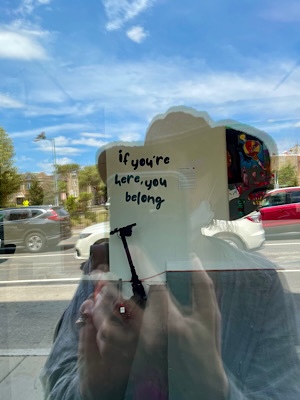
Affirmation and Iccha Shakti (Pelvic Loop 2)

Instead of being able to walk into the office with the first thing scheduled a regular 10am conference call, this morning I have to be across town to appear on a panel discussion with the Director of my Office.  This means I have to leave the house at least an hour earlier than I usually do.  As I am heading into a more stressful workday than a typical one, skipping meditation and my morning walk would not be optimal.

I made sure I was out of bed the minute I got my wake-up call (currently Vedic chanting).  It was the will to practice (the embodied, stepped down version of iccha shakti, which is the ultimate will to being) that got me into meditation cushion.  It will be getting out of the house 20 minutes earlier that will give me the time to walk to a more distant bus or metro stop so that I feel invigorated and refreshed before the talk.

Sometimes we do not get into poses because we lack the will to do so.  Keeping pelvic loop engaged requires will.  Some people naturally love the feeling of keeping the buttocks engaged, the pelvic floor lifted, and the belly toned.  Others (myself included) have to develop a keen sense of will to keep the lower torso engaged, to keep with and enhance the intensity of sensation and concentrated action.  The more I practice, the more will I have to stay engaged because I have experienced that the challenge of staying intensely engaged is worth the lightness and freedom that ensues.  For me, this is true in my yoga and meditation practice and in nearly everything else (which includes, sometimes, having the will to rest and relax).
Similar Posts

  • | |

    Yoga of Housekeeping

    Last week Orie suggested that as I have a “Yoga for Gardeners” workshop, I should also do a “Yoga of Housekeeping” workshop.  A blog post isn’t a workshop, but here are a few preliminary thoughts on yoga and housekeeping.

    From an alignment perspective, I have found that the Anusara principles of alignment make safe everything I do off the mat, as well as on.  Overwhelmed by all that needs to be done? Doing heavy lifting?  Bending and stooping?  Reaching for something way up high?

    First, soften (open to grace).  Appreciate that you have a home and things to clean.  Honor each item in the house.  Things have energy, too., and they like to be touched and cleaned.  If you have anything that you do not appreciate or does not fit in the house, give it a new life in a new home (freecycledc is a great way to pass things forward).

    Use muscular energy, drawing the muscles to the bone, hugging into the mid-line, and drawing energy into the focal point (for most housecleaning activities, this will be the pelvis).  Using muscle energy will definitely help to keep you from tweaking a muscle or straining the low back or shoulders. When you are reaching, keep the arm bones integrated by hugging the shoulder blades onto the back and then reach from the waist, though each rib to extend the length of your torso (organic energy).

    Especially for bending and lifting, after you bend your knees, hug your shins in (muscular energy), take your inner thighs back and apart (inner spiral) and then tuck your tailbone (outer spiral).  If you just bend from the knees but hunch your back, your low back will still be vulnerable.

    Switch sides for activities like sweeping, vaccuuming, and scrubbing.  Yes, it can be difficult and awkward, but it’s worth it to shift sides.  Imagine doing all of your yoga practice only on one side.  How much imbalance would you be encouraging?

    The first niyama of Patanjali’s Yoga Sutras is sauca, which means cleanliness or purity.  It is easier to think and live and be hospitable in a clean home.

    The first yama is ahimsa, or non-harming.  Do your best to use safe, biodegradable cleaning products.  Your skin and respiratory system will be grateful.  So will the earth.  Try to make cleaning your own space and act of honoring your self, your home, and the greater home of the earth.

    Fully absorb yourself in the task of cleaning.  Make it a meditation.  Integrate fully the act of cleaning, the item being cleaned, and you as the cleaner.

    Finally, be playful.

  • | | |

    Nataraja (and dancing blissfully in life)

    A work colleague of mine graciously said to me that he did not know how I got through certain meetings without yelling, he did not know if he could do it.  I replied that lots of yoga helped.  “Maybe I should get back to transcendental meditation,” he said, “but I found it did not really help; I should find something, though.”

    I said that I tried to think of the challenges at work as just part of the dance that yields such rich abundance for me.  The discussion carried on, and we not only resolved the minor problem that had led to the phone call, but also felt a deeper connection that will make it easier in the future to resolve work issues that we mutually encounter.

    What I like best about the myth of Nataraja is that the dance is not for the purpose of creating the world or with any particular design, but for the sheer bliss of dancing — anantatandava.  The dance makes possible both destruction and creation, but it is not its reason.  When we engage in the dance of our own lives, yoga invites us just to dance fully with wonder at the rich diversity of experience.  We make choices and seek to be more aligned, but ultimately we are just dancing.

  • |

    Sankalpa (Intention)

    In the tradition of our culture’s “new year’s resolution” I like to practice yoga nidra at this time of year to help establish a new sankalpa or intention.  A sankalpa is different from a new year’s resolution.  It is short, affirming, and is both in the present and forward-looking.

    Usually it takes a couple of weeks for me to be certain of what sankalpa is right for me to work with for a period of months.  One year, I had been very sick for the entire fall and early winter, so it was easy to choose “I am healthy.”  For the past two years, as I struggled with my place this time of war and societal struggle and thought about my own role in creating and avoiding conflict, I chose the sankalpa “I will come from the light in all I do” (“light” for me meaning an inner place of peace, compassion and spaciousness).

    In the past several months, mostly due to having thoroughly enjoyed creating meals from the garden and the farmers’ market, I am a little heavier than works with the clothing I own and my sense of comfort with my body image.  Instead of having a new year’s resolution to lose five pounds, which would likely fail, I am working with the sankalpa “I love and respect my body.”  The former buys into societal expectations of what my body should look like, imposes mental will over my body, and reinforces a mindset of negative judgment and denial.  The latter is joyous and affirming.  I believe that if I truly love and respect my body, I will eat in a way that is healthy for my body and the earth.  I will either lose the few pounds or be more accepting of my body as it is.  This sankalpa thus gives me much to contemplate in terms of my relationship to the mirror, my clothes, my asana practice, and my way of eating.  How much it gives me to contemplate expands if I think of the body extending beyond just my flesh and bones and physical appearance, but also to my energy body and all that I bring in through the senses.

    What sankalpa would be transformative for you this year?  What would help you embody your sankalpa (other than, of course, establishing a regular yoga nidra practice — see yoga nidra resources).

Leave a Reply

Your email address will not be published. Required fields are marked *

This site uses Akismet to reduce spam. Learn how your comment data is processed.