| |

What is Beauty? (and “Ankle Loop”)

When I was meditating this morning, the last lines of Keats’ ‘Ode on A Grecian Urn’ welled up in my thoughts: “Beauty is truth, truth beauty, — that is all/ Ye know on earth, and all ye need to know.”  How odd, I thought, for this to appear, as if out of nowhere.  I have been contemplating this week on what it means to be refined, but not in the way of an aesthete.  Rather, as I have been concentrating on the Anusara alignment principle of “ankle loop,” I have been thinking about how deepening our practice with repeated exploration and study we are able to refine our understanding and the flow of energy within us so that we can be more connected to ourselves and each other.

As I understand the essential structure of the Anusara principles, the “loops” are really tertiary principles.  The primary principles are those of “attitude, alignment, and action,” which are the principles of how we practice.  The secondary principles are the fundamental physical and energetic principles — “opening to grace, muscular energy, inner/expanding spiral, outer/contracting spiral, organic energy.”  The loops serve to refine the secondary principles.  Ankle loop, for example, which starts at the base of the shin bone, travels down the back of the heel and then back up through the arch, energizes the foot, lifts the arch, supports our stance and helps us focus muscular energy.  When we are feeling challenged finding as much muscular energy in our feet and legs as would be optimal for a full expression of the pose, we can use ankle loop to refine our understanding and practice of muscular energy in the legs.  Keeping in mind the primary principles of practice, though, the refinements should also always lead us towards the heart and not just get us into details.  Getting more sophisticated and refined, likewise should not lead us to disdain for that which is unrefined.

Funny, then, that the aesthete’s call to beauty should arise in my meditation while I have been consciously thinking about refinement.  What does it mean to appreciate and study refinements, but still honor and delight in a novice’s full expression of “attitude, alignment, and action” as much as an impeccably aligned and skillful pose that does not reveal a yearning for spirit?  Beauty may be truth, and truth beauty, but what is “beauty?”
Similar Posts

  • |

    Will There Be Any Change in My Local Yoga Class Following the Events of the Past Few Weeks?

    A regular reader of this blog, who was a member of the Willow Street Yoga community until she moved out of the country, wrote and said that though she enjoyed the classes in her new home, she missed the adjustments and alignment instructions at Willow Street.  She asked in this context the following:  “I’ve been wondering lately, when teachers leave anusara, can they still use the same terminology in their classes?  If not, why not?  Does JF have a copyright on some of the words?”  I cannot speak to any copyright and trademark issues–I took a copyright class in law school, but that was 25 years ago.

    All that I can speak to is how I will continue teaching, both at William Penn House, where the only class of the week is the one I teach, and at Willow Street Yoga Center, where I will continue to teach my gentle/therapeutic class, and the other workshops and classes I may teach.  Although I have not tendered a formal resignation, I have removed the title “certified Anusara instructor” from the header of the blog.  At this time, I do not even know, given John’s decision to step down for at least some period of time, what is the organization from which I would resign or whether a renewal license would be sent.  For the moment, there is no need for me to make any specific changes in how I teach.

    If my formal affiliation with Anusara as a corporate entity were to change, the thousands of hours I have spent contemplating, exploring, and studying the principles of alignment and how to teach them will still be the major part of my asana practice and teaching.  Anusara is a deep, strong, significant  presence and has been the most significant physical and energetic component of my practice and teaching and to some extent my yogic framework for being in the world for a decade.  Given the healing and delight I have experienced from practicing in accordance with the principles, I do not expect anything to be otherwise.  As I have been taught only to teach what I have practiced and experienced myself, and not just what I have heard from a teacher or read in a book, although obviously I cannot have experienced in my own body healing for all the various challenges of embodiment that my students have experienced, how could I not be teaching from my own interpretation of the principles of alignment, regardless of a possible need to shift vocabulary?

    What will happen with the organization from a business perspective remains to be seen.  The name of the system carries a trademark.   Whatever happens and wherever I am led in my practice and commitments in the future, as have always done, I will  honor John Friend and Anusara as the source of much of my learning and it will be a recognizable influence on my teaching.  I will say in class or when I am writing that the alignment principles I have just articulated would be called [insert Anusara alignment principle] in Anusara.  This will be true regardless of how the Anusara community is reconfigured and what my relationship is to any future organizational structure.

    In answer to the question of what will my local yoga class be like now from my own perspective:  Yes, I will be offering the same alignment instructions and adjustments–and hoping to get better over time with continued study and practice.  But also, I will be even more precise about attribution, and  I will be less likely to be using the “short hand,” which I already use relatively minimally.  I have always found that a description of the actual physical and energetic aspect of one of Anusara’s “Universal Principles of Alignment” that applied to what was going on in the practice far more helpful than just using the name of the principle as a pointer to the action being emphasized.

    It is a great question, and I am sure that the answer will be slightly different for each teacher, though I trust that all are committed to offering the best yoga class possible, just as they were before.  For me, it will take a little feeling my way around the changed landscape to see how it influences my teaching.  All I can say is that I am still committed to offering yoga practices that bring healing, joy, and connection, and I hope that I can do an ever better and fuller job of living up to my commitment.  This is true wherever I teach and whatever name is given to the hatha yoga I teach.

  • | |

    About a Can Opener

    “Lady, do you have some spare change?” asked a man sitting on a bench with eyes glassed over from one or more intoxicants, which from one of the notes in the bouquet of odors included alcohol.

    “I don’t have any change,” I replied, “but would you like a peach?  I just bought some.”

    “No.  I have my own.”  After a pause, when I’d already passed him,  he called out, “do you have a can opener?”

    I guess his peaches were canned and that he preferred them canned to fresh.


  • | | |

    State of the Garden (and a Sign)

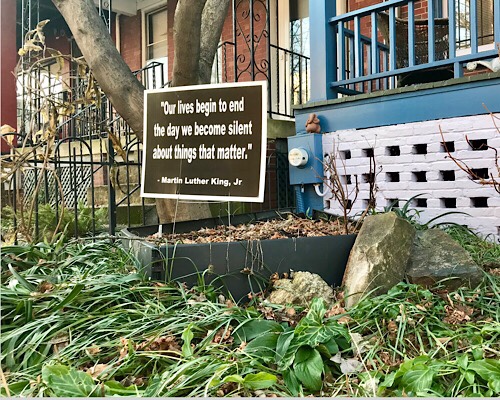
    Long time neighbors and participants in the rose garden yoga posse, who have now retired and are moving to be nearer children and grandchildren, gave me their yard sign.

    I will miss them for practice and around the neighborhood. I like, if they must go, that I will think of them fondly every time I come home to this exhortation and its call to practice.

Leave a Reply

Your email address will not be published. Required fields are marked *

This site uses Akismet to reduce spam. Learn how your comment data is processed.